
Summary of Industry’s Most Sensitive MEMS Mic
Vesper Technologies has released the VM101, a high-definition MEMS microphone boasting a 68dB signal-to-noise ratio. While slightly below their initial 70dB promise, this model still outperforms current market leaders. The technology utilizes piezoelectric aluminum-nitride crystals and a unique four-triangle diaphragm to enhance sound sensitivity, noise cancellation, and voice command accuracy. Future roadmaps include higher SNR models through 2018.
Parts used in the Vesper VM101 Project:
- High-definition microelectromechanical system (MEMS) microphone
- Piezoelectric aluminum-nitride wurtzite crystals
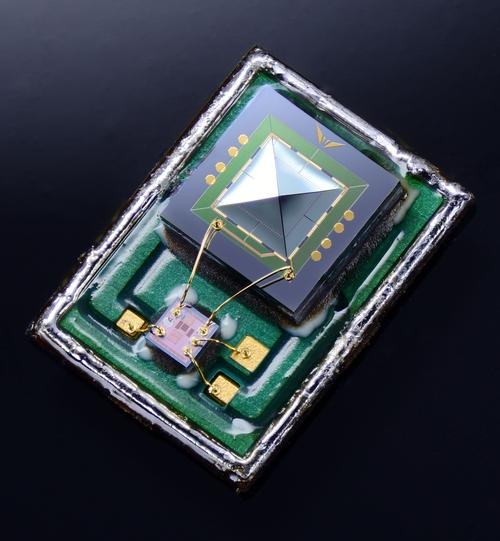
- Four-triangle diaphragm forming a square
- Gaps between triangles for sound vibration
PORTLAND, Ore. — In its rush to get to market “while the iron is hot,” Vesper Technologies Inc. (Boston) has announced what it still claims is the industry’s highest signal-to-ratio (SNR) for a high-definition (HD) microelectromechanical system (MEMS) microphone, even though it is scaled back to 68dB rather than the astounding 70dB SNR MEMS mic they previously promised.
 “Our roadmap now calls for the 70dB version in 2016, followed by an ultra-miniature, low-power 72dB model in 2017 and a 75dB signal-to-noise ratio model by 2018,” Vesper Chief Executive Officer Matt Crowley told EE Times. “Even at 68dB, our current model VM101 almost doubles the performance compared to current high-end 65 dB SNR capacitive MEMS microphones.”
The key to Vesper’s high SNR is its use of the piezoelectric aluminum-nitride wurtzite crystals in its unique four-triangle diaphragm forming a square (see photo) with the sound squeezing through the gaps between the triangles, causing them to vibrate thus creating a piezoelectric current. According to Vesper, the sensitivity of its piezoelectric material doubles the distance that sounds can be heard, does dramatic noise cancellation that improves the clarity of phone conversations and minimizes the errors made during voice-commands. And when used in multi-mic set-ups, its high-SNR mics can more easily form beams directly to the person speaking — what retailers call “audio zoom” — to further increase the accuracy of voice-enabled applications, according to Vesper.
For more detail: Industry’s Most Sensitive MEMS Mic
-
What is the current signal-to-noise ratio of the Vesper VM101?
The current model VM101 has a signal-to-noise ratio of 68dB. -
When will the 70dB version of the MEMS mic be available?
The roadmap calls for the 70dB version to be available in 2016. -
How does the sensitivity of the piezoelectric material affect sound?
The sensitivity doubles the distance that sounds can be heard. -
What benefit does the high-SNR mic provide for multi-mic setups?
It allows beams to form directly to the speaker, increasing voice-enabled application accuracy. -
Does the new microphone improve phone conversation clarity?
Yes, it performs dramatic noise cancellation that improves the clarity of phone conversations. -
What crystal structure is used in the Vesper microphone design?
The design uses piezoelectric aluminum-nitride wurtzite crystals. -
How does the diaphragm design function to create current?
Sound squeezes through gaps between triangles causing them to vibrate and create a piezoelectric current.