
Summary of How to build your own PIC-Programmer using PIC12C50x
This article describes a compact, easy-to-build PIC burner (JDM variant modified for LVP) that programs PIC12C50x, PIC12F62x, PIC16Fxx, PIC16F62x and 24Cxx EEPROMs. It was tested with PIC12C508(A), PIC12C509(A), PIC12F629, PIC12F675, PIC16F84A, PIC16F627, and PIC16F628. The board (≈50×62 mm) uses three LEDs for status, common NPN transistors, 16V capacitors, 1/4W resistors, and a 9-pin female SUB-D connector; schematic and PCB were created in Eagle.
Parts used in the PIC-Programmer:
- PIC microcontrollers to be programmed (examples: PIC12C508(A), PIC12C509(A), PIC12F629, PIC12F675, PIC16F84A, PIC16F627, PIC16F628)
- EEPROM 24Cxx
- NPN bipolar transistors (small signal types)
- Capacitors, 16 Volt types
- Resistors, 1/4 Watt, 5% tolerance
- Three LEDs (red, yellow, green)
- SUB-D female 9-pin connector (Reichelt EMV-BUCHSE 09W)
- PCB fabricated from Eagle layout
Which types of PIC microcontrollers and EPROM’s are supported?
You can use this PIC-Burner for PIC12C50x, PIC12F62x, PIC16FFxx, PIC16F62x and EEPROM 24Cxx. This PIC-Programmer was tested with PIC12C508 (A), PIC12C509 (A), PIC12F629, PIC12F675, PIC16F84A, PIC16F627, and PIC16F628.
The PIC-programmer is easy to build and compact. 3 LEDs indicates the state of the burning-process. Red: burning, yellow: clock-signal, green: power supply. The dimensions are about 50 mm x 62 mm.
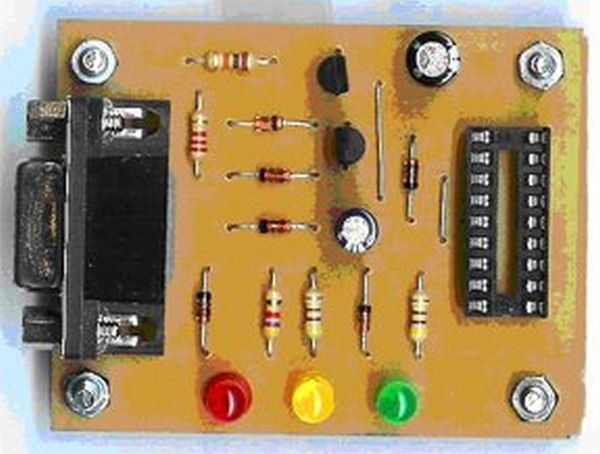
The Modification of this JDM-Programmer:
In comparison to the original JDM-Programmer exists a connection between pin 10 (JDM) and Vss instead of VDD. This modification makes it possible to program PIC microcontrollers with LVP-function (for example PIC16F627 or PIC16F628).
The Schematic of the PIC-Programmer:
The wiring diagram was drawn with Eagle-Lite by CadSoft in order to create a print layout by my self. Eagle is very popular print layout software in Germany and for non-commercial use free.
The schematic view of the PIC-Programmer (http://www.janson-soft.de/pic/parts-and-hints.txt). The bipolar npn-transistors are not very critical. Probably you can choose almost any small signal types. The capacitors are 16 Volts types. The SUB-D-connector is female and has 9 Pins (Reichelt-Best.-Nr.: EMV-BUCHSE 09W). All resistors are common and have 1/4 Watts, 5% tolerance (Download of the Eagle-SCH-file for the schematic here).
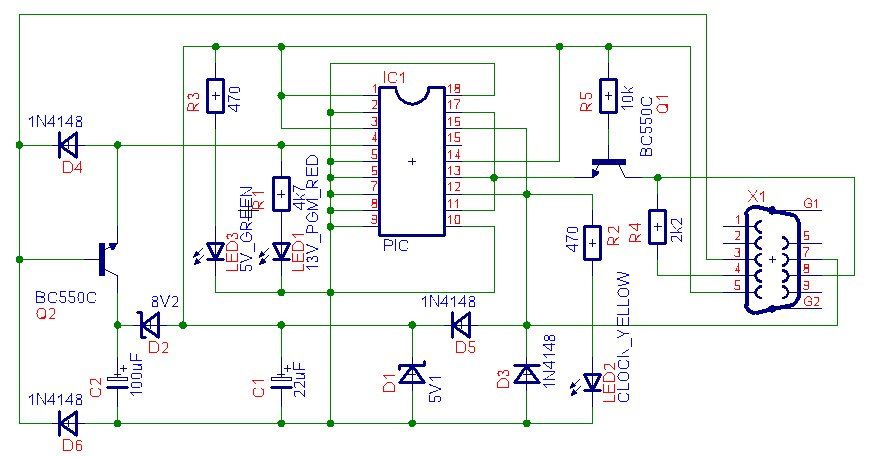
http://www.janson-soft.de/pic/jdm-schematic.sch
The Print Layout:
I developed the print layout with the help of Eagle. Because I am not a professional lay outer I used the auto router. After some tries and errors I came to a practical solution for homebrewed stuff. My intention was not to build something for the industrial mass production.
For more detail: How to build your own PIC-Programmer using PIC12C50x
- Which PIC microcontrollers are supported?
This PIC-Burner supports PIC12C50x, PIC12F62x, PIC16FFxx, PIC16F62x and was tested with PIC12C508(A), PIC12C509(A), PIC12F629, PIC12F675, PIC16F84A, PIC16F627, and PIC16F628. - Which EEPROM types are supported?
The programmer supports EEPROM 24Cxx. - What modification was made to the original JDM-Programmer?
Pin 10 (JDM) is connected to Vss instead of VDD to allow programming PICs with LVP function. - What LEDs indicate during the burning process?
Red indicates burning, yellow indicates clock signal, and green indicates power supply. - What are the PCB dimensions?
The dimensions are about 50 mm x 62 mm. - What connector is used for the PIC-Programmer?
A female SUB-D 9-pin connector (Reichelt EMV-BUCHSE 09W) is used. - Are the transistor types critical?
The bipolar NPN transistors are not very critical; almost any small signal types can probably be chosen. - What values/types are the capacitors and resistors?
Capacitors are 16 Volt types; resistors are common 1/4 Watt with 5% tolerance. - Which software was used to draw the schematic and PCB?
The wiring diagram and PCB layout were created with Eagle-Lite by CadSoft.
