
Summary of Homemade Plotter (CNC Machine)
This project describes a low-cost homemade CNC plotter designed using accessible materials and recycled components. Key features include 1/4-inch threaded steel bars for screws, plastic box corners cut into bearing holders, bearings sourced from a junk shop, silicon tubes for motor coupling, and a rectified steel bar salvaged from an Epson printer. The design prioritizes ease of assembly, cost-effectiveness, and the ability to make adjustments during construction without requiring perfect alignment or expensive commercial parts.
Parts used in the Homemade Plotter:
- 1/4 inch threaded steel bars
- Screws made from threaded steel bars
- Plastic box corners (used as bearing holders)
- Bearings purchased from a junk shop
- Silicon tubes
- Rectified steel bar from an Epson printer
- Bushings from an Epson printer
All parts were developed separately. This allowed adjustments in the assembly as well as smaller changes in case the design of one or other part become required.
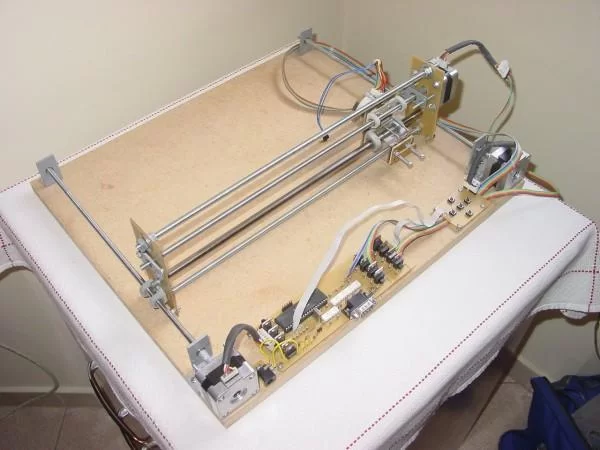
Focus on low cost and use of materials easily accessible in the local market.
(click on the pictures to enlarge)
Screws and supporting rods made using 1/4 inch threaded steel bars. Very low cost and easily available in hardware stores. Of course, the threaded steel bars are not comparable to commercial screws but they are compatible with the purpose and expected low cost of the project.
Holders of bearings obtained by sawing up the corners of a plastic box. Difficult to obtain but easy to handle for both making the passages of the screws or making the hole where the bearings are packed. The bearings were mounted under pressure (fitting) without glue.
The bearings were bought in a junk shop at Timbiras Street (Santa Efigenia Area in São Paulo – Brazil). The threaded steel bars goes through the bearings without rolling off. Easy assembly and good precision supporting them. This solution saved much time and headache.
Without any pretension to achieve perfect alignment between the bar and the threaded shaft of the stepper motor, silicon tubes were used to connect them. The tubes absorb any shear stress due to the misalignment of the axes while guaranteeing a good rigidity in the transmission of the angular movement from the motor to the spindles.
Rectified steel bar withdrawal of an Epson printer. Unfortunately, the bar and bushings that support the print head were the only parts that could be harnessed from this scrap for this project.
For more detail: Homemade Plotter (CNC Machine)
- What material is used for the screws and supporting rods?
1/4 inch threaded steel bars are used for both screws and supporting rods. - How were the bearing holders created?
Holders were made by sawing up the corners of a plastic box. - Where were the bearings sourced from?
The bearings were bought at a junk shop on Timbiras Street in São Paulo, Brazil. - How is the stepper motor connected to the threaded shaft?
Silicon tubes are used to connect them to absorb shear stress from misalignment. - Can the threaded steel bars roll off the bearings?
No, the threaded steel bars go through the bearings without rolling off. - Why was an Epson printer used in this project?
A rectified steel bar and its bushings were harvested from a scrapped Epson printer. - Were glue or perfect alignment required for assembly?
No, bearings were mounted under pressure without glue, and perfect alignment was not pretended. - What is the main focus regarding materials for this project?
The focus is on low cost and using materials easily accessible in the local market.