
Summary of Homemade breadboard
This article describes building a custom breadboard at home. While slightly more expensive than market versions, it allows for added components like LEDs, switches, and precision IC sockets. The creator modified old DIP-18 sockets by cutting them in half to serve as female connectors. Lichtenberg's alloy was applied to the bottom layer to protect the circuit traces effectively and inexpensively. The final design features only sockets and a couple of LEDs without complex logic, maintaining standard connection layouts.
Parts used in Homemade Breadboard:
- LEDs
- Switches
- Precision IC socket
- Cut in half old DIP-18 sockets
- Lichtenberg's alloy
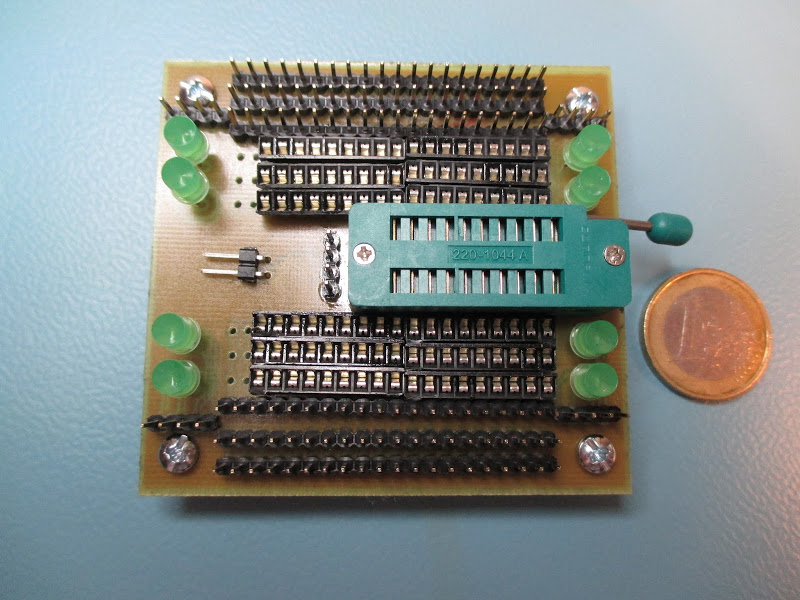
A breadboard can be also made at home, from one side, it will be more expensive than those on the markets, but for another side, it’s possible to add commonly used elements, like LEDs, switches, or other things, for example I added a precision IC socket that makes putting in and out of ICs much easier. Choosing what to put there is a bit like a making homemade pizza, one can put anything he likes (and what he has currently in the fridge).
I didn’t have ready to use female sockets, so I cut in half old DIP-18 sockets – works OK too.
The bottom layer was coated with Lichtenberg’s alloy – that’s a really nice and easy way to protected traces, I highly recommend it! It’s inexpensive too!
The circuit looks like a monster, but there isn’t a lot of logic in it, in fact, there’re only sockets, and a couple of LEDs – I didn’t want to add more components, at least with this version. The connections are the same to those of the market breadboards.
For more detail: Homemade breadboard
- Is making a homemade breadboard cheaper?
No, it is more expensive than those on the markets. - Can I add common elements like LEDs or switches?
Yes, you can add commonly used elements such as LEDs and switches. - What did the author add to make inserting ICs easier?
The author added a precision IC socket. - How were female sockets obtained if they were not ready to use?
The author cut old DIP-18 sockets in half. - What material was used to coat the bottom layer?
Lichtenberg's alloy was used to coat the bottom layer. - Does the homemade breadboard have complex logic?
No, there isn't a lot of logic; it contains only sockets and a couple of LEDs. - Are the connections the same as market breadboards?
Yes, the connections are the same as those of the market breadboards.
