
Summary of ESP8266 – Wireless Weather Station with Data Logging to Excel
This project establishes wireless communication between two ESP8266 modules to transmit data from three sensors to an Excel spreadsheet, creating a home-based wireless weather station. It requires prior knowledge of ESP8266 setup and NodeMCU flashing. The system utilizes a DS18B20 temperature sensor connected via a one-wire protocol with specific pull-up resistor requirements, alongside pushbuttons and a potentiometer for user interaction.
Parts used in the Wireless Weather Station:
- 2x ESP-12E
- 2x ESP-201 (Alternative)
- 1x FTDI Programmer (Required if using ESP-201)
- 1x DS18B20 One Wire Digital Temperature Sensor
- 1x Breadboard
- 3x Pushbutton
- 3x 10k Ohm Resistor
- 1x 4700 Ohm Resistor
- 1x 10k Ohm Potentiometer
In this project we are going to establish a wireless communication between two ESPs and send data from three sensors to an Excel spreadsheet. This tutorial shows a wireless weather station with data logging that you can implement in your home.
Before you continue reading this project, please complete the following tutorials:
- How to get started with the ESP8266
- How to make two ESP8266 talk
- How to flash your ESP8266 with NodeMCU
If you like the ESP WiFi module and you want to build more projects you can download my eBook called “Home Automation using ESP8266” here. Let’s get started!
Summary
Here’s a Figure that describes exactly how everything works together:
Parts List
Here’s the hardware that you need to make the weather station:
- Recommended: 2x ESP-12E (eBay)
- Alternative: 2x ESP-201 (eBay) + 1x FTDI Programmer (eBay)
- 1x DS18B20 (eBay)
- 1x Breadboard (eBay)
- 3x Pushbutton
- 3x 10k Ohm Resistor
- 1x 4700 Ohm Resistor
- 1x 10k Ohm Potentiometer
DS18B20 – One Wire Digital Temperature Sensor
In this project, we will be using the DS18B20 one wire digital temperature sensor. Now, before we get to the programming part, lets learn how to wire up our temperature sensor.
The DS18B20 can be powered by between 3.0V and 5.5V so you can simply connect its GND pin to GND and the VDD pin to 3.3V from the ESP8266.
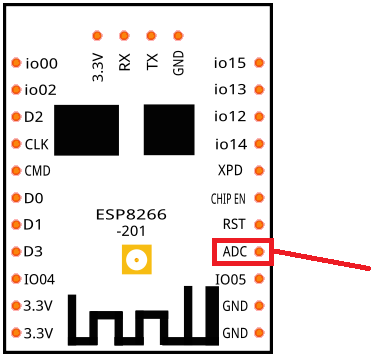
Then connect the DQ pin to IO04 on the ESP8266. A 4K7 ohm pullup resistor is required on the DQ pin to pull it up to 3.3V.
For more detail: ESP8266 – Wireless Weather Station with Data Logging to Excel
-
How do I get started with this ESP8266 project?
You must complete tutorials on getting started with the ESP8266, making two ESP8266 talk, and flashing your ESP8266 with NodeMCU. -
What is the recommended hardware for the weather station?
The recommended hardware includes two ESP-12E modules, one DS18B20 sensor, a breadboard, three pushbuttons, resistors, and a potentiometer. -
Can I use ESP-201 instead of ESP-12E?
Yes, you can use two ESP-201 modules as an alternative, but you will also need one FTDI Programmer. -
What voltage range does the DS18B20 sensor require?
The DS18B20 can be powered by a voltage between 3.0V and 5.5V. -
How should I connect the DS18B20 sensor to the ESP8266?
Connect the GND pin to GND, the VDD pin to 3.3V from the ESP8266, and the DQ pin to IO04. -
Is a pullup resistor required for the DS18B20?
Yes, a 4K7 ohm pullup resistor is required on the DQ pin to pull it up to 3.3V. -
Where is the data logged in this project?
Data from the three sensors is sent to an Excel spreadsheet. -
Does this project involve wireless communication?
Yes, the project establishes wireless communication between two ESPs to send data.