


Summary of ENCODER, ANGLE MEASUREMENT CCS C PIC16F628 SAMPLE APPLICATION
This article introduces incremental and absolute encoders for precise angle measurement and position determination. It explains that absolute encoders provide unique outputs per position using Gray or Binary encoding, offering position retention but at higher costs. In contrast, incremental encoders generate square-wave signals where resolution depends on pulses per rotation (PPR), making them sensitive to speed and direction changes. The text highlights a specific sample application involving the CCS C Pic16f628 microcontroller for these projects.Parts used in the Encoder Angle Measurement Project:
- Incremental Encoders
- Absolute Encoders
- Pic16f628 Microcontroller
- CCS C Compiler
- Proteus ISIS Simulation Software
- PCB Files
Hi Friends, In this article I will mention the use of incremental enkoderlerin. These encoders with precisely how to angle measurement or position determination to do it. Market the Absolute (absolute) Encoders and İncremental... Electronics Projects, Encoder, angle measurement CCS C Pic16f628 sample application"microchip projects, microcontroller projects, pic16f628 projects, "
Hi Friends,
In this article I will mention the use of incremental enkoderlerin. These encoders with precisely how to angle measurement or position determination to do it.
Market the Absolute (absolute) Encoders and İncremental (Incremental) Encoders, including two types of encoder.
Absolute Encoders, they give different outputs for each position. This type of enkoderlerde Gray and Binary, including among themselves are divided. There is no difference between them in terms of communication. The only difference is the encoding. Although the parallel market is usually the Absolute enkoderlerin outputs 0-10V analogue output models are available.
The biggest advantage of this enkoderlerin even protects the position of the encoder output which is observable. The negative side is that the prices are more expensive.
2. incremental encoders on the market as is used. This type of encoders, Absolute Encoders in parallel output. The encoder produces a square-wave signals are similar in every position. İncremental encoder resolution determines the sensitivity factor, in other words enkoderlerde encoder PPR (pulse per rotation). This value is how much higher the encoder so delicate.
The following illustration shows the incremental encoder, Absolute Encoder, you can see the difference between.
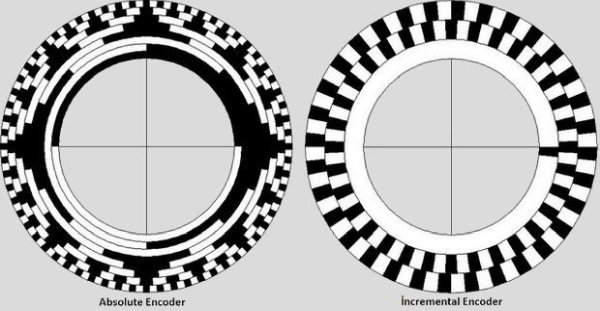

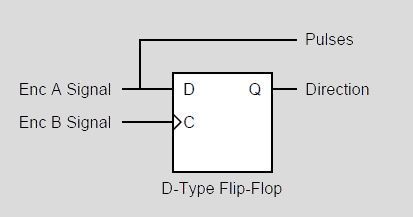
Encoder, angle measurement circuit
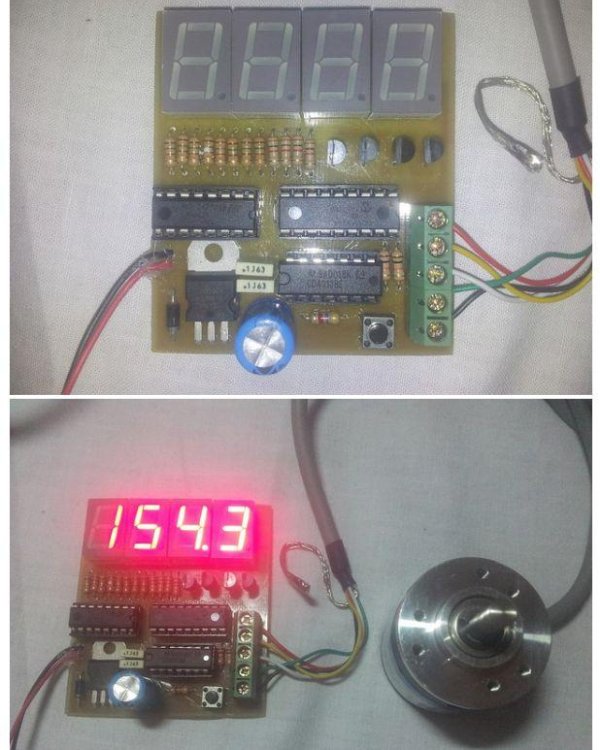
Source: ENCODER, ANGLE MEASUREMENT CCS C PIC16F628 SAMPLE APPLICATION Encoder use and protractor project CCS C Proteus isis simulation and PCB files: Encoder-angle measurement.RAR
- What types of encoders are mentioned in the market?
The article mentions Absolute Encoders and Incremental Encoders as the two main types available. - How do Absolute Encoders determine position?
They give different outputs for each position using either Gray or Binary encoding. - What is the biggest advantage of Absolute Encoders?
Their output protects the position of the encoder even if it is observable. - What determines the sensitivity of an Incremental Encoder?
The resolution determines the sensitivity factor, specifically defined by PPR (pulses per rotation). - Does the communication differ between Gray and Binary Absolute Encoders?
No, there is no difference between them in terms of communication; only the encoding differs. - What kind of signals do Incremental Encoders produce?
This type of encoder produces square-wave signals that are similar in every position. - Which microcontroller is used in the sample application?
The project uses the Pic16f628 microcontroller with the CCS C compiler. - Can Absolute Encoders have analogue outputs?
Yes, although parallel markets usually feature them, 0-10V analogue output models are available.
Related projects
DHT11 Low Cost Humidity Sensor using PIC16F628A with Proteus Simulation
IntroductionThis microcontroller project demonstrates how to interface a low-cost DHT11 temperature and humidity sensor with a PIC16F628A using a Proteus simulation environment.The...
LCD & Display Projects · PIC16F628AFrequency Counter by PIC16F628
In this project we are building a basic and low cost frequency counter circuit . It can measure from 16Hz to 100Hz...
Games, Toys & Calculators · PIC16F628ATIC TAC TOE game using PIC16F628
This project is not to introduce Tic Tac Toe. Everyone knows this game. It's to introduce two features. Bi-coloured LEDs, microcontrollers and...
Sensors & TemperatureSpectrum Analyzer using TMS320F28023DA with Proteus Simulation
Introduction This project demonstrates a real-time audio spectrum analyzer using the TMS320F28023DA Piccolo microcontroller, simulated in Proteus VSM. The system captures an...
Sensors & TemperatureDHT22 Low Cost Humidity Sensor using PIC18F25K20 with Proteus Simulation
IntroductionThis microcontroller project demonstrates how to interface a DHT22 (RHT03) digital temperature and humidity sensor with a PIC18F25K20 using Proteus simulation.The project...
Sensors & TemperatureCrafting a Microcontroller-Based Temperature Monitoring System
Abstract As technological advancements progress, processes become increasingly intricate, demanding a corresponding expansion in the parameters necessary for efficient analysis. Data acquisition,...

Ibrar Ayyub
I am an experienced technical writer holding a Master's degree in computer science from BZU Multan, Pakistan University. With a background spanning various industries, particularly in home automation and engineering, I have honed my skills in crafting clear and concise content. Proficient in leveraging infographics and diagrams, I strive to simplify complex concepts for readers. My strength lies in thorough...