
Summary of DIY USB 5V Solar Power Bank
Solar energy is a clean, renewable resource harnessed via photovoltaic cells to generate electricity. This project details the construction of a DIY USB power bank that charges itself using sunlight and stores energy in a LiPo battery for stable 5V output to gadgets. It features dual charging capabilities: solar harvesting or an external 5V source, ensuring the device never runs empty during daylight hours without manual intervention.
Parts used in the DIY USB 5V Solar Power Bank:
- Solar panel
- LiPo battery
- MCP73831 battery charger
- LT1302-5 step up converter
- USB gadget interface
- External 5V source input
- SoloCapture schematic editor software
Solar energy is renewable, free, widely available and clean form of energy. It is considered as a serious source of energy for many years because of the vast amounts of energy that is made freely available, if harnessed by modern technology. Many people are familiar with so-called photovoltaic cells, or solar panels, found on things like spacecraft, rooftops, and handheld calculators. The cells are made of semiconductor materials like those found in computer chips. When sunlight hits the cells, it knocks electrons loose from their atoms. As the electrons flow through the cell, they generate electricity.
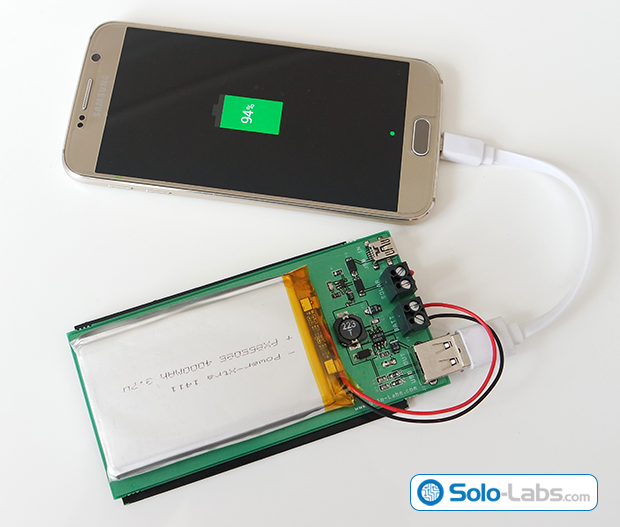
In this project, we are building a power bank which harvests energy by using a solar panel. The energy gained by the solar panel is stored in a LiPo battery. Then the battery is used to supply a stable 5V which is used by USB gadgets. The power bank can also be charged by an external 5V source. The best thing for this power bank during day that you don’t need to remember to charge it. It charges itself by using the sunlight and you don’t come up with an empty bank.
Circuit Design
The schematic of the project is drawn in SoloCapture, the schematic editor of SoloPCB tools. SoloCapture makes the schematic drawing process very easy and fast. You can download SoloPCB tools at Solo-Labs.com for FREE.
The circuit consists of two stages. The first stage is the battery charger state based on MCP73831 and the second stage is the step up converter based on LT1302-5 which converts the battery voltage to 5V.
Read more: DIY USB 5V Solar Power Bank
- How does the solar panel generate electricity?
When sunlight hits the semiconductor cells, it knocks electrons loose from their atoms, causing them to flow through the cell and generate electricity. - Can the power bank be charged by sources other than sunlight?
Yes, the power bank can also be charged by an external 5V source. - What voltage does the power bank supply to USB gadgets?
The circuit uses a step-up converter to supply a stable 5V to USB gadgets. - Which chip is used as the battery charger stage?
The first stage of the circuit uses the MCP73831 as the battery charger. - What component converts the battery voltage to 5V?
The second stage uses the LT1302-5 step-up converter to convert the battery voltage to 5V. - Why is this power bank beneficial during the day?
During the day, you do not need to remember to charge it because it charges itself using sunlight. - Where can the SoloPCB tools be downloaded?
You can download SoloPCB tools at Solo-Labs.com for FREE. - What material are the photovoltaic cells made of?
The cells are made of semiconductor materials like those found in computer chips.