
Summary of Data logging with an EEPROM
This project uses a PIC 18F4520 microcontroller to log analog input data onto an external 24FC1025 EEPROM via I2C interrupts. Once a set number of samples are collected, the system transmits the stored data to a PC running MATLAB over an RS-232 serial link for plotting. The setup includes two buttons to initiate data collection and trigger data transmission, allowing users to analyze signals like triangle waves and determine maximum sampling rates for 8-bit and 10-bit configurations.
Parts used in the Data Logging Project:
- PIC 18F4520 Microcontroller
- 24FC1025 External EEPROM
- Function Generator
- RS-232 Serial Link
- MATLAB Software
- Button 1 (Start Collection)
- Button 2 (Send Data)
Contents |
 Original Assignment
Your task is to use the PIC to log data from an analog input on an EEPROM, and after the data collection is over, to send the data back from the EEPROM to a PC running matlab. Use an interrupt service routine to read an analog input and write the value to an external EEPROM using I2C. After reading in a fixed number of samples, perhaps 1,000 or 10,000, the program should send the data back to a matlab program via an RS-232 link. The logged data should then be plotted by matlab.
You should decrease the sample time until the ISR does not successfully complete. What is the fastest rate at which an analog input can be read and stored to the external EEPROM? Try this for an analog input configured for both 8-bit (1 byte of data stored on the EEPROM) and 10-bit (2 bytes of data stored on the EEPROM). How much data can you store on the EEPROM?
As an alternative, you can avoid the use of an ISR and simply read and store the data as fast as you can in a loop.
As a test input, use a triangle wave signal from the function generator between 1 and 4 V, and plot the data in matlab.
See Interfacing to External EEPROM, PIC RS232, and Serial communication with Matlab.
Overview
An external EEPROM is useful when trying to store data. In addition to storing much more data than is available on the 18F4520 PIC, an EEPROM stores the data even when power is removed and can then be collected at a later time. Storing large amounts of data over time is especially beneficial once communication can be made between the PIC and Matlab. Using the serial function in Matlab, the data can be obtained and then analyzed.
In this project, we used the PIC to log data from an analog input onto an EEPROM and then later sent the data back from the EEPROM to Matlab to plot. For our lab, we worked with a 24FC1025 EEPROM whose data sheet can be found here. Additionally, we established serial port connection between the PIC microcontroller and Matlab using the RS232. Our project also made use of two buttons. The first button tells the PIC to begin collecting data points from the analog input and storing the data onto the EEPROM. The second button tells the PIC to send the data from the EEPROM to Matlab.
 Circuit
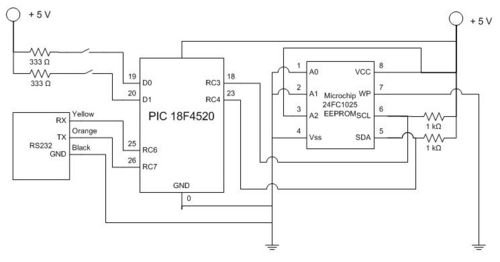
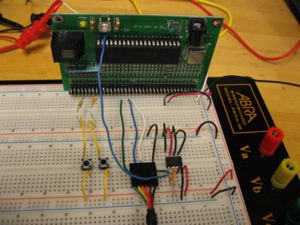
To the right is a circuit diagram for interfacing a 24FC1025 EEPROM to the 18F4520 PIC. Below the diagram are photos of the circuit layout.
inputs on the PIC which dictate when to collect and store data and when to send the data to Matlab.
For more detail: Data logging with an EEPROM
- How is data stored on the device?
Data is logged from an analog input onto an external EEPROM using an interrupt service routine with I2C. - What signal is used as a test input?
A triangle wave signal from a function generator between 1 and 4 V is used as the test input. - How many buttons are used in the circuit?
The project makes use of two buttons to control data collection and transmission. - Can data be stored without power?
Yes, the EEPROM stores the data even when power is removed. - What interface connects the PIC to the PC?
An RS-232 link is established between the PIC microcontroller and Matlab. - How does the user start collecting data?
The first button tells the PIC to begin collecting data points from the analog input. - How does the user retrieve the data?
The second button tells the PIC to send the data from the EEPROM to Matlab. - What formats can the analog data be stored in?
Data can be configured for 8-bit storage or 10-bit storage on the EEPROM.
