
Summary of DA14531 SmartBond Tiny Module Bluetooth Low Energy IoT Solution
Dialog Semiconductor launched the DA14531 SmartBond TINY module, a cost-effective solution for adding Bluetooth Low Energy (BLE) to IoT systems like consumer electronics and smart appliances. Priced under $1, it integrates an antenna and essential components. Key features include configurable Dialog Serial Port Service (DSPS) for UART emulation and Codeless software using Hayes AT-style commands, simplifying development for all skill levels.
Parts used in the DA14531 SmartBond TINY Module:
- DA14531 SoC
- Integrated antenna
- All required components
- Configurable Dialog Serial Port Service (DSPS) software
- Codeless software
Dialog Semiconductor plc, a leading provider of power management, charging, AC/DC power conversion, BLE, low power Wi-Fi and Industrial ICs, today announced the availability of the DA14531 SmartBond TINY module, empowering customers to build the next generation of connected devices.
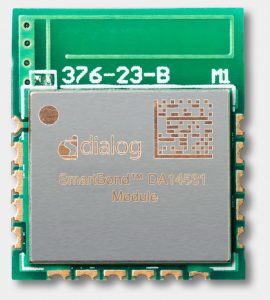
The SmartBond TINY module was specifically optimized to significantly reduce the cost of adding Bluetooth low energy functionality to an IoT system. Its easy-to-use design and software allow developers to quickly and intuitively develop highly functional connected devices, targeting the next generation of connected consumer, connected medical, smart home and smart appliance applications. The module incorporates two unique software features designed to eliminate the complexity often associated with traditional Bluetooth low energy development and empowers customers to develop robust IoT products regardless of their software coding capabilities.
The first is the configurable Dialog Serial Port Service (DSPS) software, which emulates a universal asynchronous receiver-transmitter (UART) serial port over BLE, removing the need to write Bluetooth software for “BLE Pipe” applications when connecting the module to a host MCU’s serial port. The second feature, Dialog’s new Codeless software, takes this concept even further by replacing complex code with a simple series of human readable ASCII commands that can be used to generate customer applications. Codeless uses the industry standard Hayes AT-style command set to configure and operate the module.
The launch of the SmartBond TINY DA14531 SoC in 2019 set a new industry benchmark for BLE SoC pricing, at less than 50 cents. The DA14531 module further leverages the capabilities of the SoC, including an integrated antenna and all required components, to add BLE functionality to an IoT system in high volumes at a cost of under $1. That price point for BLE functionality, performance and quality is unmatched by competitors,” said Sean McGrath, Senior VP, Connectivity and Audio BG, Dialog Semiconductor. “Not only is this module breaking barriers in terms of cost and power, it is extremely easy for both beginners and experts to use, ensuring that all customers can benefit from its high level of integration and programmable ease of use.
- What is the primary purpose of the DA14531 SmartBond TINY module?
To significantly reduce the cost of adding Bluetooth low energy functionality to an IoT system. - How does the configurable Dialog Serial Port Service eliminate complexity?
It emulates a universal asynchronous receiver-transmitter serial port over BLE, removing the need to write Bluetooth software for BLE Pipe applications. - What type of commands does the Codeless software use?
It uses the industry standard Hayes AT-style command set to configure and operate the module. - Can beginners use this module effectively?
Yes, the module is extremely easy for both beginners and experts to use due to its high level of integration and programmable ease of use. - What is the price point for the DA14531 module?
The module adds BLE functionality at a cost of under 1 dollar. - Does the module require an external antenna?
No, the module incorporates an integrated antenna along with all required components. - Which application areas are targeted by this module?
It targets connected consumer, connected medical, smart home, and smart appliance applications. - How does the Codeless feature replace complex code?
It replaces complex code with a simple series of human readable ASCII commands.