
Summary of BPW34 GAMMA RAY DETECTOR
This article describes a portable radiation detector designed by Stefan Wagner using a miniature Silicon PIN Photodiode (BPW34) instead of a traditional Geiger-Müller tube. By connecting three BPW34 diodes in parallel, the project enhances sensitivity to gamma rays while minimizing background noise from cosmic rays. The system amplifies current pulses generated by electron-hole pairs using an instrumentation amplifier and processes signals with an LM3111 operational amplifier to trigger a buzzer upon detection, offering a simpler alternative to high-voltage circuits.
Parts used in the BPW34 Gamma Ray Detector:
- Three BPW34 miniature Silicon PIN Photodiodes
- Instrumentation amplifier
- LM3111 operation amplifier
- Buzzer
The usual approach to radiation detection is the use of a Geiger-Müller tube and its high voltage circuit requirements, but during a quick surf through the internet today, I came across this portable and “accurate looking” solution developed by Stefan Wagner, on EasyEDA.
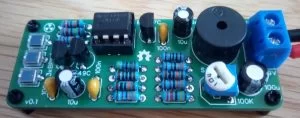
Rather than the Geiger Muller tube and its complex circuitry, the project uses a miniature Silicon PIN Photodiode, the 3x BPW34 (which were connected in parallel to improve sensitivity), as the primary sensing component. The BPW34 is a PIN photodiode with high speed and high radiant sensitivity in miniature, flat, top view, clear plastic package. It is sensitive to visible and near-infrared radiation and has a small sensitive area, which is an advantage in radiation detection, as the background rate due to cosmic rays is very low, and signals from small samples will be easier to detect than when a counter tube is used.
The behavior of the BPW34 PIN photodiode used in the project is similar to that of a low-cost counter tube in the sense that, while alpha particles may be stopped by the enclosure of the device, gamma rays due to their high penetration ability will pass through and create electron-hole pairs in the depletion layer of the diode. This will lead to the charge carriers in the diode being drawn away and a small current pulse being created. The small current pulse can then be amplified and processed to determine radiation levels.
For the amplification, the project featured an instrumentation amplifier and the processing is done with an LM3111 operation amplifier which is used to compare the values and trigger a buzzer when radiation is detected.
With the Geiger-Muller tube becoming hard to find and the high voltage circuitry adding another layer of complexity, this accurate approach by Stefan using relatively, readily available components might be the best way to build your next radiation detection device.
Read more: BPW34 GAMMA RAY DETECTOR
- Why use a BPW34 photodiode instead of a Geiger-Müller tube?
The BPW34 is a readily available component that avoids the need for complex high voltage circuitry required by Geiger-Müller tubes. - How does the project improve sensitivity?
Sensitivity is improved by connecting three BPW34 photodiodes in parallel. - What type of radiation can this device detect?
The device detects gamma rays which penetrate the enclosure to create electron-hole pairs in the diode's depletion layer. - Can alpha particles be detected by this setup?
No, alpha particles may be stopped by the enclosure of the device. - How are radiation levels determined in this circuit?
Radiation levels are determined by amplifying small current pulses and processing them with an LM3111 operational amplifier. - What triggers the alarm when radiation is found?
The LM3111 operation amplifier compares values and triggers a buzzer when radiation is detected. - What is an advantage of the small sensitive area of the BPW34?
A small sensitive area results in a very low background rate due to cosmic rays, making signals from small samples easier to detect. - Is this approach considered accurate?
The article describes the solution as accurate looking and potentially the best way to build a next-generation radiation detection device.