
Summary of BANANA PI M2 MAGIC, SMALLEST BANANA PI BOARD
Sinovoip's Banana Pi M2 Magic is a compact 51mm ARM SoC board designed for IoT applications. It features an Allwinner R16 or A33 quad-core processor, 512MB DDR3 memory, and up to 64GB storage via eMMC or microSD. The board includes WiFi, Bluetooth, MIPI DSI display support, and a camera interface but lacks HDMI and Ethernet. It runs Tina IoT Linux and supports both DC power and lithium batteries.
Parts used in the Banana Pi M2 Magic:
- Allwinner R16 or Allwinner A33 SoC
- ARM Cortex-A7 Quad-core Processor
- ARM Mali 400 MP2 GPU
- 512MB DDR3 SDRAM
- 8GB eMMC Flash (up to 64GB option)
- Micro SD Card Slot
- 4-lane MIPI DSI Connector
- CSI Camera Interface
- Onboard Microphone
- WiFi 802.11 b/g/n Module
- Bluetooth 4.0 LE Module
- USB 2.0 Host Port
- Micro USB 2.0 OTG Port
- 40-pin GPIO Header
- PMIC AXP223
- DC Power Barrel Jack
- Battery Interface
Sinovoip had announced its new board Banana Pi M2 Magic. At first, it is an ARM SoC development board that features a high computing performance in a 51mm square portable design. In addition to onboard WiFi and Bluetooth, M2 Magic offers 8GB eMMc storage and DDR3 SDRAM of 512 MB. There is also an SD card slot for more storage, to install an OS for example.
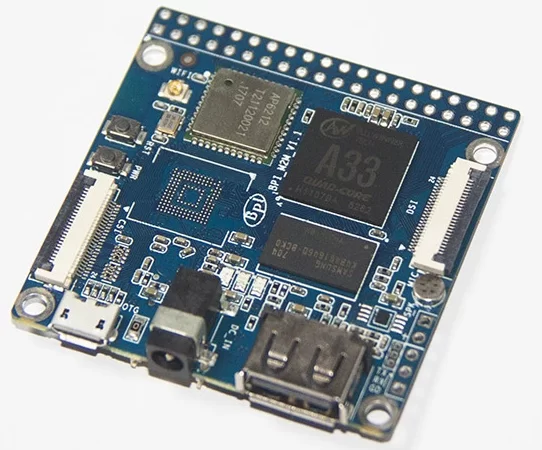
Banana Pi M2 Magic specifications:
- SoC: Allwinner R16 or Allwinner A33, quad-core ARM Cortex-A7 processor with ARM Mali 400 MP2 GPU
- System Memory: 512MB DDR3
- Storage: 8 GB eMMC flash (option: 16, 32 or 64GB) + micro SD slot
- Display Interface: 4-lane MIPI DSI connector
- Camera Interface: CSI connector supporting up to 5MP sensor, 1080p30 H.265 video capture
- Video Decoder: Multi-format FHD video decoding, including Mpeg1/2, Mpeg4, H.263, H.264, etc H.264 high profile 1080p@60fps
- Audio: Onboard microphone
- Connectivity: Wifi 802.11 b/g/n, Bluetooth 4.0 LE (AP6212)
- USB: 1x USB 2.0 host, 1x micro USB 2.0 OTG port
- Expansion: 40-pin header with GPIOs, UART, I2C, SPI, PWM…
- Misc: Reset & power buttons, RGB LEDs,
- Power Supply:
- 5V @ 2A via DC power barrel
- 3.7V Lithium battery support
- Dimensions: 51 x 51 mm
- Weight: 40 grams
Alongside the processor and the memory at the front side of the board, you will find a 40-pin GPIO header, a DSI display slot, an Antenna connector, a CSI camera slot, a USB OTG adapter, a USB2.0 port, a microphone and a DC power jack. On the rear side, there is an antenna, a PMIC AXP223, a battery interface and a microSD card slot.
This board is oriented for IoT applications in general. Since there is no HDMI interface, M2 Magic is suitable for headless use, or you can use the MIPI DSI display interface to connect a screen. It also doesn’t have an Ethernet interface, so you will have to use WiFi and Bluetooth connectivity.
The board will run Tina IoT Linux, which is a lightweight Linux distribution optimized for Allwinner R-Series processor.
Read More: BANANA PI M2 MAGIC, SMALLEST BANANA PI BOARD
- What processor does the Banana Pi M2 Magic use?
The board uses an Allwinner R16 or Allwinner A33 quad-core ARM Cortex-A7 processor with an ARM Mali 400 MP2 GPU. - How much system memory does the board have?
The Banana Pi M2 Magic features 512MB of DDR3 SDRAM. - Can I expand the storage on this board?
Yes, it offers 8GB eMMC flash with options for 16, 32, or 64GB, plus a micro SD slot for additional storage. - Does the Banana Pi M2 Magic support HDMI output?
No, the board does not have an HDMI interface and relies on the MIPI DSI connector for display connections. - What operating system runs on the Banana Pi M2 Magic?
The board runs Tina IoT Linux, a lightweight distribution optimized for Allwinner R-Series processors. - Can the board be powered by a battery?
Yes, it supports a 3.7V Lithium battery in addition to 5V @ 2A via a DC power barrel. - What wireless connectivity options are available?
The board includes WiFi 802.11 b/g/n and Bluetooth 4.0 LE via the AP6212 module. - Is there an Ethernet port on the Banana Pi M2 Magic?
No, the board does not have an Ethernet interface and requires WiFi or Bluetooth for network connectivity.