
Summary of Single-Tube nixie clock | Microcontroller Project
This article details a single-digit Nixie clock project driven by a PIC16F84A microcontroller. It features sequential time display (hours, minutes, seconds) with DCF-77 atomic synchronization and manual setup options. The design includes a custom high-voltage power supply using only four components to generate 170V from a 5V source via a DC/DC converter. The system uses a 74141 IC for driving the tube cathodes safely and allows for programmable extinction times without requiring a MikroC compiler license.
Parts used in the Single-Tube Nixie Clock:
- PIC16F84A microcontroller
- IN-14 Russian Nixie tube
- DCF-77 atomic clock module
- MOSFET (IRF830)
- Inductor coil (300 µH or 330 µH)
- Fast recovery diode
- Capacitor (2.2 µF 250V)
- Resistor divider network
- Variable potentiometer
- 74141 IC (BCD to decimal decoder)
Here is the nixie clock !
- PIC16F84A microcontroller
- Single-digit Nixie, sequential hours, minutes and seconds display
- DCF-77 atomic clock, with automatic or manual time set-up
- high voltage power supply for Nixie with only 4 components
- 24 hours cycle programmable extinction time
- no MikroC compiler licence needed !
This project will show you how to drive a nixie tube display with a PIC16F84A simple microcontroller.
The nixie is a vertical-mount, front-reading IN-14 russian tube (thanks Alex !), very convenient for prototyping because of its long solderable pins.
How to power the nixie ?
 A 170 volt power supply must be applied between the anode of the tube and one of its cathod, to light the corresponding number from 0 to 9. The lightened number needs around 1.5 mA to glow.
If the voltage is lower, the number is not completely lightened and may even extinguish (under 140 V).
If the voltage is higher, digits will randomly light at the same time, and no digit will be clearly readable.
It is possible to get the high voltage from the main power supply, but it is highly dangerous because live parts may be exposed to dangerous voltage.
That’s why is use a DC/DC converter, which gives the +170V needed by the nixie from the +5V power supply of the circuit. The PIC16F84A generates a software PWM, and drives the MOSFET’s gate. The MOSFET switches on an off the current into a 300 µH coil. The inducted high voltage is collected by a fast recovery diode and then fed into a capacitor.
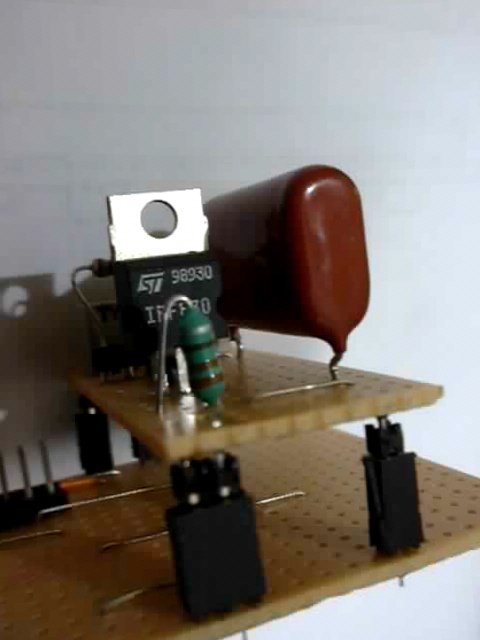
This is a close-up view, showing the IRF830 MOSFET, the 330 µH miniature coil, and the big 2.2 µF 250V capacitor.
Note that the power supply is build as an individual board, I use it also in other test boards for other projects.
A simple resistor divider feeds back a voltage reference into a PIC input : if the voltage exceeds the 1 level of the PIC, the software turns PWM off, until the voltage turns under the 1 level of the PIC : then the PWM output starts again, and so on… this allows to keep a constant high voltage of around +170 V, depending on the variable resistor setting.
This is a close-up of the voltage reference divider.
We can also see that the 15 K anode current limiting resistor is mounted on a socket : during tests, a 47 K resistor was used. Remember this : reducing the current will increase the life of your tube ! You have to find a good value for a good brightness and a long life.
Note that the power supply is build as an individual board, I use it also in other test boards for other projects.
A simple resistor divider feeds back a voltage reference into a PIC input : if the voltage exceeds the 1 level of the PIC, the software turns PWM off, until the voltage turns under the 1 level of the PIC : then the PWM output starts again, and so on… this allows to keep a constant high voltage of around +170 V, depending on the variable resistor setting.
This is a close-up of the voltage reference divider.
We can also see that the 15 K anode current limiting resistor is mounted on a socket : during tests, a 47 K resistor was used. Remember this : reducing the current will increase the life of your tube ! You have to find a good value for a good brightness and a long life.
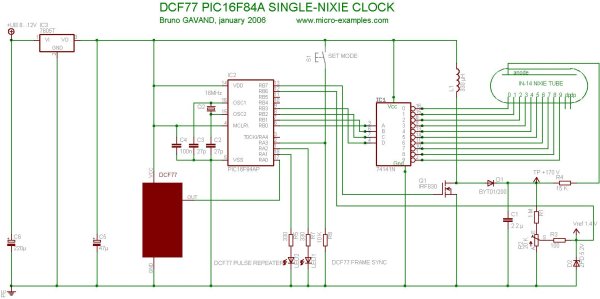
Power supply adjustment : turn the variable potentiometer, so that you can read around 175 V on a voltmeter connected to the test point (see schematic). Don’t forget that there is a 2.2 µF capacitor charged with +170 V in the circuit. This is enough to hurt you VERY BADLY if you touch it.
How to drive the nixie ?
The anode is connected to the high voltage through a 15 K resistor, in order to limit the current to approximately 1.5 mA. It is not possible to drive the cathodes with the pic output, because of the high voltage engaged.
I use a 74141 IC, which has been designed for nixie tubes : it includes a BCD to decimal decoder, and each output has a high-voltage transistor.
How to drive the nixie ?
The anode is connected to the high voltage through a 15 K resistor, in order to limit the current to approximately 1.5 mA. It is not possible to drive the cathodes with the pic output, because of the high voltage engaged.
I use a 74141 IC, which has been designed for nixie tubes : it includes a BCD to decimal decoder, and each output has a high-voltage transistor.
For more detail: Single-Tube nixie clock | Microcontroller Project
- How is the high voltage generated for the Nixie tube?
A DC/DC converter generates +170V from a +5V supply using a software PWM, an IRF830 MOSFET, a 300 µH coil, a fast recovery diode, and a capacitor. - What voltage is required to light the Nixie digit?
A voltage of around 170 volts must be applied between the anode and cathode; voltages below 140V may cause extinguishing while higher voltages cause random lighting. - Can I drive the Nixie cathodes directly with the PIC output?
No, it is not possible because of the high voltage involved; a 74141 IC is used instead to handle the BCD decoding and high-voltage switching. - How does the circuit maintain a constant high voltage?
A resistor divider feeds back a voltage reference to a PIC input, which turns the PWM off if the voltage exceeds the threshold and restarts it when the voltage drops. - What is the recommended current for the Nixie tube?
The lit number needs around 1.5 mA to glow properly, achieved by using a 15 K anode current limiting resistor. - How can I increase the life of my Nixie tube?
Reducing the current will increase the life of your tube, so you should find a good resistor value that balances brightness with longevity. - Is a MikroC compiler license required for this project?
No, this project does not require a MikroC compiler license. - What safety precaution is mentioned regarding the power supply?
The 2.2 µF capacitor holds a charge of +170 V which can hurt you very badly if touched, so extreme caution is needed during adjustment.
