


Summary of Photomultiplier Tube (PMT) Controller Circuit B using pic-microcontrolleroard
This article describes a four-channel PMT controller system based on a PIC microcontroller. It manages high voltage levels, offset voltages, amplifier gain, and channel mixing via USB or RS-232. The system identifies connected PMT modules using an interface board with analog ID signals. Additionally, it features a USB-based scan controller circuit that drives X-Y scanner galvos and generates timing signals for data acquisition.Parts used in the Four Channel PMT Controller:
- PIC microcontroller
- USB connection (HID device)
- PIC-to-PIC RS-232 protocol link
- Hand unit
- PMT Interface Board
- External amplifier system
- X-Y scanner galvos
- Scan Controller Circuit Board
- Sets the four high voltage levels of the PMTs
- Provide four bipolar offset voltages for black level adjustment on an external amplifier system
- Control a 2 level programmable gain of a four channel external amplifier system
- Control analog mixing of channels of the four channel external amplifier system
- Depending on the type of PMT module attached, communicate with it (Circuit board specification)
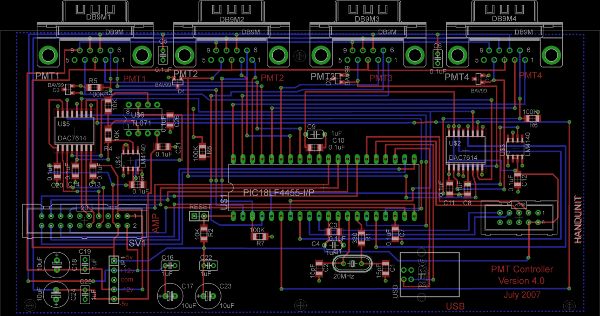
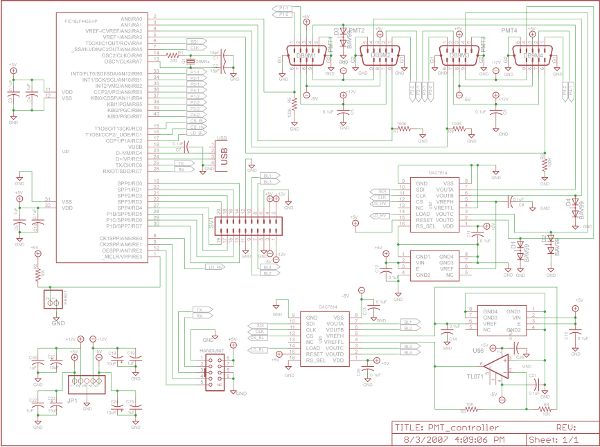
Figures 1 and 2 show the current printed circuit board and schematic layouts.
PMT Interface Board
The PMT Interface Board is used to indicate to the controller which type of PMT is connected on each channel. The type of PMT is specified using an analog ID signal. The PMTs that can currently be recognized by the system are:
- HC125 Bialkali module
- Ultra Bialkali (UBA) module
- H7422P-40MOD Type 1 (with cooler and protection circuit)
- H7442P-40MOD Type2 (without cooler and protection circuit)
- GaAsP hybrid detector
(See the PMT controller specification for more information about the analog ID codes)
Figures 3 and 4 show the printed circuit board and schematic layouts for the interface board.
Scan Controller Circuit Board - USB based scancard
Our simplest scan controller is an independent board that communicates with the PC via USB connection. It drives the X-Y scanner galvos and produces the timing signal for data acquisition. Figures 5 and 6 show the printed circuit board and schematic layouts. It has several unique features such as a zero-latency gate
For more detail:Photomultiplier Tube (PMT) Controller Circuit B
Quick Solutions to Questions related to Four Channel PMT Controller:
- How does the PMT controller communicate with a PC?
The controller communicates with a PC by USB as an HID device. - What types of PMTs can be recognized by the system?
The system recognizes HC125 Bialkali, Ultra Bialkali, H7422P-40MOD Type 1, H7442P-40MOD Type 2, and GaAsP hybrid detector modules. - How is the type of PMT specified to the controller?
The type of PMT is specified using an analog ID signal on the PMT Interface Board. - What functions do the external inputs send to the PMT controller?
Inputs set high voltage levels, provide bipolar offset voltages, control programmable gain, and manage analog mixing of channels. - What is the role of the Scan Controller Circuit Board?
It drives the X-Y scanner galvos and produces the timing signal for data acquisition. - Does the scan controller have unique features?
Yes, it features a zero-latency gate. - Can the controller control a four channel external amplifier system?
Yes, it controls a 2 level programmable gain and analog mixing of channels. - What protocol is used for communication between the controller and the hand unit?
A PIC-to-PIC RS-232 protocol is used for this communication.
Related projects
Leveraging Blockout Banners for Effective Electronics and Tech Product Displays
Blockout banners have become a popular and effective tool for displaying electronics and tech products in various settings, from trade shows and...
LCD & Display Projects · PIC18F4520Interfacing PIC18F4520 microcontroller with an HD44780 LCD
Introduction Being able to display data from a microcontroller visually has many advantages. It allows for menus, status indicators, and instructions to...
LCD & Display ProjectsVideo Project Development in the Midst of an Impromptu Online Semester
Receiving robot parts in the mail was an unexpected conclusion to the Winter 2020 semester for students. However, when faced with a...
LCD & Display Projects · PIC16F628AFrequency Counter by PIC16F628
In this project we are building a basic and low cost frequency counter circuit . It can measure from 16Hz to 100Hz...
LCD & Display ProjectsWHAT IS A PIC MICROCONTROLLER? WHAT CAN IT DO?
PIC microcontrollers ( Programmable Interface Controllers), are electronic circuits that can be programmed to carry out a vast range of tasks. They...
LCD & Display Projects · PIC16F877ASerial Data Received from PC and Displayed on 16×2 Using USART of Pic16f877 Microcontroller
Here is a simple tutorial on how to receive serial data from PC(Personal Computer) Hyperterminal and display it on 16x2 lcd using...

Ibrar Ayyub
I am an experienced technical writer holding a Master's degree in computer science from BZU Multan, Pakistan University. With a background spanning various industries, particularly in home automation and engineering, I have honed my skills in crafting clear and concise content. Proficient in leveraging infographics and diagrams, I strive to simplify complex concepts for readers. My strength lies in thorough...