
Summary of Ultra Low Power Chips
Imec demonstrated an ultra-low power RFID transponder chip at IEDM 2014, fabricated using thin-film transistor (TFT) technology on plastic. Operating at 0.55V and consuming just 2.5µW, the chip enables long-term autonomy for IoT applications like item-level tagging and body area networks. Processed on a 25µm foil compatible with flat-panel display fabs, it offers flexibility, robustness, and low cost for embedding in packaging, textiles, or security documents.
Parts used in the Ultralow Power RFID Transponder Chip:
- Thin-film transistor (TFT) technology
- Plastic film
- 8-bit transponder chip
- Commercial AAA battery
- 25µm thin foil
- Flat panel display fabs infrastructure
Imec news
Imec Presents Ultralow Power RFID Transponder Chip in Thin-Film Transistor Technology on Plastic at IEDM 2014
17/12/2014
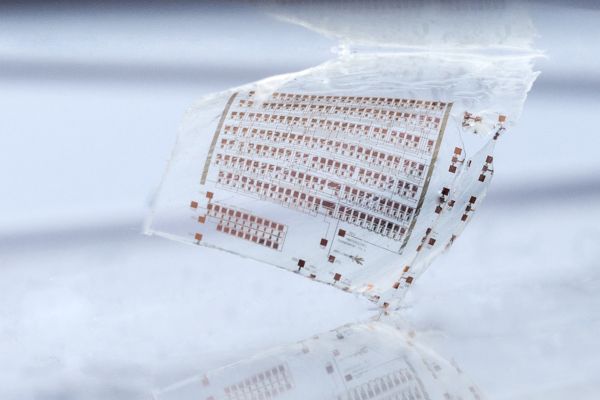
IEEE International Electron Devices Meeting (IEDM) 2014 (San Francisco) – Dec. 17, 2014 – At this week’s IEDM 2014, held in San Francisco, California, nanoelectronics research center imec demonstrated an ultra-low power RFID transponder chip. Operating at sub 1V voltage and realized in thin-film transistor technology (TFTs) on plastic film, the chip paves the way for universal sensing applications, such as item level RFID tagging, body area networks (BAN) and environmental monitoring, that require prolonged remote autonomy, and ultimate thinness, flexibility and robustness.
One of the major drivers of the semiconductor industry is the Internet of Things (IoT). Market studies envision a society where billions of autonomous sensor nodes are seamlessly integrated into objects, in the environment and on human bodies, operating independently for months, interacting with each other and connecting to the internet. This IoT is expected to improve and enhance daily-lives through smart houses and smart cars, personal health monitoring and much more. Companies across the electronics value chain are rushing to define their vision and strategy and determine how this IoT fits into their product roadmap.
To enable this IoT vision, imec is leveraging its expertise in thin-film electronics, ultra-low power electronics and sensing, in this way tackling the technology roadblocks for universal sensing applications that lie ahead. The team demonstrated an 8-bit transponder chip made in thin-film transistor technology. The chip operates at a supply voltage of 0.55V while consuming only 2.5µW. A commercial AAA battery could power the chip for more than 20 years. Moreover, processed on a 25µm thin foil in a process flow compatible to a commodity manufacturing infrastructure (flat panel display fabs), the chip addresses the issue of cost and mechanical flexibility, thinness and robustness. The chip can be embedded in security documents, smart packaging, disposable electronics or textiles.
The research is done in the framework of Holst Centre’s (initiated by imec and TNO) industrial affiliation program on thin-film electronics and with support from the EU through the project COSMIC that developed complimentary thin film circuit technologies on foil for applications like gate driver for flexible displays, ADC, ALU and RFID tags.
For more detail: Ultra Low Power Chips
- What is the operating voltage of the chip?
The chip operates at a supply voltage of 0.55V. - How much power does the chip consume?
The chip consumes only 2.5µW. - Can a commercial AAA battery power this chip?
Yes, a commercial AAA battery could power the chip for more than 20 years. - What material is the chip processed on?
The chip is processed on a 25µm thin foil. - Which manufacturing infrastructure is compatible with the process flow?
The process flow is compatible with commodity flat panel display fabs. - What are some potential applications for this chip?
Applications include item level RFID tagging, body area networks, environmental monitoring, smart packaging, disposable electronics, and textiles. - Does the chip support flexible and robust applications?
Yes, the chip addresses issues of mechanical flexibility, thinness, and robustness. - Who supported the research project COSMIC?
The EU supported the project COSMIC that developed complimentary thin film circuit technologies.