Summary of 555 Timer Breakout Board Plus
Summary: A compact breakout board for the NE555P timer simplifies building astable or monostable circuits by exposing all eight pins and providing slots for two resistors and one capacitor. It eliminates wiring on a breadboard, uses three 2-pin female headers for C1, R1, and R2, and male headers for power, ground, and output. Trigger (TRG) is left open for monostable use. Prototype dimensions are 0.88" x 0.82"; final design may vary.
Parts used in the555 Timer Breakout Board Plus:
- NE555P (Texas Instruments)
- PCB breakout board (prototype 0.88 in x 0.82 in)
- 3 × 2-pin female headers (for C1, R1, R2)
- Male headers for power, ground, and output
- Optional resistors to insert into R1 and R2 slots
- Optional capacitor to insert into C1 slot

Hello, my name is Patrick Grady and I’m a highschool senior in the US. I’m an avid programmer and tinkerer and love anything related to electronics and computers.
This past winter I took a class in Digital Electronics and was introduced to the 555 timer. One of the most common applications of the 555 timer is the astable mode, which is unfortunately rather clunky to build on a breadboard. This 555 breakout board does more than expose the 555’s eight pins: it sets you up to run your 555 timer in astable mode with slots to insert two resistors and a capacitor of your choice. This board eliminates all the wiring for the 555 timer. The 555 Timer Breakout Board Plus will cut out the tedium of setting up the 555 timer and will allow hobbyists to dig straight in to their projects.
As a electronics hobbyist myself, I recognize the usefulness of this simple device, but also acknowledge its relevance is limited to the niche market of hobbyist electronics. If you want this device or think a friend could use it, please contribute to the campaign and buy a 555 timer breakout board!

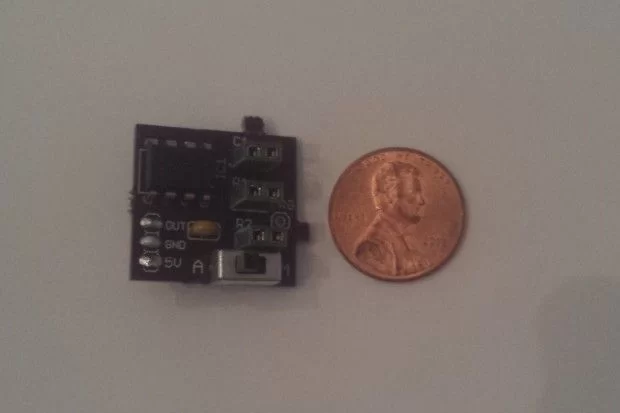
We have built a fully functional prototype board, which you can check out above in the campaign images. The board is 0.88 inches by 0.82 inches.
NOTE: This board does not necessarily reflect the exact final design of the board.
Here you can see the Eagle board layout. We will be using the NE555P made by Texas Instruments. For C1, R1 and R2 we will be using three, 2 pin female headers so that the user can easily stick in whatever resistors or capacitors they want to use in the circuit. The power, ground, and output headers will be male so that this board can easily be used with a breadboard. TRG will be left open to allow the user to use the timer in monostable mode.
For more detail: 555 Timer Breakout Board Plus
- What timer IC is used on the board?
The board uses the NE555P made by Texas Instruments. - Can I use the board in astable mode?
Yes, the board is set up for astable mode with slots for two resistors and a capacitor. - Can I use the board in monostable mode?
Yes, TRG is left open to allow use in monostable mode. - How are C1, R1, and R2 implemented?
They use three 2-pin female headers so users can insert their own resistors and capacitor. - What type of headers are used for power, ground, and output?
Power, ground, and output headers are male so the board can be used with a breadboard. - Does the prototype reflect the final design exactly?
No, the note says the board does not necessarily reflect the exact final design. - What are the prototype board dimensions?
The prototype board measures 0.88 inches by 0.82 inches. - Does the board eliminate wiring for the 555 timer?
Yes, the board eliminates the wiring and exposes the 555's eight pins for easier use.