


Summary of The LM324 Quad Op-Amp Line Follower Robot with Pulse Width Modulation
This article details the design of a Line Follower Robot (LFR) using analog components, specifically the LM324 Quad Op-Amp, to achieve precise speed control comparable to microcontroller-based systems. It explains how CdS photocells and blue LEDs detect black tracks on white surfaces, utilizing Pulse Width Modulation (PWM) for proportional motor speed adjustment rather than simple on/off switching to ensure smooth navigation.Parts used in the LM324 Quad Op-Amp Line Follower Robot:
- Cadmium Sulphide (CdS) photocell sensor
- Light Dependent Resistor (LDR)
- High intensity blue Light Emitting Diode (LED)
- DC motor
- Pulse Width Modulation (PWM) signal generator
- LM324 Quad Op-Amp
Designing a simple and yet functional Line Follower Robot (LFR) is always a fascinating and challenging subject to be learned, the LFR actually could be implemented in many ways start from a simple two transistors to a sophisticated PID (Proportional, Integrate and Differential) which take advantage of the programmable feature of microcontroller to calculate the PID equation to successfully navigate the black track line on a white background surface. 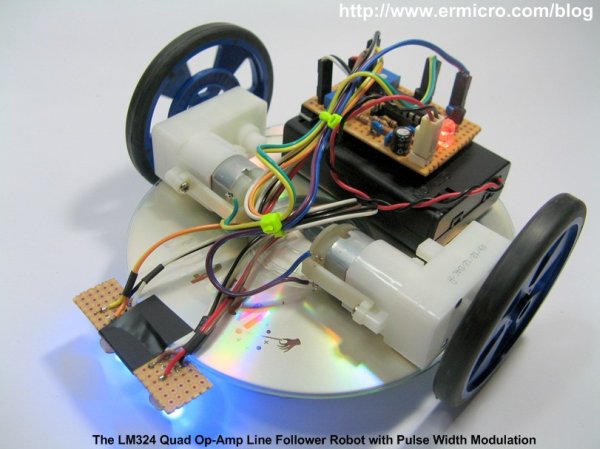
Designing a non microcontroller based LFR is quite challenging tasks as we need to limit the electronic components numbers so the LFR will not too complicated to be built by most average robotics beginners or electronic hobbyists, but at the same time we need to have a good speed control mechanism in order for the LFR to navigate the black track line successfully. The microcontroller based design LFR in the other hand is a popular choice because it reduces a number of electronic components significantly while still providing a flexible programmable control to the LFR.
On this tutorial we are going to build yet another LFR using just the standard analog components easily found on the market but use the same speed control method technique found in many good microcontroller based Line Follower Robot design. As the result we could get a good precision analog line follower robot that comparable to the microcontroller based Line Follower Robot design. On this tutorial you will also learn many useful information of how to use the operational amplifier.
The Line Follower Robot
This Line Follower Robot basically use a Cadmium Sulphide (CdS) photocell sensor or known as Light Dependent Resistor (LDR) and the high intensity blue Light Emitting Diode (LED) to illuminate the area under the photocell sensor to sense the black track line and the DC motor speed control technique to navigate the black line track as shown on this following picture: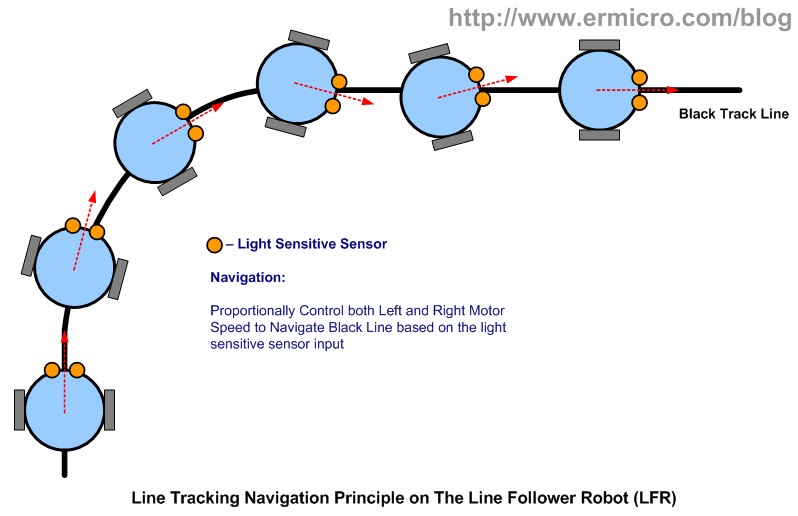
The easy method to navigate the black track line is to turn ON and OFF the left or the right DC motor according to the sensor reading (black turn OFF and white turn ON), but using this method will make the LFR to move in zigzag way. By proportionally control both left and right DC motor speed according to the light intensity level received by the photocell sensor (reflected back by the black track line) we could make the LFR easily navigate this track. The common technique to control the motor speed efficiently is to use a pulse signal known as the pulse width modulation or PWM for short.
For more detail: The LM324 Quad Op-Amp Line Follower Robot with Pulse Width Modulation
Quick Solutions to Questions related to LM324 Quad Op-Amp Line Follower Robot:
- How does the robot navigate the black track line?
The robot navigates by proportionally controlling both left and right DC motor speeds according to light intensity levels received by the photocell sensor. - What happens if you turn motors ON and OFF based on sensor readings?
Using this method will make the LFR move in a zigzag way. - Which components are used to sense the black track line?
A Cadmium Sulphide (CdS) photocell sensor or Light Dependent Resistor (LDR) and a high intensity blue LED are used. - What technique is used to control motor speed efficiently?
Pulse width modulation or PWM is the common technique used to control motor speed efficiently. - Can an analog design match the precision of a microcontroller design?
Yes, the resulting analog line follower robot has precision comparable to microcontroller based designs. - Why is designing a non-microcontroller based LFR challenging?
It requires limiting electronic component numbers while still providing a good speed control mechanism for successful navigation. - What is the role of the blue LED in this project?
The blue LED illuminates the area under the photocell sensor to help it sense the black track line.
Related projects
Real-Time CAN-Based Vehicle Monitoring System with PIC MCU
INTRODUCTION The Controller Area Network (CAN) is a robust vehicle communication bus standard that was primarily developed for automobile applications but has...
Motors & RoboticsEasy Way to Learn Robotics Using Microcontrollers: A Beginner’s Guide
The title, "Easy Way to Learn Robotics Using Microcontrollers," promises an accessible entry point for those curious about the exciting world of...
Motors & Robotics · PIC16F877AEfficient Sun-Following Robot: A Solar Tracker with Microcontroller Control
Abstract The impending global challenge of dwindling non-renewable fuel resources underscores the urgency of transitioning towards renewable energy alternatives like solar power....
Motors & RoboticsInnovative Robotics: A Comprehensive Project Exploration
A DC motor functions as an electromechanical device, translating electrical signals into mechanical movements. The rotation of the motor correlates directly with...
Motors & RoboticsAdvanced Techniques for Fault Detection, Indication, and Protection in Induction Motors
1. INTRODUCTION The impact of microcontroller usage on our daily lives is remarkable. This versatile device is now prevalent in various control...
Motors & RoboticsExploring Versatility: GSM-Based Robotic Vehicle Technology
Introduction To Robotics The term 'Robot' remains elusive, defying a precise definition due to its evolving usage. Initially, it referred to humanoid...

Ibrar Ayyub
I am an experienced technical writer holding a Master's degree in computer science from BZU Multan, Pakistan University. With a background spanning various industries, particularly in home automation and engineering, I have honed my skills in crafting clear and concise content. Proficient in leveraging infographics and diagrams, I strive to simplify complex concepts for readers. My strength lies in thorough...