
Summary of Circuit adds foldback-current protection
This article describes adding foldback-current limiting to three-terminal adjustable linear regulators (e.g., LM317) to protect the pass transistor during overloads. By adding a MOSFET, a transistor, and resistors including a feedback resistor R4, the circuit reduces regulator bias during faults so output current folds back as output voltage falls, limiting dissipation and improving reliability. Equations for foldover and short-circuit currents (IKNEE and ISC) are provided for design.
Parts used in the Foldback-Current-Limited LM317 Project:
- LM317 adjustable three-terminal regulator (IC1)
- MOSFET Q1
- Bipolar transistor Q2
- Resistor R1
- Resistor R2
- Feedback resistor R4
- Additional resistors for output set and bias (implied)
- Input and output capacitors (typical for regulator stability, implied)
For many applications that require power-supply currents of a few amperes or less, three-terminal adjustable-output linear voltage regulators, such as National Semiconductor’s LM317, offer ease of use, low cost, and full on-chip overload protection. The addition of a few components can provide a three-terminal regulator with high-speed short-circuit current limiting for improved reliability. The current limiter protects the regulator from damage by holding the maximum output current at a constant level, IMAX, that doesn’t damage the regulator (Reference 1). When a fault condition occurs, the power dissipated in the pass transistor equals approximately VIN×IMAX. Designing a regulator to survive an overload requires conservatively rated—and often overdesigned—components unless you can reduce, or fold back, the output current when a fault occurs (Reference 2).
The circuit in Figure 1 incorporates foldback-current limiting to protect the pass transistor by adding feedback resistor R4. Under normal conditions, transistor Q2 doesn’t conduct, and resistors R1 and R2 bias MOSFET Q1 into conduction. When an output overload occurs, Q2 conducts, reducing the on-state bias applied to Q1 and thus increasing its drain-source resistance and limiting the current flowing into regulator IC1, an LM317. Adding R4 makes Q2‘s bias current dependent on the output voltage, VOUT, which decreases under overload conditions.
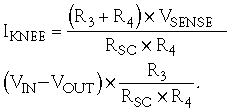
For the circuit in Figure 1, you can calculate the maximum foldover and short-circuit currents, IKNEE and ISC, respectively, as follows
For more detail: Circuit adds foldback-current protection
- What is the purpose of adding foldback-current limiting to an LM317 regulator?
To protect the regulator pass transistor by reducing output current under fault conditions, lowering power dissipation and improving reliability. - How does the added circuit achieve current foldback?
By using Q2 and feedback resistor R4 to reduce Q1 bias as output voltage falls, increasing Q1 resistance and reducing output current. - Which components are added to implement foldback-current limiting?
A MOSFET Q1, a bipolar transistor Q2, resistors including R1, R2, and feedback resistor R4, plus the LM317 regulator. - Does the circuit protect the regulator during short circuits?
Yes; the foldback limiting reduces short-circuit current (ISC) to limit dissipation during faults. - What determines the maximum output current IMAX in this design?
IMAX is set by the current-limiting behavior of the added components and resistor network so it holds the maximum output current at a safe constant level. - How is power dissipation in the pass transistor approximated during a fault?
Approximately as VIN multiplied by IMAX when a fault condition occurs. - Are design equations provided for foldover and short-circuit currents?
Yes; the article states equations for IKNEE (foldover) and ISC (short-circuit) are provided for the circuit in Figure 1. - Does Q2 conduct under normal operation?
No; under normal conditions Q2 does not conduct and Q1 is biased by R1 and R2.