
Summary of 3X 4K FANLESS DIGITAL SIGNAGE PLAYER POWERED BY AMD RYZEN EMBEDDED R1000 SOC
IBASE Technology launched the SI-323-N, a compact, fanless digital signage player powered by the AMD Ryzen Embedded R1000 SoC. It supports three independent 4K @60Hz displays using AMD Radeon Vega 3 Graphics and Eyefinity technology. Designed for commercial spaces like airports and malls, it features IBASE iCONTROL for remote monitoring and power management, hardware EDID protection, and compatibility with Windows 10 IoT Enterprise and Linux Ubuntu.
Parts used in the SI-323-N Digital Signage Player:
- AMD Ryzen™ Embedded R1000 SoC
- AMD Radeon™ Vega 3 Graphics
- 8GB DDR4 system memory
- Two Gigabit Ethernet ports
- Mini PCIe expansion interface
- M.2 E-Key slot for wireless functions
- M.2 M-Key slot for storage
- IBASE iCONTROL software
- Hardware EDID
- Windows 10 IoT Enterprise or Linux Ubuntu operating systems
Triple-Display 4K Signage with AMD Ryzen Embedded R1000
The SI-323-N is designed for digital signage installations that need to drive three independent displays from one compact system. Its AMD Ryzen Embedded R1000 processor combines CPU processing with Radeon Vega 3 graphics, allowing the player to handle separate 4K output at 60Hz on each supported HDMI connection. This makes the system relevant to multi-screen environments where different content may need to appear simultaneously without requiring a separate media player for every display.
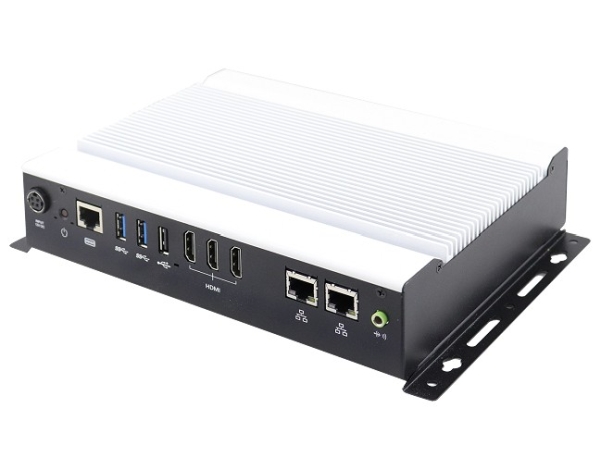
Its fanless construction is also significant for commercial installations. Removing a mechanical cooling fan can reduce moving parts and makes the unit easier to deploy in locations where space, noise, or routine maintenance may be concerns. Applications mentioned by IBASE include airports, shopping malls, restaurants, and other commercial spaces where digital menu boards, information screens, advertising, or wayfinding displays may need to operate for extended periods.
Simplifying Multi-Screen Digital Signage Management
The use of AMD’s Ryzen Embedded architecture is intended to give the SI-323-N enough processing and graphics capability for configurable multi-display signage rather than treating every connected screen as an identical output. AMD Eyefinity support is particularly relevant where an operator wants to arrange content across several displays or create different screen configurations from the same signage system.
For integrators, this can simplify system design because display processing is concentrated within a single embedded player. The practical value depends on the signage software and display configuration being used, but the hardware is designed to provide the flexibility needed for installations ranging from independent information screens to coordinated multi-display layouts.
Remote Monitoring and Display Reliability Features
The SI-323-N includes management functions intended to reduce the amount of manual attention required after a signage player has been installed. IBASE iCONTROL provides functions such as scheduled power control, automatic power recovery, and low-temperature boot protection, while the accompanying monitoring capabilities help operators check the condition of deployed displays.
Hardware EDID emulation addresses another practical signage problem. EDID is the information a display provides to a source device about supported resolutions and display capabilities. If a screen is disconnected, loses power, or is temporarily unavailable, a signage computer can sometimes lose the expected display configuration. Maintaining EDID information in hardware can help the player preserve its intended output settings and reduce configuration problems when displays reconnect.
The built-in display-status monitoring feature is especially useful for signage deployed across locations that are not continuously supervised. Rather than relying entirely on someone at the site to notice a failed or disconnected display, administrators can use monitoring information to identify potential display problems more efficiently.
Expansion Options for Connected Signage Systems
The player’s connectivity and expansion options allow the basic signage platform to be adapted to different deployment requirements. It includes DDR4 memory support, dual Gigabit Ethernet connections, Mini PCIe, an M.2 E-Key slot for wireless connectivity, and an M.2 M-Key slot for storage.
The Mini PCIe interface can accommodate options such as Wi-Fi, Bluetooth, 4G LTE, or a capture card, while the M.2 interfaces provide separate paths for wireless modules and storage. This flexibility can matter when Ethernet cabling is unavailable, cellular connectivity is required, additional local storage is needed, or a signage installation needs to receive an external video source.
Support for both Windows 10 IoT Enterprise and Ubuntu also gives system integrators a choice of operating environment rather than tying the hardware to a single software platform. Actual compatibility with a particular digital signage application would still depend on that application’s operating-system and hardware requirements.
SI-323-N Hardware and Deployment Capabilities
The SI-323-N combines its main signage functions with several features intended for commercial deployment:
- Three HDMI 2.0 outputs: Designed for three independently driven displays, with independent audio output support.
- AMD Ryzen Embedded R1000 SoC: Provides the system’s CPU and integrated graphics processing.
- Hardware EDID emulation: Helps preserve expected display information when screens are disconnected or temporarily unavailable.
- Display-status monitoring: Supports checking the operational state of connected displays.
- DDR4-2400 memory: Two SO-DIMM slots support dual-channel memory with a stated maximum capacity of 32GB.
- Mini PCIe expansion: Can be used for compatible Wi-Fi, Bluetooth, 4G LTE, or capture-card options.
- M.2 E-Key expansion: Provides another interface for compatible wireless modules.
- M.2 M-Key storage: Allows compatible M.2 storage to be installed.
- Fanless compact enclosure: Intended for installations where space and mechanical maintenance need to be minimized.
- iCONTROL management functions: Adds power scheduling, recovery, protection, and remote monitoring capabilities that can help manage deployed signage systems.
Read more: 3X 4K FANLESS DIGITAL SIGNAGE PLAYER POWERED BY AMD RYZEN EMBEDDED R1000 SOC
-
What processor powers the SI-323-N?
The player is based on the AMD Ryzen™ Embedded R1000 SoC with AMD Radeon™ Vega 3 Graphics. -
Does the device support multiple 4K displays?
Yes, it supports 4K @60Hz resolution for each of its three independent HDMI displays. -
How does the player manage multi-screen configurations?
It uses AMD's Eyefinity technology to eliminate programming complexity for different display setups. -
Can I remotely monitor and control the player?
Yes, IBASE iCONTROL enables remote monitoring, power scheduling, and automatic power recovery. -
What happens if a display cable is disconnected?
Hardware EDID prevents display problems caused by cable disconnection, unrecognized displays, or power interruption. -
Which operating systems are compatible with this player?
The SI-323-N works with both Windows 10 IoT Enterprise and Linux Ubuntu. -
What expansion interfaces are available on the device?
It includes Mini PCIe, M.2 E-Key for wireless functions, and M.2 M-Key for storage. -
Is the player designed for space-constrained environments?
Yes, it is a compact and fanless player suitable for airports, shopping malls, and restaurants.
