
Summary of 0 TO 5V OUTPUT ANALOG HALL SENSOR FOR FOOT CONTROLLER
This project utilizes a DRV5053 Hall Effect sensor and an LMV612 Op-Amp to create a non-contact analog position or angular sensing system. Designed for foot controllers and industrial pedals, it converts magnetic field changes into a 0–5V linear output. The circuit features adjustable offset and gain via trimmer potentiometers (PR1, PR2) and includes an RC filter for signal stability. Its high stability and wide sensing range make it ideal for applications requiring precise mechanical actuation control without physical wear.
Parts used in the Analog Hall Effect Foot Controller:
- DRV5053 Chopper-stabilized Hall IC Sensor
- LMV612 Low power RRIO Op-Amp
- Trimmer Potentiometer PR1 (Gain adjustment)
- Trimmer Potentiometer PR2 (Offset adjustment)
- Resistor R1
- Resistor R8
- Resistor R3
- Capacitor C4
- Dual-spring system actuator
This project includes an analog Hall Effect sensor and an Op-Amp circuit which can be used as position or angular sensing with the benefits of no contact and wearing, high stability and wide sensing range. Two configurations of the magnet and Hall sensors are analyzed. Trimmer Potentiometer PR2 provided to adjust the offset and PR1 helps to set the system gain. The Op-Amp circuit helps to achieve the desired output bias and range. The sensor provides an approximately linear response, adapt wide magnet types and field range. DRV5053 Sensor is the heart of the project. The DRV5053 device is a chopper-stabilized Hall IC that offers a magnetic sensing solution with superior sensitivity stability over temperature and integrated protection features. The project is useful for applications like Foot Controller, Industrial control stick, Industrial foot pedal, general position or angular sensing.
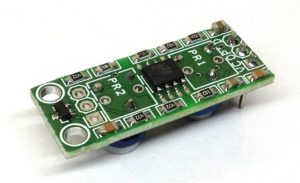
The output of DRV5053 is about 0.2V to 1.8V with the quiescent 1V at zero fields or no perpendicular flux to the sensing surface. In the non-linear configuration, the output range is limited either from 0.2V to 1V or from 1V to 1.8V. An Op-Amp stage is introduced in this design. It deals with the raw Hall sensor output signal with adjustable offset and scaling range. LMV612 op-amp used for signal conditioning. Actually, any fixed position along the full stroke of the magnet can be set as an offset point mechanically. When the relative position of the magnet and the Hall sensor is fixed at the designed offset point, the final output voltage can be adjustment by PR2. U1B is used as the amplitude amplifier stage with adjustable gain tuning by PR1. Also, there is an RC filter at the final output with R3 and C4. The actuator is fixed at a mid-point between the two ends of the stroke by a dual-spring system. Controlling by the foot, the actuator can go two sides of the stroke direction. The application requires the output to stay at about 1.1V when the actuator is at a balanced point (fixed offset point). When the foot strokes downside, the output goes from 1.1V down to ~0V. When the foot strokes upside, the output goes from 1.1V up to ~5V.
FEATURES
- Supply 5V DC
- Approximate linear response
- Adapt to wide magnet types and field range
- 0 to 5V full scale output ability
- Adjustable quiescent offset and gain
- Low power RRIO amplifier stage
- Cost-effective
- PCB Dimensions 32.09mm X 12.70MM
TUNING GUIDE
- Tuning PR2 for the designed fixed offset output
- Place the magnet to its MIN MAX stroke and tuning PR1 to get designed output range
- Release or return the fixed offset point, back to step 1 readjustment the offset point
- Back to step 2 to readjustment the offset output
- Repeat 1 to 4 steps to get both the designed offset the scaled output range.
- Note that the adjustment range of offset and scaling is also related to the mechanical magnet Configuration and the magnetic field. Do possible adjustment of the mechanical configuration if needed.
- The OpAmp parameters are also adjustable for special sensing range and output coverage. It is recommended to change R1 for extend offset adjustment ability and R8 for extend the gain range.
Read more: 0 TO 5V OUTPUT ANALOG HALL SENSOR FOR FOOT CONTROLLER
- What is the quiescent output voltage of the DRV5053 at zero fields?
The quiescent output is 1V when there is no perpendicular flux to the sensing surface. - How does the circuit adjust the offset point?
The offset is adjusted using Trimmer Potentiometer PR2 after mechanically fixing the magnet at the designed offset point. - Can this system provide a 0 to 5V full scale output?
Yes, the design achieves a 0 to 5V full scale output ability with the actuator at balanced, downside, and upside positions. - Which component is responsible for the amplitude amplification stage?
U1B serves as the amplitude amplifier stage with adjustable gain tuning by PR1. - What is the function of the dual-spring system in this project?
The dual-spring system fixes the actuator at a mid-point between the two ends of the stroke for balanced operation. - How can the gain range be extended in this design?
It is recommended to change resistor R8 to extend the gain range for special sensing requirements. - Does the sensor support wide magnet types?
Yes, the sensor adapts to wide magnet types and field ranges while providing an approximately linear response. - What is the purpose of the RC filter in the final output?
The RC filter composed of R3 and C4 is placed at the final output for signal conditioning.
