Summary of View noisy signals with a stable oscilloscope trigger
Summary: Noise on signals, including instrument noise, can prevent stable oscilloscope triggering—especially for millivolt-level signals. Effective trigger stability requires reducing noise on the incoming signal routed to the analog trigger circuit, not just post-ADC display processing. Display-focused techniques like averaging or High Resolution mode reduce shown noise but do not improve the trigger (averaging also fails for single-shot events). Oscilloscopes include built-in, sometimes hard-to-find, features to address triggering in noisy environments.
Parts used in theNoisey Signal Triggering Project:
- Oscilloscope (with analog trigger circuit)
- Signal source (millivolt-level or larger amplitude signals)
- Probe or input cabling
- Instrument settings/features: Averaging
- Instrument settings/features: High Resolution mode
Noise on a signal creates a triggering challenge for test equipment, especially oscilloscopes. Becuase the instrument itself also contributes noise, small signals in the millivolt range need proper instrument settings prevent noise from overwhelming the signal of interest. Even with larger-ampltude signals, noise can create a condition where a stable trigger is difficult to achieve.
Oscilloscope have built-in features to help deal with the noise. These features can sometimes be buried in menus, or not well known by infrequent oscilloscope users.
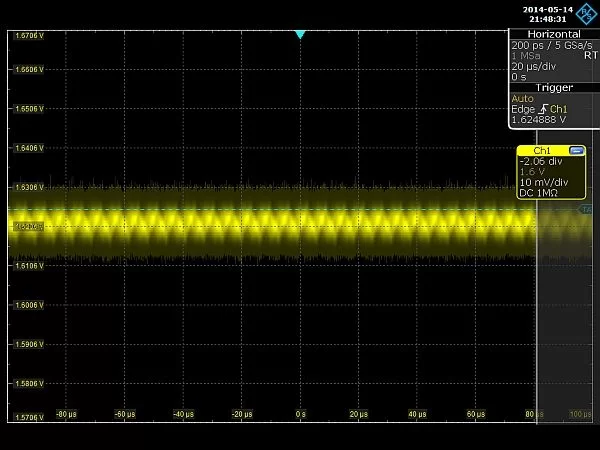
You should distinguish between simply suppressing and/or dealing with the displayed noise, and actually delivering a less noisy signal to the trigger circuit. Only the latter will create a stable trigger in these environments. Because oscilloscopes often route a small portion of the incoming electrical energy to a separate analog trigger circuit, any noise suppression techniques need to occur on the incoming signal, not the ADC processed or displayed signals. By triggering on post-ADC data, additional techniques for creating a stable trigger in noise become possible.
Suppressing noise
Common techniques for dealing with noise utilize averaging and/or using High Resolution mode. Averaging, which works on repetitive data only, is effective at combining data points from multiple acquisitions to reduce the displayed noise. Because this is a displayed data technique, it won’t suppress noise to the trigger circuit, and thus won’t create a stable trigger. Averaging won’t work on a single-shot event.
For more detail: View noisy signals with a stable oscilloscope trigger
- Why does noise prevent a stable oscilloscope trigger?
Noise on the incoming signal can mask the trigger threshold because the trigger circuit receives the noisy input, making it hard to detect the intended event. - Can averaging create a stable trigger in noisy signals?
No. Averaging reduces displayed noise but works on post-ADC displayed data and does not suppress noise sent to the analog trigger circuit. - Does High Resolution mode stabilize triggering?
No. High Resolution mode is a display technique and does not reduce noise reaching the analog trigger circuit, so it will not create a stable trigger by itself. - How can you create a stable trigger in a noisy environment?
By suppressing noise on the incoming signal before it reaches the analog trigger circuit so the trigger receives a cleaner signal. - Will display-only noise suppression help single-shot events?
No. Display techniques like averaging do not work for single-shot events and do not affect the trigger circuit. - Where are oscilloscope features for noise handling typically found?
They are built into oscilloscopes but can be buried in menus or unfamiliar to infrequent users. - Should trigger techniques operate on post-ADC data or the incoming signal?
To achieve a stable hardware trigger, techniques must operate on the incoming signal; triggering on post-ADC data enables other software-based approaches but is different from analog trigger suppression.