


Summary of Strobe Lights Project
Summary (under 100 words): The project creates stroboscopic nightclub lighting by rapidly switching old white LEDs on and off using an 8051 microcontroller driving MOSFETs via a switching transistor. Power is supplied from a 230V to 12V step-down transformer, rectified and filtered to DC, then regulated to +5V with a 7805 for the microcontroller and circuitry. The fast ON/OFF control produces the strobe effect on LED arrays for dance-floor lighting.Parts used in the Strobe Lights Project:
- Old white LEDs (LED array)
- 8051 family programmable microcontroller
- MOSFET (for driving LED groups)
- Switching or interfacing transistor (between microcontroller and MOSFET)
- 230V to 12V step-down transformer
- Bridge rectifier
- Capacitive filter (smoothing capacitor)
- 7805 voltage regulator (+5V regulator)
- Power supply wiring and connectors
Stroboscopic effects of lights for nightclubs are realized by bringing into play old white Light Emitting Diodes (LEDs) swapping the ejection lanterns/lamps for superior effectiveness at minimal cost. This control is achievable by instantaneously changing the Light Emitting Diodes on & off at elevated volts for small amount of time span. This speedy control of power from complete shine to complete off aids in creating a stroboscopic outcome which is commonly bring into play in discotheque dance floorboards for improved effects.
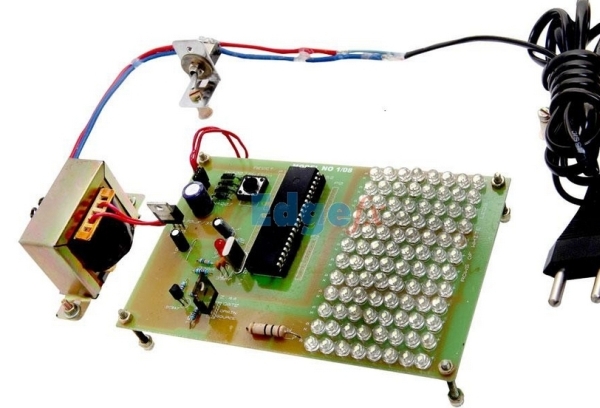 8051 family’s programmable micro-controller is fit into placed to give such effect being motivated by a MOSFET for group of Light Emitting Diodes. The microcontroller as per schedule produces ON/OFF commands at lofty rate as a result providing the stroboscopic effect of lights. Since the controller provides merely 5volts drive, it’s not achievable for the MOSFET to be constantly be switched ON at that high voltage. A crossing point transistor is made use of amid the controller productivity and the MOSFET for driving the same.
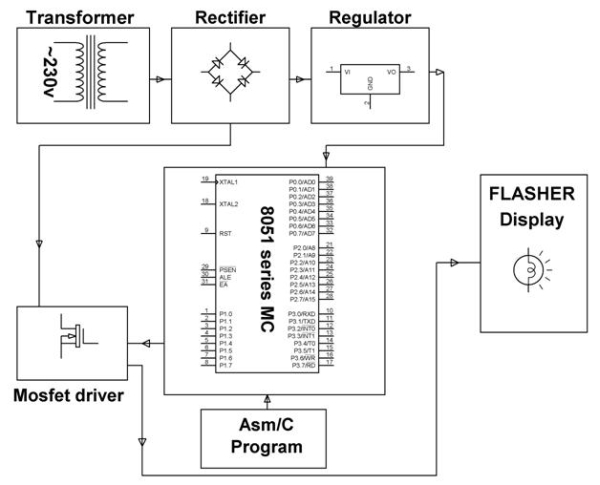 The power delivery comprises of a 230/12V step down transformer, this transformer steps down the volt to 12V AC. This is transformed to DC by means of a Bridge rectifier. The ripples are detached by means of a capacitive filter and it’s then synchronized to +5Volts by means of a voltage controller 7805 which is necessary for the functioning of the micro-controller and additional gears.
For more detail: Strobe Lights Project
Quick Solutions to Questions related to the Strobe Lights Project:
- How is the stroboscopic effect produced?
By instantaneously switching LEDs on and off at a high rate using the 8051 microcontroller, creating rapid transitions from full light to off. - Can old white LEDs be used for strobe lights?
Yes, old white LEDs are used by replacing existing lamps for improved effectiveness at minimal cost. - What role does the 8051 microcontroller play?
The 8051 generates scheduled high-rate ON/OFF commands to produce the stroboscopic lighting effect. - Why is a transistor used between the microcontroller and MOSFET?
Because the microcontroller provides only 5 volts drive, a switching transistor is used between the controller and MOSFET to enable proper MOSFET switching at higher voltages. - How is the power supply configured?
Power uses a 230V to 12V step-down transformer, bridge rectifier, capacitive filter, and a 7805 regulator to provide stabilized +5V. - What is the purpose of the 7805 regulator?
The 7805 provides the regulated +5V necessary for the microcontroller and other electronics. - Does the project require AC to DC conversion?
Yes, the 12V AC from the transformer is converted to DC with a bridge rectifier and smoothed with a capacitive filter. - What component drives groups of LEDs?
The MOSFET is used to drive groups of LEDs under control of the microcontroller via the switching transistor.
Related projects
An Application-Driven Microcontroller Curriculum
Understanding how to apply microcontrollers lies at the core of modern embedded systems education. This student project takes an experiential approach to...
LED ProjectsBuild this microcontroller controlled rainbow flying disc – and then throw it!
Hello all and welcome to this super simple and inexpensive instructable. If you like throwing frisbees AND you like flashing lights AND...
LED ProjectsLED Scrolling Display Project Working With Circuit Diagram
We normally use a simple static LED display screen to convey a message. Earlier, when we want to display large data, we...
LED Projects8051 MICROCONTROLLER
8051 Microcontroller based electronic locker system CIRCUIT DESCRIPTION Security is a prime concern in our day-today life. Everyone wants to be as...
LED ProjectsDigital Temperature Sensor Circuit
Temperature sensors are widely used in electronic equipments to display the temperature. You can see the digital clock displaying the room temperature...
LED ProjectsPassword Based Door Lock System using 8051 Microcontroller
Traditional lock systems using mechanical lock and key mechanism are being replaced by new advanced techniques of locking system. These techniques are...

Ibrar Ayyub
I am an experienced technical writer holding a Master's degree in computer science from BZU Multan, Pakistan University. With a background spanning various industries, particularly in home automation and engineering, I have honed my skills in crafting clear and concise content. Proficient in leveraging infographics and diagrams, I strive to simplify complex concepts for readers. My strength lies in thorough...