Summary of SPARKFUN LORA GATEWAY MODULE BOOSTS THE CAPABILITIES WITH ESP32 MCU
This article compares SparkFun’s new LoRa Gateway 1-Channel (ESP32) module to its predecessor, noting the main upgrade is an ESP32-WROOM-32 MCU with 16 MB flash (vs 4 MB). It explains LoRa is a modulation technology used by LoRaWAN, highlights the module’s support for Wi-Fi and Bluetooth via the ESP32, and the RFM95W LoRa modem operating at 868/915 MHz for long-range communication. The article concludes the new module offers expanded capabilities without a price increase.
Parts used in the LoRa Gateway 1-Channel (ESP32) module:
- ESP32-WROOM-32 MCU (with 16 MB flash)
- RFM95W LoRa modem
- Wi-Fi capability (provided by ESP32)
- Bluetooth capability (provided by ESP32)
We have covered several LoRaWAN Gateway modules, with one of the latest being the Seeed Studio’s WM1302. However, for those who don’t know much about wireless communication protocols, then LoRaWAN and LoRa are two different things and are not interchangeable.
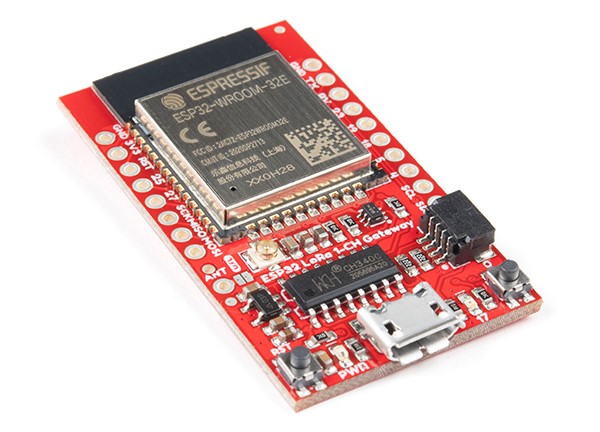
To understand in short, LoRa is a non-cellular modulation technology for LoRaWAN. One of the recently manufactured LoRa Gateway modules was developed by SparkFun based on the ESP32-WROOM-32 MCU.
Just as other similar modules, even this has a minimalistic hardware design and has the same form factor as the previous versions. If you have used the predecessor WRL-15006 ROHS that is LoRa Gateway – 1 -Channel (ESP32) module. In that case, you won’t find any specific difference between the modules, except the updated module has MCU with 16 MB flash memory than 4 MB. However, if you aren’t looking for more flash memory for your application, there is no need to upgrade as the cost of this new product is the same as the old one. This might be a good deal for a designer who has not used the SparkFun LoRa Gateway module and is looking for one to aid in their application.
Looking at the specifications, you will notice that as expected from any LoRa Gateway module, this one also supports Wi-Fi and Bluetooth wireless communication protocol. Thanks to the integrated MCU that has provided the module with wide capabilities that you can explore. Apart from these wireless communication protocols, the module primarily has an RFM95W LoRa modem that operates in the range of 868/915 MHz frequency and is designed for ultra-long range spread spectrum communication based applications.
“The LoRa Gateway 1-Channel is a monster 3-network capable device thanks to an ESP32 module and an RFM95W LoRa modem. The RFM95W handles the 915 MHz band while the ESP32 takes care of bluetooth and WiFi.
Read more: SPARKFUN LORA GATEWAY MODULE BOOSTS THE CAPABILITIES WITH ESP32 MCU
- What is the main difference between the new SparkFun module and the predecessor WRL-15006?
The new module uses an ESP32-WROOM-32 MCU with 16 MB flash instead of 4 MB in the predecessor. - Does the new module support Wi-Fi and Bluetooth?
Yes, the module supports Wi-Fi and Bluetooth via the integrated ESP32 MCU. - What frequency does the RFM95W LoRa modem operate on?
The RFM95W operates on the 868/915 MHz frequency range. - Is LoRa the same as LoRaWAN?
No, LoRa is a non-cellular modulation technology used for LoRaWAN; they are different. - Is there a cost increase for the updated module with more flash memory?
No, the article states the cost of the new product is the same as the old one. - Does the module retain the same form factor as previous versions?
Yes, it has a minimalistic hardware design and the same form factor as previous versions. - Who handles Bluetooth and Wi-Fi functions on the module?
The ESP32 MCU handles Bluetooth and Wi-Fi functions. - What type of applications is the RFM95W designed for?
It is designed for ultra-long range spread spectrum communication based applications.