


Summary of PIC – First Project
This article explains programming PIC microcontrollers using Embedded C and the MikroC IDE. It details creating a hex file, using a Pickit2 programmer to burn code, and specific setup steps like running as administrator and configuring clock speeds. The process involves writing code in MikroC, building the project to generate a hex file, connecting hardware via USB with necessary drivers, and using the Pickit2 software to import and write the program to the chip.Parts used in the PIC Microcontroller Programming Project:
- PIC Microcontroller
- MikroC Compiler from Mikroelektronika
- MPLAB IDE (Optional integration)
- Pickit2 Programmer
- Pickit3 Programmer (for latest devices)
- Computer with USB connection
- PL2303 Driver
- 20 MHz Crystal Oscillator
- .hex File
Programming in PIC microcontroller can be done by using assembly language or by using Embedded C because of the ease of writing code.We have used done the programming through Embedded C language.For programming any microcontroller we need a IDE or Intregrated Developement Enviroment. In case of PIC microcontroller the official IDE is MPLAB Further several third parties develop C language compilers for PICs, many of which integrate to MPLAB or feature their own IDE.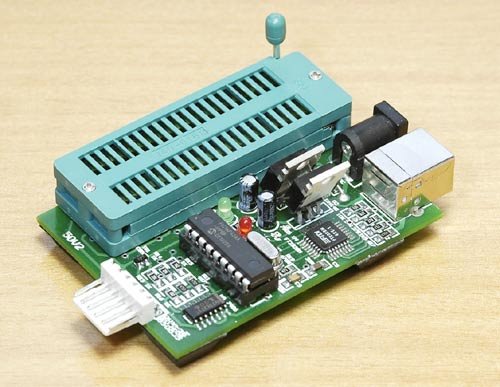 A fully featured compiler for the PICBASIC language to program PIC microcontrollers is available from meLabs, Inc. Mikroelektronika offers PIC compilers in C.For the tutorial given on this website we have used MikroC, a PIC C compilers from Mikroelektronika.The reason we used MikroC is because of its simplicity then again its my opinion.When we build any program, a hex file is created. A hex file is a format used to store machine language code in hexadecimal form. After creating the hex file , we use a programmer to burn the code onto the microcontroller for that we use Pickit2 programmer[for latest devices Pickit 3].The software can be downloaded from here
Steps for using MikroC IDE
Run MikroC as administrator as shown in the figure [Note: MikroC and MikroC pro for PIC are different compilers.We have used MikroC in all our tutorials for PIC. Please don’t confuse it with MikroC pro].
A sub window will open .Implement the following things in it
- Give a name to your Project [ Please don’t use names that are exactly same as the functions used in MikroC such as ‘main‘ or ‘for‘ ]
- Select a suitable location[Please don’t select desktop or my documents locations. Save inside a specific folder]
- Select the device for which you want to write the code
- Write down the value of clock in your hardware [I have used 20 MHz crystal oscillator thats why i wrote 20.000000]
- Click on “Default” and Click on “OK“
- Now a workspace will be created. Write your program in that area.
- After completing your program, save it and click on the build icon as shown in the figure
- If your program has no error then compiler will display a success message in the compiler messages area as shown in the figure above else the error messages will be displayed.Fix those errors(if any)
- Hex file successfully created.


Steps to write your program to PIC microcontroller
Connect your PIC microcontroller to the PIC programmer.
- Connect your PIC programmer to your computer.If you are connecting through your USB, you must first install this driver: PL2303
- Download and Open Pickit 2 programmer software[Download Link].
- If the device name is mentioned as shown in the figure below then it is successfully connected .If not then check your connection and the programmer again.
- Go to “File” in the menu and click on “Import Hex” and then go to the location where you have saved your MikroC project and select the .hex file associated with your MikroC project.
- After importing the .hex file change the VDD PICkit 2 value to “5.0” and click on “Write” as shown in the figure.
For more detail: PIC – First Project
Quick Solutions to Questions related to PIC Microcontroller Programming:
-
What language is used for programming PIC microcontrollers in this tutorial?
Embedded C language is used because of the ease of writing code. -
Which compiler was selected for this tutorial and why?
MikroC from Mikroelektronika was chosen due to its simplicity. -
What is a hex file created during the compilation process?
A hex file is a format used to store machine language code in hexadecimal form. -
How should you run the MikroC IDE to start a project?
You must run MikroC as an administrator. -
Where should you save your project files according to the instructions?
Save inside a specific folder and do not select desktop or my documents locations. -
What driver is required if connecting the programmer through USB?
You must first install the PL2303 driver. -
What value should be set for VDD in the Pickit2 software before writing?
The VDD value should be changed to 5.0. -
What step confirms the device is successfully connected to the programmer?
The device name being mentioned in the software window indicates successful connection.
Related projects
Download Legacy MPLAB IDE 8 from Microchip
The original MPLAB® IDE 8 series is still relevant when maintaining older PIC® and dsPIC® projects that were created before MPLAB X...
IDEs & CompilersHow to Download MPLAB X IDE Safely
MPLAB® X IDE is used for developing, building, debugging and programming embedded applications across several Microchip device families. For an active firmware...
IDEs & CompilersDownload MPLAB IDE v8.92 from Microchip
MPLAB® IDE v8.92 belongs to the final generation of the original MPLAB IDE 8 development environment. It still appears in older PIC®...
IDEs & CompilersSoftware UART (SoftUART) using TMS320F28027 Piccolo with Proteus Simulation
IntroductionCreating reliable serial communication without a hardware UART might sound tricky, but this SoftUART project proves how flexible embedded systems can be....
IDEs & CompilersMastering PIC 24F Series: A Comprehensive Guide with MPLAB and Proteus
Introduction The field of embedded systems plays a crucial role in modern society, with a myriad of applications across various sectors such...
IDEs & CompilersDigital Clock using PIC Microcontroller Interrupt – XC8
A Real Time clock (Digital Clock) can be made easily by using Timer 1 of a PIC Microcontroller. The Timer1 module exists...

Ibrar Ayyub
I am an experienced technical writer holding a Master's degree in computer science from BZU Multan, Pakistan University. With a background spanning various industries, particularly in home automation and engineering, I have honed my skills in crafting clear and concise content. Proficient in leveraging infographics and diagrams, I strive to simplify complex concepts for readers. My strength lies in thorough...