
Summary of NEW GRAPHENE HALL EFFECT SENSOR TO IMPROVE ACCURACY AND PRECISION IN MAGNETIC MEASUREMENT APPLICATIONS
Paragraf, a Cambridge-based startup, has partnered with CERN to deploy graphene-based Hall effect sensors for high-precision magnetic field measurements. These sensors eliminate false signals caused by the planar Hall effect found in traditional devices due to their atomically thin, two-dimensional graphene composition. They operate across extreme temperatures from +80°C down to 1.5 Kelvin, enabling accurate mapping inside superconducting magnets using liquid helium. This technology supports advanced harmonic content analysis and is currently available to lead partners for further testing in novel mapping systems.
Parts used in the Paragraf Graphene Hall Effect Sensor Project:
- Graphene-based Hall effect sensors
- Atomically thin graphene sensing component
- Rotating shaft for sensor stack mounting
- Superconducting magnets
- Liquid helium cooling system
The Cambridge-based startup, Paragraf has collaborated with the Magnetic Measurement section at CERN to demonstrate the potential of graphene-based Hall effect sensors to improve accuracy in magnetic measurement applications. Overcoming the shortfalls of existing Hall effect sensors that exhibit planar Hall effects that produce false signals, Hall effect Sensor from Paragraf truly senses magnetic fields along one direction giving a negligible planar Hall effect. This is because the active sensing component of the Hall effect Sensor from Paragraf is made of atomically thin graphene which is two-dimensional. This enables the true perpendicular magnetic field value to be obtained, allowing for higher precision mapping of the local magnetic field.
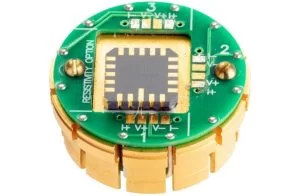
Opening the door to a new mapping technique by mounting a stack of sensors on a rotating shaft, Hall effect sensors without planar effect indeed will be the preferable option. Measurements of the harmonic content in accelerator magnets almost point-like along the magnet axis would be the added advantage. Wide temperature range from +80°C down to cryogenic temperatures of 1.5 Kelvin is one of the key properties of the Paragraf Hall effect sensor.
With this major step, CERN would be able to measure the fields inside the superconducting magnets with high accuracy. This could be done using sensors operating in liquid helium temperature ranges (below -269 °C, 4 Kelvin, -452 °F) where the calibration of sensors is less than trivial. CERN’s Magnetic Measurement section is planning to perform more in-depth tests on the Hall effect sensors to eventually use them in building a novel mapping system for magnetic fields. Currently, the Paragraf’s graphene Hall effect sensors are available to lead partners in small volumes.
-
How do Paragraf Hall effect sensors improve accuracy?
They use atomically thin graphene to sense magnetic fields along one direction, eliminating the planar Hall effect that produces false signals. -
What temperature range can these sensors operate in?
The sensors function across a wide range from +80°C down to cryogenic temperatures of 1.5 Kelvin. -
Can these sensors measure fields inside superconducting magnets?
Yes, they allow CERN to measure fields inside superconducting magnets with high accuracy. -
Why are these sensors preferable for rotating shaft applications?
Hall effect sensors without a planar effect are ideal for mounting stacks on rotating shafts to open new mapping techniques. -
What advantage do these sensors offer regarding harmonic content?
They provide added advantages in measuring harmonic content in accelerator magnets almost point-like along the magnet axis. -
Is calibration difficult at liquid helium temperatures?
Calibration of sensors at liquid helium temperature ranges below -269 °C (4 Kelvin) is noted as less than trivial. -
Are the sensors currently available for general purchase?
No, the sensors are currently available only to lead partners in small volumes.