
Summary of MIDI-Controlled Analog Music Synthesizer
This article details a senior electrical engineering project: a MIDI-controlled analog music synthesizer. The initial design utilized two voltage-controlled pulse oscillators (VCOs) and a PIC microcontroller with a digital-to-analog converter for control. A later revision added a voltage-controlled amplifier (VCA) to create a monophonic unit. While the current version supports one-volt-per-octave scaling, tuning issues in upper octaves remain pending resolution.
Parts used in the MIDI-Controlled Analog Music Synthesizer:
- Alesis Q25 MIDI keyboard
- Voltage-controlled pulse oscillators (VCOs)
- PIC microcontroller
- Digital to analog converter (DAC)
- Control voltage (CV) circuitry
- Voltage-controlled amplifier (VCA)
For my electrical engineering senior design project, I decided on designing a analog music synthesizer with MIDI control. I have to admit, this was what I wanted to do since high school and was my ultimate goal as a musician, artist, DIY person, and engineer. This project, in the end, will combine all of my knowledge into one nice little package that I get to show off to friends, family, and faculty and is to be completed by the end of this year.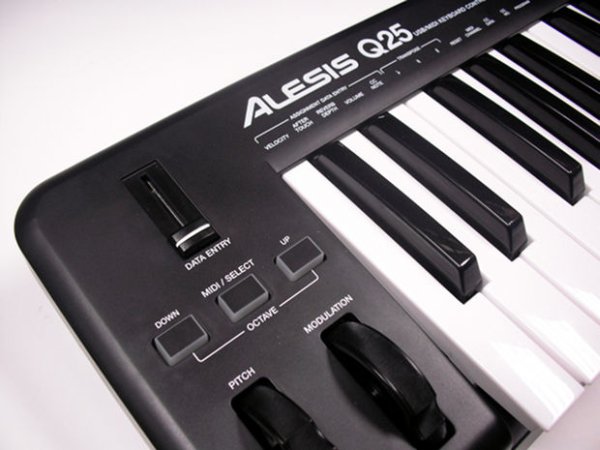
The first image is the Alesis Q25 MIDI keyboard I purchased to test with.
The second, third, and fourth images are of one of the initial synth implementations.
The initial design features two voltage-controlled pulse oscillators (VCOs) scaled at one volt per octave. MIDI control is done with a PIC microcontroller that receives data and outputs it to a digital to analog converter (DAC). The voltage from the DAC is used as a control voltage (CV) for the oscillators. Velocity has not been implemented in this version and the last note played is always heard at output.
The fifth image is our current revision. It features the addition of a voltage-controlled amplifier (VCA). With this version, we now have a MIDI-controlled monophonic synthesizer. It is not in the video.
I’ll add another video of the most recent revision as soon as I get back into the lab.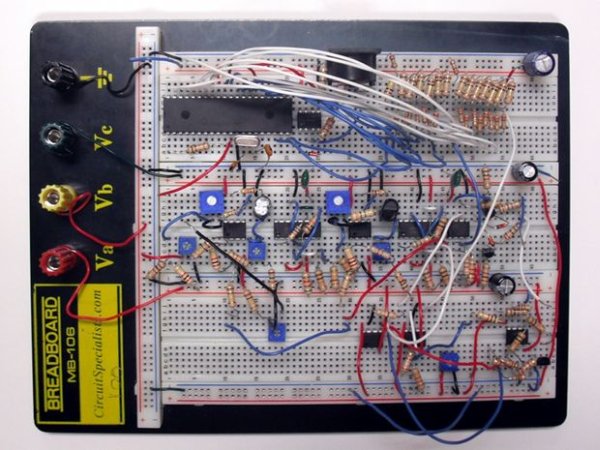
Tuning is an issue in the upper octaves, as demonstrated in the video, but will be fixed soon. The video demonstrates the operation of the one volt per octave scaling and MIDI control with the keyboard. Please post any comments about my project or ideas of what should be added in future revisions. Thanks! 😀
Update (8.25.2015)
Sorry everyone, I never got around to documenting
For more detail: MIDI-Controlled Analog Music Synthesizer
- What is the main goal of this electrical engineering project?
The goal is to design an analog music synthesizer with MIDI control that combines knowledge from high school interests into a single package. - How does the MIDI control function in the initial design?
A PIC microcontroller receives MIDI data and outputs it to a digital to analog converter which provides control voltage for the oscillators. - Does the first version of the synthesizer support velocity sensitivity?
No, velocity has not been implemented in this version and the last note played is always heard at output. - What major component was added in the current revision?
A voltage-controlled amplifier (VCA) was added to enable MIDI-controlled monophonic synthesis. - Is the VCA feature demonstrated in the provided video?
No, the VCA feature is present in the hardware but is not included in the video demonstration. - What specific tuning issue is currently affecting the device?
Tuning is an issue in the upper octaves, though the one volt per octave scaling operation is working correctly. - When is the project scheduled to be completed?
The project is intended to be completed by the end of the year.
