
Summary of MEET THE NEXT-GEN LITHIUM-SULFUR BATTERIES
This article discusses a breakthrough in lithium-sulfur battery technology developed by researchers at Monash University. By using sulfur cathodes instead of graphite, these batteries offer five to six times the storage capacity of standard lithium-ion batteries at a lower cost due to sulfur's abundance. The team solved the issue of rapid performance degradation caused by electrode expansion during charging, enabling hundreds of stable charge-discharge cycles.
Parts used in the Lithium-Sulfur Battery Project:
- Sulfur cathodes
- Graphite (for comparison)
- Lithium-ion battery components
- Binder across the electrodes
- Sulfur electrodes
What would you give for a battery, 5x the storage capacity of whatever you’re reading from? Well, the countdown to commercial availability for batteries of this type of capacity has already begun and it would be considerably cheaper than then currently available batteries.
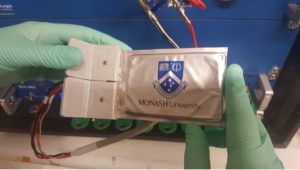
This radical improvement comes from using sulfur cathodes rather than graphite in lithium-ion batteries. Sulfur ranks high on the list of very abundant materials and is relatively cheap to produce unlike rare minerals like cobalt used to produce regular lithium-ion batteries. So why didn’t anyone think of this until now?
Actually, it’s pretty well known that lithium-sulfur batteries can store far more energy than their lithium-ion counterparts, six-times in theory. However, the battery’s performance degrades quite rapidly due to its high storage capacity (That’s six times the stress—pretty understandable), as the sulfur cathode is nearly double its usual size when the battery is fully charged which destroys electron paths in the binder across the electrodes. As a result of this, repeated charging and discharging lead to rapid deterioration of the batteries’ performance.
Solving this problem was the goal of a research team at Monash University led by Mahdokt Shaibani, and their efforts have led to the development of a new technique for processing lithium-sulfur batteries that allows them to undergo hundreds of charge-discharge cycles without breaking down. Attaining a level of stability that is already being considered as a huge breakthrough in battery technology.
The team’s technique involved tweaking the process of making lithium-ion batteries just a little differently so that the binder across the electrodes can accommodate the expansion of the sulfur electrodes. In an article published to explain their work, Mahdokt Shaibani said:
Read more: MEET THE NEXT-GEN LITHIUM-SULFUR BATTERIES
- How much more storage capacity do these new batteries have?
They can store up to six times more energy than lithium-ion counterparts. - Why is this battery type cheaper to produce?
Sulfur is abundant and relatively cheap compared to rare minerals like cobalt. - What problem did previous lithium-sulfur batteries face?
Performance degraded rapidly because the sulfur cathode expanded and destroyed electron paths. - Who led the research team that solved this issue?
The team was led by Mahdokt Shaibani at Monash University. - How many cycles can the new batteries withstand?
They can undergo hundreds of charge-discharge cycles without breaking down. - Does the size of the sulfur electrode change during use?
Yes, it becomes nearly double its usual size when fully charged. - What technique did the team use to solve the expansion issue?
They tweaked the manufacturing process so the binder can accommodate electrode expansion.