
Summary of Low Power NTSC/PAL/SECAM Video Decoder with Differential CVBS Inputs
The TW9990 is a low-power video decoder chip designed for automotive applications, supporting NTSC, PAL, and SECAM standards with automatic format detection. It features dual 10-bit ADCs, programmable gain control, adaptive comb filtering, and digital output compatible with ITU-R 601/656 YCbCr formats. The chip operates on 1.8V analog/digital power and 3.3V I/O power, requiring only a single 27MHz crystal.
Parts used in the TW9990 Project:
- TW9990 Video Decoder Chip
- Single 27MHz Crystal
- Analog Anti-alias Filter
- Dual 10-bit ADCs
- Analog Clamping Circuit
- Chroma IF Compensation Module
Key Features
- Video Decoder
- NTSC (M, 4.43) and PAL (B, D, G, H, I, M, N, N combination), PAL (60), SECAM support with automatic format detection
- Software selectable analog input control allows for combinations of single ended CVBS, differential CVBS, and S-Video
- Built-in analog anti-alias filter
- Two 10-bit ADCs and analog clamping circuit
- Fully programmable static gain or automatic gain control for the Y channel
- Programmable white peak control for the Y channel
- 4-H adaptive comb filter Y/C separation
- PAL delay line for color phase error correction
- Image enhancement with peaking and CTI.
- Digital sub-carrier PLL for accurate color decoding
- Digital Horizontal PLL for synchronization processing and pixel sampling
- Advanced synchronization processing and sync detection for handling non-standard and weak signal
- Programmable hue, brightness, saturation, contrast, and sharpness.
- Automatic color control and color killer
- Chroma IF compensation
- VBI slicer supporting industrial standard data services
- VBI data pass through, raw ADC data output
- Programmable output cropping
Digital Output
- ITU-R 601 or ITU-R 656 compatible YCbCr (4:2:2) output format
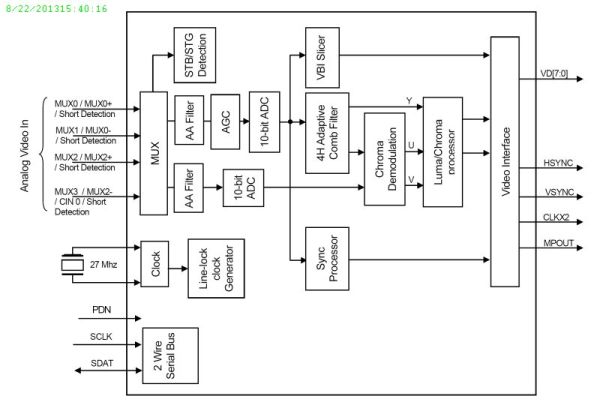
The TW9990 is a low power NTSC/PAL/SECAM video decoder chip that is designed for automotive applications. It supports both single-ended and differential composite video as well as S-Video. Typical power consumption is 110mW for composite input applications, and the available power down mode further reduces power consumption. It uses 1.8V for both analog and digital supply voltage and 3.3V for I/O power. A single 27MHz crystal is all that is needed to decode all analog video standards.
For more detail: Low Power NTSC/PAL/SECAM Video Decoder with Differential CVBS Inputs
- What video standards does the TW9990 support?
The chip supports NTSC (M, 4.43), PAL (B, D, G, H, I, M, N, N combination, 60), and SECAM with automatic format detection. - Can the TW9990 handle both single-ended and differential inputs?
Yes, it allows software selectable combinations of single-ended CVBS, differential CVBS, and S-Video. - What is the typical power consumption for composite input?
Typical power consumption is 110mW for composite input applications. - Does the chip require multiple crystals for different standards?
No, a single 27MHz crystal is all that is needed to decode all analog video standards. - What voltage levels are required for operation?
The device uses 1.8V for both analog and digital supply voltage and 3.3V for I/O power. - How does the chip handle synchronization processing?
It uses advanced synchronization processing and sync detection specifically designed for handling non-standard and weak signals. - What output format does the TW9990 provide?
It provides ITU-R 601 or ITU-R 656 compatible YCbCr (4:2:2) output format. - Is there a feature to reduce power further than the typical mode?
Yes, an available power down mode further reduces power consumption.