Summary of LIMESDR MINI – SOFTWARE-DEFINED-RADIO CARD
The LimeSDR Mini is a compact, affordable complement to the original LimeSDR, sharing the same LMS7002M transceiver but offering two channels instead of four. It features SMA connectors and runs on the established LimeSDR ecosystem. The board includes an Altera MAX 10 FPGA, USB 3.0 connectivity, and various GPIO headers. An optional acrylic enclosure is available for protection.
Parts used in the LimeSDR Mini:
- Lime Microsystems LMS7002M RF transceiver
- Altera MAX 10 FPGA (10M16SAU169C8G)
- USB 3.0 Type-A connector with FTDI FT601 controller
- SMA coaxial RF connectors
- U.FL connector for external clock source
- 30.72 MHz onboard VCTCXO
- Dual color LED indicators
- FPGA GPIO pinheaders
- FPGA JTAG connector
- Custom acrylic enclosure
LimeSDR vs LimeSDR Mini
The LimeSDR and LimeSDR Mini are members of the same family of software-defined radios. One does not replace the other. Rather, they are complementary.
Simply put, the LimeSDR Mini is a smaller, less expensive version of the original LimeSDR. However, it still packs a punch – at its core, the LimeSDR Mini uses the same LMS7002M radio transceiver as its big sibling. The Mini has two channels instead of four, and, by popular demand, SMA connectors instead of micro U.FL connectors. Check out the comparison table below for more details.
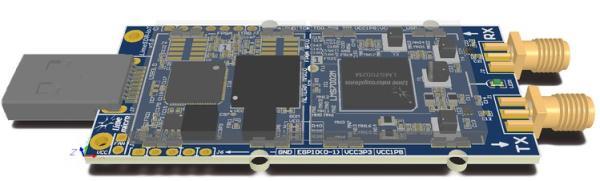
We’ve already shipped thousands of LimeSDR boards and they are now available for purchase from stock. The LimeSDR Mini is built on the LimeSDR supply chain, dev tools, and community in a way that makes software-defined radio more accessible than ever.
Features & Specfications
- RF transceiver: Lime Microsystems LMS7002M
- FPGA: Altera MAX 10 (10M16SAU169C8G)
- 169-pin FBGA package
- 16 K Les
- 549 KB M9K memory
- 2,368 KB user flash memory
- 4 x fractional phase locked loops (PLLs)
- 45 x 18×18-bit multipliers
- 130 x general purpose input/output (GPIO)
- Single supply voltage
- Flash feature
- FPGA configuration via JTAG
- EEPROM memory: 2 x 128 KB for RF transciever MCU firmware and data
- Flash memory: 1 x 4 MB flash memory for data
- General user inputs/outputs:
- 2 x dual color (red + green) LED
- 8 x FPGA GPIO pinheader (3.3 V)
- Connectivity:
- USB 3.0 Type-A (FTDI FT601 controller)
- 2 x coaxial RF (SMA) connectors (each can be switched between high and low frequency bands)
- U.FL connector for external clock source
- FPGA GPIO headers
- FPGA JTAG connector
- Clock system:
- 30.72 MHz onboard VCTCXO
- Possibility to tune VCTCXO with onboard DAC
- External clock input via U.FL connector
- Board dimensions: 69 mm x 31.4 mm
Accessories
In addition to the LimeSDR Mini iteself, we’re also offering a few accessories.
Enclosure
We’ve designed a custom acrylic enclosure to protect your LimeSDR Mini and make it easy to throw it into your pocket or bag without worrying about damaging the board.
Read More: LIMESDR MINI – SOFTWARE-DEFINED-RADIO CARD
- What is the main difference between the LimeSDR and LimeSDR Mini?
The Mini has two channels instead of four and uses SMA connectors instead of micro U.FL connectors. - Does the LimeSDR Mini use the same radio transceiver as the original?
Yes, it uses the same Lime Microsystems LMS7002M radio transceiver at its core. - Can I use an external clock source with the LimeSDR Mini?
Yes, you can connect an external clock source via the U.FL connector. - What type of FPGA is included in the LimeSDR Mini?
The board features an Altera MAX 10 FPGA with a 169-pin FBGA package. - How many general purpose input/output pins are available?
The device provides 130 general purpose input/output pins plus 8 dedicated FPGA GPIO pinheaders. - Is there an enclosure available for the LimeSDR Mini?
A custom acrylic enclosure is designed to protect the board and make it portable. - What kind of memory does the LimeSDR Mini have?
It includes EEPROM memory for firmware and 4 MB of flash memory for data storage. - Does the LimeSDR Mini support high and low frequency bands?
Yes, the two coaxial RF connectors can be switched between high and low frequency bands.