


I can't take credit for the design of this one. I bought the
gear as a clock a few years ago. It was mounted on a frame
and had one of those cheap clock units running it. The
gear is designed to be driven by the minute-hand shaft of
the clock mechanism.
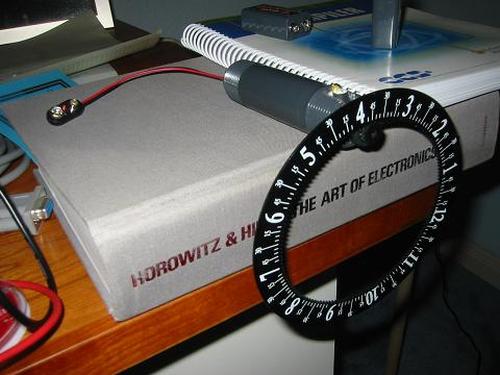
The problem was that it kept breaking. I think the problem
was that the clock mechanism wasn't strong enough to hold
the weight of the gear.
I bought a stepper motor with four input wires. A PIC
16F676 microcontroller functions as the timer. Every
three minutes, four output pins are driven either high
or low for half a second. These are each connected to
a pair of transistors - one PNP, one NPN to drive the
motor with more current. The stepper motor rotates 18
degrees each time.
For more detail: Gear Clock using PIC16F676 Microcontroller
Related projects
30 volts Panel Volt Meter Using PIC MCU
This is a simple application of internal 10-bit ADC(analog to digital converter) of PIC16F676 microcontroller.you can use this circuit to measure up...
Audio, Sound & Radio · PIC16F676Shrieker using PIC16F676 Microcontroller
Recently a cell phone ring tone was in the news - it's 17,000 Hertz and meant to be heard by teenagers, but...
Sensors & Temperature · PIC16F676Temperature Indicator using PIC microcontroller
Hi friends, today we will see how to make temperature indicator using PIC microcontroller. The basic aim of this project is make...
Clocks & TimersAdaptive Alarm Clock: Build a Smart, User-Centric wake-Up system
Project Overview The goal of this ambitious undergraduate project was to develop a novel alarm clock capable of analyzing a person's unique...
Clocks & TimersDesigning Your Ideal Alarm Clock: An Introduction to PIC18
Within this laboratory session, you'll employ the C language to create an alarm clock, delving into the implementation of "C" programs on...
Clocks & TimersBuilding your Dream Alarm Clock Using the PIC18
Objective: In this laboratory session, your objective is to create an alarm clock using the C programming language. You will gain proficiency...

Ibrar Ayyub
I am an experienced technical writer holding a Master's degree in computer science from BZU Multan, Pakistan University. With a background spanning various industries, particularly in home automation and engineering, I have honed my skills in crafting clear and concise content. Proficient in leveraging infographics and diagrams, I strive to simplify complex concepts for readers. My strength lies in thorough...