
Summary of ELECTRONIC ANTI FOULING CIRCUIT BOATS FOR SAVERS ULTRASONIC PIC12F675
This article describes an electronic anti-fouling circuit designed for boat motors to prevent damage from crustaceans and parasites using ultrasonic signals. The system utilizes a PIC12F675 microcontroller programmed in assembly language to drive a Piezzo sonic transducer via an ETD29 transformer. Operating on 12V DC, the circuit generates high-voltage AC output (up to 800V) to emit ultrasonic frequencies, which can also be adapted for pest control in homes and gardens.
Parts used in the Electronic Anti Fouling Boat Motor:
- PIC12F675 microcontroller
- TL499 integrated circuit
- Piezzo sonic transducer speaker
- ETD29 transformer
- 12 volts DC power supply
- Printed circuit board (PCB)
- Oscilloscope
Ultrasonic Anti-Fouling Circuit for Boats Using PIC12F675
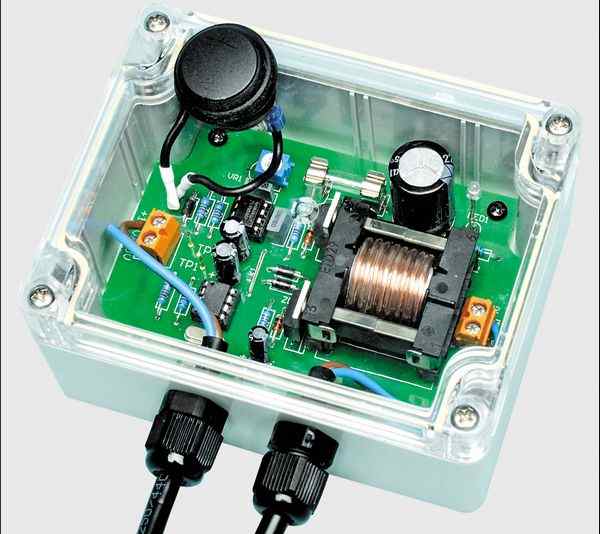
The Ultrasonic Anti-Fouling Circuit for Boats is designed to reduce marine growth by transmitting changing ultrasonic vibrations through a boat’s hull. The project uses a PIC12F675 microcontroller to control the signal pattern and a high-voltage driver to operate a piezoelectric transducer. The original project specifies operation across multiple frequency bands between approximately 19.08 kHz and 41.66 kHz.
How Ultrasonic Anti-Fouling Works
Marine fouling can build up on hulls, propellers and other underwater surfaces when a boat remains in the water for extended periods.
Rather than instantly removing established growth, an ultrasonic system is intended to make the hull less favorable for attachment by transmitting varying vibration patterns through it. The hull should therefore be cleaned before installation, while actual performance can depend on hull construction, transducer placement and bonding quality.
PIC12F675 Frequency Control
The project uses the PIC12F675 to generate and control the ultrasonic signal sequence. The PIC12F675 is an 8-bit Flash microcontroller with a compact eight-pin package, making it suitable for small embedded control applications.
In this design, the firmware scans 14 frequency bands and uses multiple frequencies within each band instead of operating continuously at only one fixed frequency. The original firmware is written in assembly language.
Main Circuit Specifications
Key specifications given for the project include:
- Frequency range of approximately 19.08 kHz to 41.66 kHz
- 14 overlapping frequency bands
- 12 frequencies within each band
- 500 ms pause between bands
- 5 µs push-pull driver dead time
- 11.5–16 V DC supply range
- Approximately 220 mA average consumption at 12 V with the stated test load
- Peak current reaching 3 A around transducer resonance
These values belong to the documented project design and should not automatically be applied to a different transducer or driver circuit.
Transducer Placement Matters
The piezoelectric transducer should transfer its vibration efficiently into a clean, rigid section of the inner hull.
Air gaps, flexible mounting material or poor bonding can reduce energy transfer. Larger boats may also require multiple transducers to distribute vibration across areas such as the keel, stern and propeller-shaft region.
PIC12F675 and High-Voltage Driver
The circuit uses PIC12F675 and TL499A integrated circuits and operates from a 12 V supply. A transformer stage drives the piezoelectric ultrasonic transducer, with the original project describing very high AC voltages at the output.
The downloadable project materials include assembly source code, HEX firmware, PCB information, circuit diagrams and measurement data.
Important High-Voltage Safety
The transducer driver can produce potentially dangerous voltages, with the project reporting test levels reaching hundreds of volts. The transformer secondary, transducer and connected wiring must therefore not be touched while the circuit is energized.
High-voltage measurements require appropriately rated equipment and suitable electrical experience. The output circuitry should also be safely discharged before handling.
Final Overview
The Ultrasonic Anti-Fouling Circuit for Boats combines PIC12F675 programming, frequency sweeping and a high-voltage piezoelectric driver in a marine electronics application.
Its effectiveness depends not only on the programmed frequencies but also on reliable power electronics, correct transducer installation and effective vibration transfer into the hull. For electronics enthusiasts, the project also provides a useful reference for studying PIC-controlled ultrasonic signal generation and piezoelectric transducer driving.
Source: ELECTRONIC ANTI FOULING CIRCUIT BOATS FOR SAVERS ULTRASONIC PIC12F675
Anti fouling project alternative link:electronic-anti-fouling-boats-for-savers-ultrasonic-pic12f675.rar
- What is the primary purpose of this circuit?
The circuit is designed to prevent damage to boat motor propellers and bodies caused by wood adhesive crustaceans, protozoa, and parasites. - Which microcontroller is used in the project?
The project uses the PIC12F675 microcontroller. - How does the circuit generate ultrasonic signals?
It uses a circuit that outputs ultrasonic signals driven by a Piezzo sonic transducer connected to an ETD29 transformer. - What voltage does the system operate on?
The circuit works with a 12 volts DC power supply. - Can the frequency be adjusted for other uses?
Yes, changing the frequency allows the circuit to be used for pest control in homes and gardens. - What programming language was used for the software?
The software was written in assembly language. - What is the maximum AC voltage output tested?
Tests showed the circuit could produce up to 800V AC at the transformer output. - Is there a specific transformer required for the design?
The design specifies using an ETD29 transformer with its windings described in detail.
