


Summary of eDrum – Trigger MIDI Converter using PIC16F877
This article describes a DIY electronic drum Trigger-to-MIDI converter (eDrum) built around a PIC16F877 microcontroller running at 20 MHz, offering 22 analog and 2 digital inputs, LCD display, MIDI and RS-232 outputs, and modular, expandable firmware. It emphasizes using inexpensive, easy-to-find components to provide professional-level trigger conversion without onboard sounds, relying on external sound sources. The project evolved into a rackmount unit named ED248.Parts used in the eDrum Trigger-to-MIDI Converter:
- PIC16F877 microcontroller
- 20 MHz clock/crystal
- 16x2 two-line LCD with backlight
- Operational amplifiers
- 22 analog inputs (trigger inputs)
- 2 digital inputs
- 22 input gain potentiometers
- 4 control buttons
- MIDI Out connector
- RS-232 serial Out connector
- Rackmount enclosure (for ED248 unit)
Introduction
This page is about electronic drums. Here you will find detailed information on how to build an electronic Trigger to MIDI Converter module, based on PIC Microcontroller, and how to build the triggers. This project has been developed for many years now, and it is constantly improving. You can expect professional results form your eDrum module. Let's start with the...
Design description
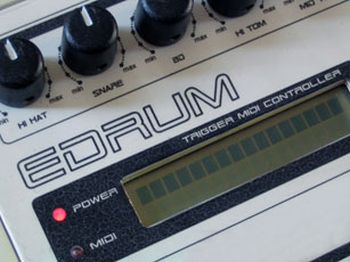
eDrum design is based on PIC16F877 RISC microcontroller from Microchip running at 20MHz, two line (16x2) LCD with backlight, and some operational amplifiers. It has 22 analog inputs, 2 digital inputs, 22 input gain potentiometers, 4 control buttons, one MIDI out and one serial RS-232 out.
The goal for this design was to use easy to find and cheap electronic components, while maintaining results at the professional levels. I also wanted the design to be modular and easily expandable. This has been achieved by using PIC microcontroller and carefully designed firmware, written in assembly language.
It was not my intention to design an instrument that already exist and is relatively cheap, like Alesis DM4 or DM5. Instead, my idea was to take advantage of equipment we already own (computer with soundcard, synth, sampler,...) to produce the drum sound. So, all that is needed is... Trigger-to-MIDI conversion. Because of that, eDrum will not offer any drumkits or sounds.
Result
I've been working on a professional rackmount version of eDrum. This is the latest unit, "ED248":
For more detail: eDrum - Trigger MIDI Converter using PIC16F877
Quick Solutions to Questions related toeDrum Trigger-to-MIDI Converter:
- What microcontroller does the eDrum use?
The eDrum uses a PIC16F877 microcontroller running at 20MHz. - How many analog and digital inputs does the design provide?
The design provides 22 analog inputs and 2 digital inputs. - Does the eDrum produce drum sounds internally?
No, eDrum only performs Trigger-to-MIDI conversion and does not offer drumkits or sounds. - What display is included in the design?
It includes a two-line 16x2 LCD with backlight. - What outputs are available on the eDrum module?
It has one MIDI Out and one RS-232 serial Out. - How many input gain controls are there?
There are 22 input gain potentiometers. - What was the design goal for component selection?
The goal was to use easy to find and cheap components while maintaining professional results. - Is the firmware custom and how was it developed?
The firmware is custom, written in assembly language for modularity and expandability. - What is the name of the rackmount unit developed from this project?
The rackmount unit is called ED248.
Related projects
PIC16F877 Driving LCD in 4-Bit Mode using PIC16F877 with Proteus Simulation
Introduction This microcontroller project shows how a PIC16F877 can drive an LCD display using 4-bit mode inside a Proteus simulation.The project demonstrates...
Programmers & ICSP · PIC16F877AEPE PIC/LCD Demo using PIC16F877 with Proteus Simulation
IntroductionThe EPE PIC/LCD Demo is a classic microcontroller project that demonstrates how a PIC16F877 can fully control a PG12864F graphical LCD.Designed as...
Motors & Robotics · PIC16F877AEfficient Sun-Following Robot: A Solar Tracker with Microcontroller Control
Abstract The impending global challenge of dwindling non-renewable fuel resources underscores the urgency of transitioning towards renewable energy alternatives like solar power....
Audio, Sound & RadioAudio Spectrum Analyzer
We developed an audio spectrum analyzer as our final project for ECE 4760. This analyzer presented a histogram-style representation of audio signals....
Audio, Sound & Radio · PIC12F675Audio CRO using PIC12F675 Microcontroller
This project is a miniature Audio CRO. For those not familiar with the abbreviation "CRO," it means "Cathode Ray Oscilloscope" and this...
Audio, Sound & RadioBuild a musical EKG with the Freescale FRDM-KL05
Short Introduction: I have been following the Battle of the DreamBoards Championship with interest and I enjoyed the variation of functionality features...

Ibrar Ayyub
I am an experienced technical writer holding a Master's degree in computer science from BZU Multan, Pakistan University. With a background spanning various industries, particularly in home automation and engineering, I have honed my skills in crafting clear and concise content. Proficient in leveraging infographics and diagrams, I strive to simplify complex concepts for readers. My strength lies in thorough...