
Summary of Custom Characters on LCD using PIC – MPLAB XC8
This tutorial explains creating up to eight custom 5×8 (or four 5×10) characters on HD44780-compatible LCDs using a PIC microcontroller and MPLAB XC8 by writing patterns into the LCDs CGRAM. It contrasts CGROM, DDRAM, and CGRAM, and shows characters are built from 5×8 or 5×10 dot matrices (example: Ω symbol).
Parts used in the Custom Characters on LCD using PIC – MPLAB XC8:
- PIC Microcontroller (e.g., PIC16 series such as 871 family referenced)
- HD44780-compatible LCD module (5×8 dot matrix typical)
- MPLAB XC8 compiler
- MPLAB IDE (or equivalent development environment)
- Interfacing wires and breadboard or PCB for connections
- Power supply for PIC and LCD (Vcc and ground)
I hope that you already go through our tutorial, Interfacing LCD with PIC Microcontroller – MPLAB XC8. HD44780 compatible controllers used in these LCDs allows us to define 8 custom characters in addition to the standard pre-programmed characters. In this tutorial we will learn, how to create custom characters on LCD using PIC Microcontroller and MPLAB XC8 compiler.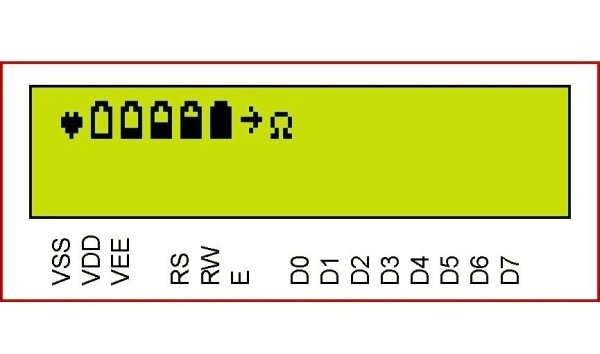
DDRAM, CGROM and CGRAM
CGROM – Character Generator ROM
This is the memory which holds 5×8 or 5×10 dot patterns of predefined characters in the LCD. It can generate 208 5×8 dot character patterns and 32 5×10 dot character patterns.
DDRAM – Display Data RAM
This is the memory which holds the character data which is currently displayed on the LCD screen. Its capacity is 80×8 bits, ie 80 characters.
CGRAM – Character Generator RAM
This memory works similar to CGROM but as this is a RAM we can modify its data any time. So we can store our custom character patterns in this memory through program. We can store up to eight 5×8 character dot patterns or four 5×10 character dot patterns in this memory.
Character Generation
Characters are displayed on the LCD using 5×8 or 5×10 dot matrix. Most of the commonly available displays uses 5×8 dot matrix. We can simply create a custom character by defining each pixel in the dot matrix. Here is an example of creating Ω symbol on 5×8 dot matrix.Project List – 871 PIC Microcontroller 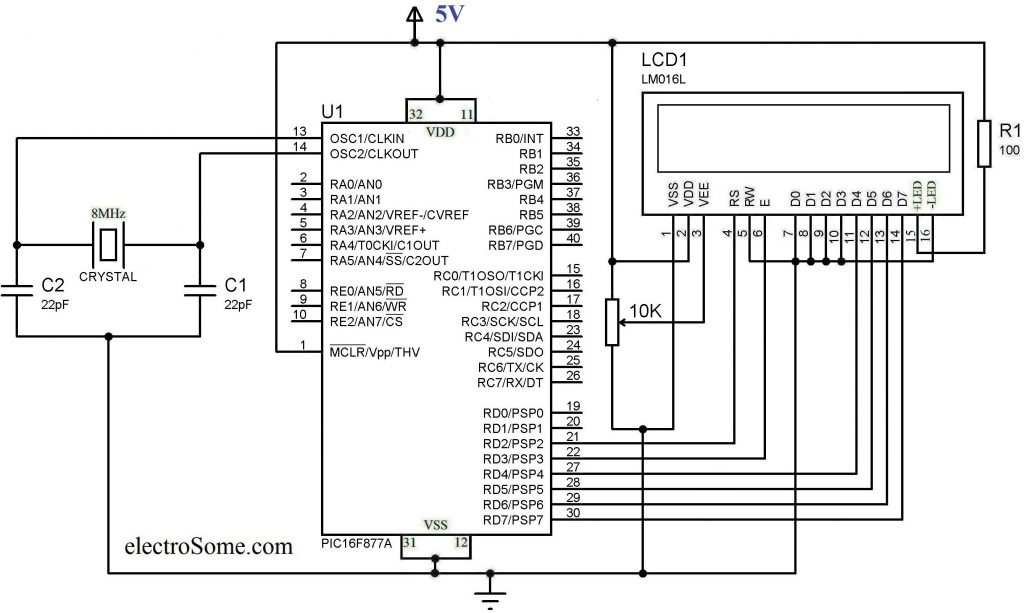
For more detail: Custom Characters on LCD using PIC – MPLAB XC8
- What memory holds predefined character patterns in the LCD?
CGROM holds predefined 5×8 or 5×10 dot patterns. - Where is the currently displayed character data stored?
DDRAM stores the character data currently displayed on the LCD. - Which memory allows storing custom character patterns?
CGRAM allows storing custom character patterns because it is RAM and can be modified by program. - How many custom 5×8 characters can be stored in CGRAM?
You can store up to eight 5×8 character dot patterns in CGRAM. - How many custom 5×10 characters can CGRAM store?
CGRAM can store up to four 5×10 character dot patterns. - What dot matrix sizes are used to generate characters on the LCD?
Characters are generated using 5×8 or 5×10 dot matrices, with 5×8 being most common. - Can custom characters be created using PIC and MPLAB XC8?
Yes, custom characters can be created by defining pixel patterns and storing them in CGRAM using a PIC microcontroller and MPLAB XC8. - What example symbol is shown in the tutorial for creating a custom character?
The tutorial shows an example of creating the Omega symbol on a 5×8 dot matrix.
