


Summary of Cell Phone Detector
This project is a GSM 900 MHz mobile phone sniffer that detects signal activity (not call content) using dipole antennas, chokes, diodes, and an LM358 amplifier; detected signals are audible via headphones. The design uses two identical detector units, PCB artwork, and components chosen for sensitivity and low noise.Parts used in the Mobile Phone Detector:
- R1, R5 : 100K 1/4W Resistor
- R2, R6 : 1k 1/4W Resistor
- R3, R7 : 8.2M 1/4W Resistor
- R4, R8 : 220 Ohm 1/4W Resistor
- R9 : 2.2K 1/4W Resistor
- D1, D2 : BAT43 Schottky Diode
- C1, C2, C4 : 100nF Polyester Capacitor
- C3 : 100uF 16V Electrolytic Capacitor
- L1, L2 : Choke (see text)
- U1 : LM358 (dual op-amp)
- J1 : 8 Pin Socket
- J2 : Stereo Jack
- 1 × 9V Battery
- 1 × 9V Battery Socket
- 1 × LED
- 1 × On/Off Switch
- Dipole antennas (two)
- Headphone (for listening)
Project Summary
This is a mobile phone sniffer circuit that can detect the signals being used in the GSM (Global System for Mobile Communication) band at about 900 MHz. Since the signals are digitally encoded, it can detect only the signal activity, not the speech or the message contents. A headphone is used to hear the detected signals.
 Project Description
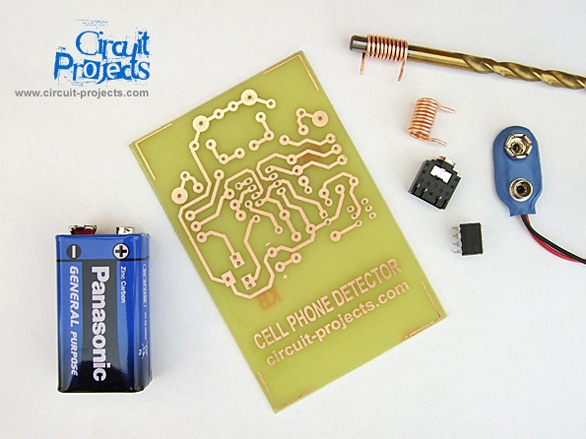
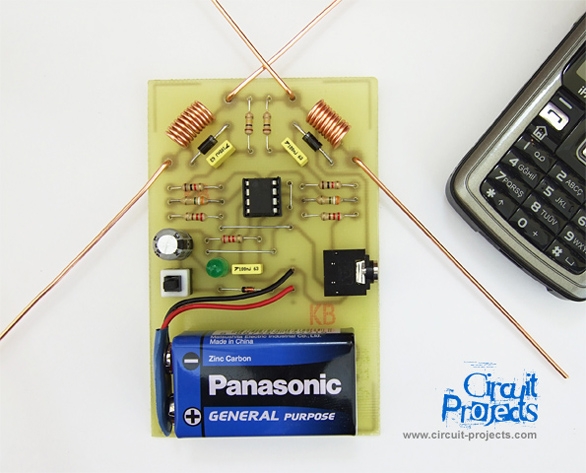
The circuit schematic is given in the .rar archive attachment. There are two separate detector units. Every detector unit consists of a dipole antenna, a choke and a diode. The antenna receives the GSM signals in media. Then a small amount of charge is induced in the choke. The diode demodulates the signal and finishes detecting. The diodes must be schottky diodes or germanium diodes. Since the forward voltage of a silisium diode is high, it won’t give a sufficient result in this circuit.
LM358 amplifies the received signal. It contains two separate op-amps that are supplied by a common power source. R3 and R7 resistors determine the gain of the amplifiers. When the resistor values are greater than 10M then the noise level increases. If they are small like about 100k, this time it becomes harder to hear the signal.
The PCB file is provided in pdf format. You can apply it to the board by using the ironing method.
 R1, R5 : 100K 1/4W Resistor
R2, R6 : 1k 1/4W Resistor
R3, R7 : 8.2M 1/4W Resistor
R4, R8 : 220 Ohm 1/4W Resistor
R9 : 2.2K 1/4W Resistor
D1, D2 : BAT43 Schottky Diode
C1, C2, C4 : 100nF Polyester Capacitor
C3 : 100uF 16V Electrolytic Capacitor
L1, L2 : See Text
U1 : LM358
J1 : 8 Pin Socket
J2 : Stereo JAck
1 × 9V Battery
1 × 9V Battery Socket
1 x LED
1 x On/Off Switch
Quick Solutions to Questions related to Mobile Phone Detector:
- What does this mobile phone detector detect?
It detects GSM band signal activity around 900 MHz but not speech or message contents. - How many detector units are in the circuit?
There are two separate detector units in the circuit. - Which diodes should be used in this project?
Schottky diodes or germanium diodes should be used; the project lists BAT43 schottky diodes. - Why not use silicon diodes in this detector?
Silicon diodes have a high forward voltage and will not give sufficient result in this circuit. - What component amplifies the received signal?
The LM358 dual op-amp amplifies the received signal. - How do R3 and R7 affect performance?
R3 and R7 determine amplifier gain; values above 10M increase noise, while much lower values (around 100k) make the signal harder to hear. - What format is the PCB file provided in?
The PCB file is provided in PDF format for ironing transfer to the board. - What is used to hear the detected signals?
A headphone connected via a stereo jack is used to hear the detected signals.
Related projects
Exploring Various Applications of Microcontrollers: A World of Tiny Brains
Exploring Various Applications of Micro Controller Microcontrollers have become ubiquitous in the modern world with applications in nearly every industry. This student...
Wireless & IoTIntelligent Sips: Revolutionizing Dining with the SmartCup
Abstract The SmartCup Attachment is a comprehensive system designed for restaurants to monitor the liquid levels in their customers' cups. This system...
Wireless & IoTMaximizing Wi-Fi Capabilities with the Explorer 16 Development Board
As society progresses, the necessity for wireless communication is evolving from a mere luxury to an essential requirement. Wi-Fi, extending beyond conventional...
Wireless & IoTTransform Your Home into a Smart Haven with DIY Wireless Automation
Introduction Smart home technology has grown tremendously in popularity over the last decade. A recent survey found that 46% of consumers view...
Wireless & IoTMicrocontrollers: Space Exploration and other fields applications
What is a Microcontroller? Microcontrollers are small, standalone computers used to manage operations in electronic devices. They can be found in a...
Wireless & IoTBluetooth Wireless Voltage Meter using Wiimote + Pic Chip + AutoIt
In this tutorial I'm going to be showing you how you can send voltage values to your pc using a Pic chip,...

Ibrar Ayyub
I am an experienced technical writer holding a Master's degree in computer science from BZU Multan, Pakistan University. With a background spanning various industries, particularly in home automation and engineering, I have honed my skills in crafting clear and concise content. Proficient in leveraging infographics and diagrams, I strive to simplify complex concepts for readers. My strength lies in thorough...