
Summary of Build a Motion Control Rig for Time-Lapse Photography
This project uses an Arduino and a stepper motor to create a precise camera panning rig for time-lapse photography, controlled via an LCD keypad shield. It lets you set start/stop positions and duration (5 minutes to 12 hours), runs from USB power (portable battery packs OK), and offers predictable, very slow motion for moving time-lapses beyond simple mechanical timers.
Parts used in the Motion Control Rig for Time-Lapse Photography:
- Arduino microcontroller
- Stepper motor
- LCD keypad shield
- USB power source or portable USB battery pack
If you dig around in your camera’s settings long enough, you’re almost assured to find that it has a mode to create time-lapse videos — those magical, time compressing movies that can turn any hillside or street corner into a lightning-paced dreamscape.
Time-lapse videos by themselves are easy enough to make, but if you do enough of them, you’re likely to get bored with the motionless camera framing. But what can you do here? Having a moving time lapse means moving a camera very predictably, and very, very slowly. You can build a simple panning rig out of a mechanical kitchen timer, but that’s only good if your time lapse is an hour or less, plus, the camera will rotate the full 360 degrees in that hour, further limiting your control.
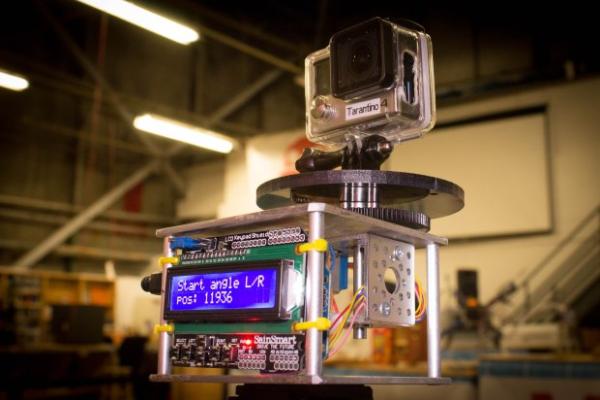 In this project, we’ll be using an Arduino microcontroller and a stepper motor to precisely control the panning of a camera during a time lapse. Using this LCD keypad shield as an interface, we can precisely set our starting and stopping positions, as well as setting the duration of our time lapse — anywhere between five minutes and 12 hours. The device can be powered via any USB power source, and those portable USB bricks used to keep your smartphone alive during long days will work perfectly, and can power the device for up to 12 hours.
- What is used to control the panning of the camera?
An Arduino microcontroller combined with a stepper motor is used to control camera panning. - How do you set start and stop positions and duration?
The LCD keypad shield serves as an interface to precisely set starting and stopping positions and the time-lapse duration. - What range of durations can be set for the time lapse?
Durations between five minutes and 12 hours can be set. - Can the device be powered by portable battery packs?
Yes, portable USB battery packs used for smartphones can power the device for up to 12 hours. - Why use a stepper motor instead of a mechanical kitchen timer?
A stepper motor with Arduino provides precise, very slow, and predictable motion and avoids the limitations of a kitchen timer like fixed 360-degree rotation in an hour. - Does the project require special power besides USB?
No, the device can be powered via any USB power source.