
Contents
hide
Summary of BROADCOM AEDR-9920 THREE-CHANNEL REFLECTIVE INCREMENTAL ENCODER
The AEDR-9920 is a miniature 4×4×1.05 mm reflective incremental encoder offering three-channel (ABI) differential or TTL-compatible outputs for linear and rotary sensing. It supports high temperature ranges, pin-selectable and SPI-reprogrammable interpolation up to 512x (256x pin, 65,536 CPR or 262,144 PPR after quad), base frequencies to 2 MHz, and an IR light source for contamination robustness. Available in 3.3V and 5V versions with optional AEC-Q100 automotive grade.
Parts used in the AEDR-9920 Miniature Reflective Incremental Encoder Project:
- AEDR-9920 miniature reflective incremental encoder (surface-mount leadless package 4.0 × 4.0 × 1.05 mm)
- Code wheel or linear scale (spiral code wheel for lower optical radius)
- Signal processor or interfacing microcontroller supporting differential or TTL inputs
- Power supply (3.3 V or 5 V)
- PCB for surface-mount placement
- SPI interface for user reprogramming
- Mounting hardware or mechanical coupling for rotary or linear integration
- Optional AEDR-9920A automotive-grade variant (AEC-Q100 compliant)
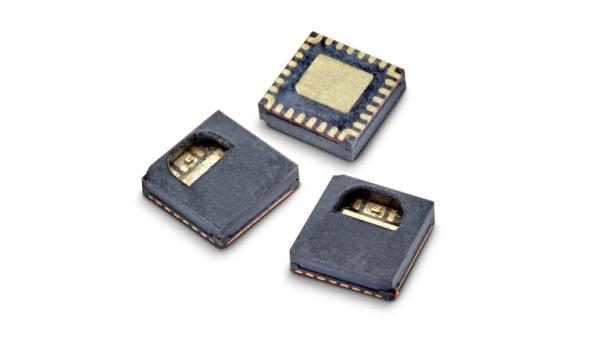
The AEDR-9920 miniature reflective incremental encoder offers three-channel (ABI) differential digital outputs for linear and rotary applications starting at 4.6 mm optical radius with larger spatial (misalignment) tolerance up to 500 µm. A smaller optical radius can be achieved with a lower spatial and support the lower resolution with a spiral code wheel. The differential or TTL-compatible output signals can be directly interfaced to most signal processors. The compact size and programmable resolution provide easy integration into small motors, actuators, linear stages, and medical equipment.
Key Features
- Miniature size – 4x4mm
- For miniature, small motor, and high temp applications
- Built-in pin selectable and user SPI reprogrammable interpolations
- Suitable for linear and rotary applications
Additional Features
- Next-generation miniature reflective incremental encoder:
- High operating temperature, resolution, and frequency
- Operating Voltage 3.3 V and 5 V
- Encoding line density: 225 LPI (8.86 LPmm)
- Example: Rotary RoP 4.6 mm, to achieve 256 CPR
- Higher resolutions with pin selectable interpolation up to 256x
- 65,536 CPR or 262,144 PPR after quad
- User SPI reprogrammable interpolation from 1x up to 512x
- Base frequency 200 Khz and up to 2 Mhz at 16x interpolation and above
- Infrared (IR) light source:
- More robust to contamination
- Surface-mount leadless package (W x L x H):
- 4.0 × 4.0 × 1.05 mm
- Operating temperature range:
- From -40 to 115 °C (extended industrial)
- Optional automotive part AEDR-9920A:
- AEC-Q100-compliant
- Automotive Grade 1: from -40 to 125 °C
Read more: BROADCOM AEDR-9920 THREE-CHANNEL REFLECTIVE INCREMENTAL ENCODER
- What outputs does the AEDR-9920 provide?
Three-channel (ABI) differential digital outputs and TTL-compatible signals. - What package size is the AEDR-9920 available in?
Surface-mount leadless package measuring 4.0 × 4.0 × 1.05 mm. - What supply voltages does the AEDR-9920 support?
Operating voltages of 3.3 V and 5 V. - Can the interpolation be reprogrammed?
Yes; it supports pin-selectable interpolation and user SPI reprogrammable interpolation from 1x up to 512x. - What resolutions are achievable with the AEDR-9920?
Pin selectable up to 256x; user SPI up to 512x, enabling up to 65,536 CPR or 262,144 PPR after quad. - What operating temperature range does it support?
Standard range from -40 to 115 °C; automotive AEDR-9920A supports -40 to 125 °C. - What is the base frequency and maximum frequency?
Base frequency is 200 kHz and up to 2 MHz at 16x interpolation and above. - Is the AEDR-9920 suited for contaminated environments?
Yes; it uses an infrared light source that is more robust to contamination. - What applications is the AEDR-9920 designed for?
Miniature, small motor, actuators, linear stages, and medical equipment for linear and rotary applications.