
Summary of Berkeley Lab makes graphene-MoS2 transistor
Berkeley Lab developed a method to assemble transistors using atomically thin graphene and molybdenum disulfide (MoS2). The process involves etching channels in graphene on a silicon-dioxide substrate, then filling them with MoS2 to create nanometer-scale junctions. This approach improves electron injection performance compared to metal contacts and has been successfully integrated into an inverter logic circuit. The technique supports wafer-scale production compatible with current semiconductor manufacturing.
Parts used in the Graphene-MoS2 Transistor:
- Graphene
- Molybdenum disulfide (MoS2)
- Silicon-dioxide substrate
- Silicon wafer
- Inverter logic circuitry
The method etches narrow channels in conducting graphene laid down on a silicon-dioxide substrate. These channels are then filled with a transition-metal dichalcogenide, or TMDC, or more specifically MoS2. Both of these materials have a 2D structure that is just one atomic layer thick. The synthesis method was able to cover an area a few centimeters long by a few a millimeters wide opening up the possibility of commercial-scale production in a wafer fab on a silicon wafer.
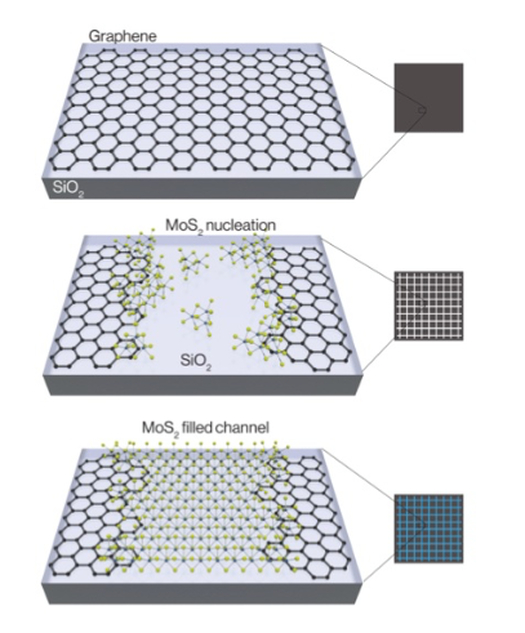
The use of two atomic sheets meet to form nanometer-scale junctions allows graphene to inject electrons into the conduction band of the MoS2 channel with improved performance compared with simply using metal contacts to inject electrons, the researchers said.
Schematic shows the chemical assembly of two-dimensional crystals. Graphene is first etched into channels and the TMDC molybdenum disulfide (MoS2) begins to nucleate around the edges and within the channel. On the edges, MoS2 slightly overlaps on top of the graphene. Finally, further growth results in MoS2 completely filling the channels. (Source: Berkeley Lab)
The research team assembled the transistor into the logic circuitry of an inverter underscoring its applicability to commercial IC production.
“Both of these two-dimensional crystals have been synthesized in the wafer scale in a way that is compatible with current semiconductor manufacturing. By integrating our technique with other growth systems, it’s possible that future computing can be done completely with atomically thin crystals,” said Mervin Zhao, a lead researcher and Ph.D. student at Berkeley Lab and UC Berkeley.
The team reported its work online July11 in the journal Nature Nanotechnology .
For More Details: Berkeley Lab makes graphene-MoS2 transistor
- How does the new transistor improve electron injection?
The use of two atomic sheets meeting to form nanometer-scale junctions allows graphene to inject electrons into the conduction band of the MoS2 channel with improved performance compared to simply using metal contacts. - What materials are used in the 2D transistor assembly?
The project uses graphene and molybdenum disulfide, both of which have a 2D structure that is just one atomic layer thick. - Can this synthesis method be used for commercial-scale production?
Yes, the method covers an area a few centimeters long by a few millimeters wide, opening the possibility of commercial-scale production in a wafer fab on a silicon wafer. - Is the technique compatible with current semiconductor manufacturing?
Both two-dimensional crystals have been synthesized in a way that is compatible with current semiconductor manufacturing. - What was assembled to demonstrate the applicability of this technology?
The team assembled the transistor into the logic circuitry of an inverter to underscore its applicability to commercial IC production. - Where was this research published?
The team reported its work online July 11 in the journal Nature Nanotechnology. - What is the thickness of the crystals used in this project?
Both graphene and molybdenum disulfide have a 2D structure that is just one atomic layer thick. - How are the MoS2 channels formed within the graphene?
The method etches narrow channels in conducting graphene, and the TMDC molybdenum disulfide begins to nucleate around the edges and within the channel until it completely fills them.