


Summary of Automatic Railway Gate Control System Using PIC16F877A microcontroller
This tutorial outlines a beginner-friendly project to design an automatic railway gate control system using a PIC16F877A microcontroller. The system replaces manual gate operations by automatically opening and closing gates based on pre-set train schedules stored within the microcontroller, preventing collisions between road traffic and trains. While the article focuses on the simulation design concept, it emphasizes that the logic can be adapted for real hardware implementation.Parts used in the Automatic Railway Gate Control System:
- PIC16F877A microcontroller
- Main controller station
- Railway line
- Railway gates
- Train time schedule data
Hello everybody ,welcome
In this tutorial we will describe how to make automatic railway system using PIC microcontroller . Before that you need to know about working principle of railway system . When road cross railway line then traffic must wait and let the train pass , to prevent the collision . For that train time should be fixed and set inside the microcontroller and that perticular time the gate of train will open and road side traffic should wait and let train pass . The concept behind this project is very simple and is intended for beginner as a learning purpose . In this content we will only show you design concept in simulation based , but you can design your own concept in the real hardware .
Automatic Railway Gate Control System Using PIC16F877A microcontroller (Schematic Diagram)
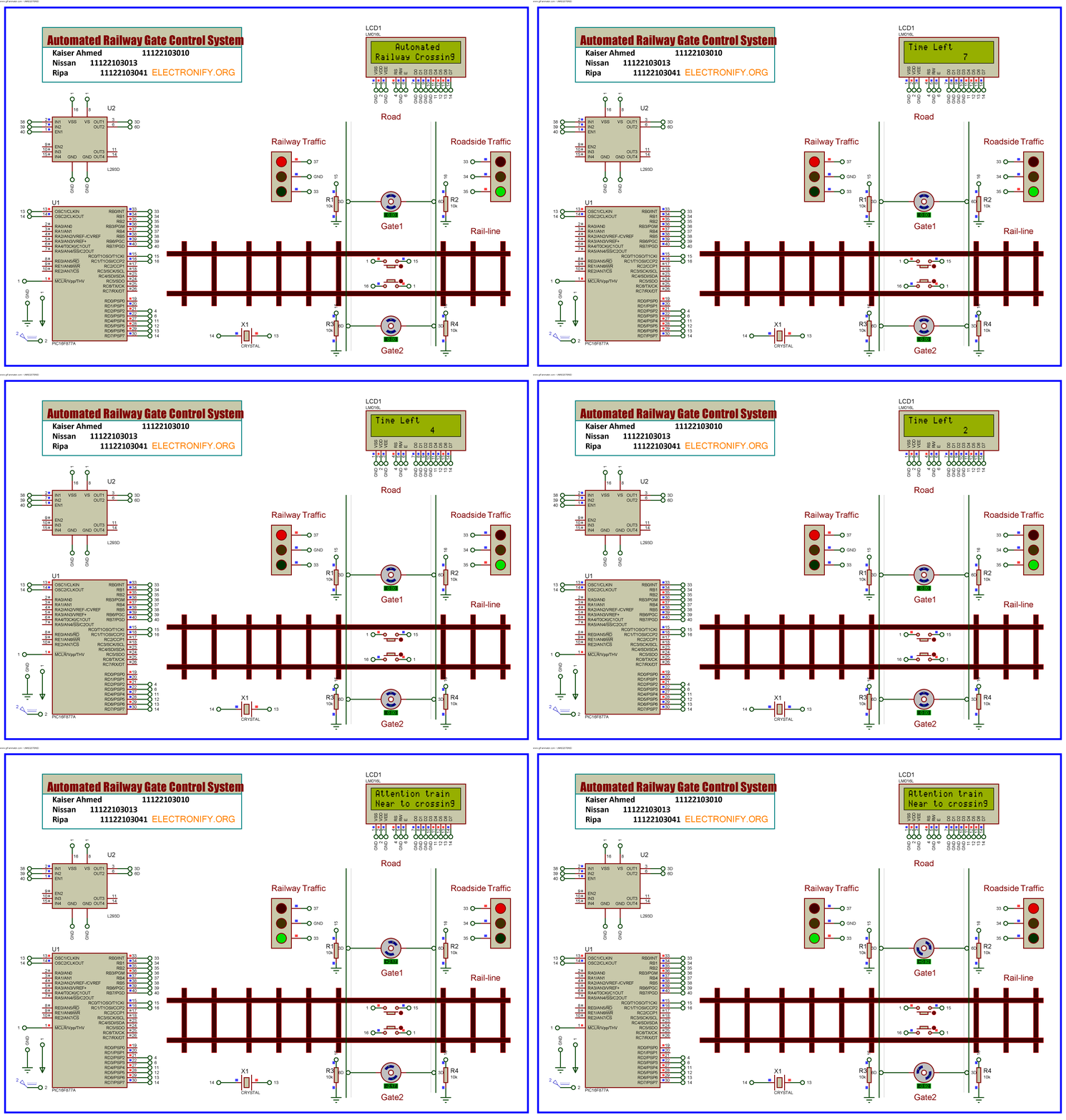
Quick Solutions to Questions related to Automatic Railway Gate Control System:
- How is the railway gate currently operated manually?
Railway gates are generally closed or opened manually by a gatekeeper to prevent collision. - What information is sent from the main controller station manually?
Time schedule and other information are sent from the main controller station manually. - Which microcontroller is used in this tutorial?
The project uses a PIC microcontroller, specifically the PIC16F877A. - What is the working principle of the railway system described?
Traffic must wait when a road crosses the railway line to let the train pass and prevent collision. - How does the system determine when to open or close the gate?
The gate opens and closes at specific times when the train time is fixed and set inside the microcontroller. - Is this project intended for advanced engineers?
No, the concept is very simple and intended for beginners as a learning purpose. - Does the article show a real hardware design?
No, the content only shows the design concept in simulation based. - Can the design be implemented in real hardware?
Yes, you can design your own concept in the real hardware based on the simulation.
Related projects
PIC16F877 Driving LCD in 4-Bit Mode using PIC16F877 with Proteus Simulation
Introduction This microcontroller project shows how a PIC16F877 can drive an LCD display using 4-bit mode inside a Proteus simulation.The project demonstrates...
Programmers & ICSP · PIC16F877AEPE PIC/LCD Demo using PIC16F877 with Proteus Simulation
IntroductionThe EPE PIC/LCD Demo is a classic microcontroller project that demonstrates how a PIC16F877 can fully control a PG12864F graphical LCD.Designed as...
Motors & Robotics · PIC16F877AEfficient Sun-Following Robot: A Solar Tracker with Microcontroller Control
Abstract The impending global challenge of dwindling non-renewable fuel resources underscores the urgency of transitioning towards renewable energy alternatives like solar power....
Motors & RoboticsReal-Time CAN-Based Vehicle Monitoring System with PIC MCU
INTRODUCTION The Controller Area Network (CAN) is a robust vehicle communication bus standard that was primarily developed for automobile applications but has...
Motors & RoboticsEasy Way to Learn Robotics Using Microcontrollers: A Beginner’s Guide
The title, "Easy Way to Learn Robotics Using Microcontrollers," promises an accessible entry point for those curious about the exciting world of...
Motors & RoboticsInnovative Robotics: A Comprehensive Project Exploration
A DC motor functions as an electromechanical device, translating electrical signals into mechanical movements. The rotation of the motor correlates directly with...

Ibrar Ayyub
I am an experienced technical writer holding a Master's degree in computer science from BZU Multan, Pakistan University. With a background spanning various industries, particularly in home automation and engineering, I have honed my skills in crafting clear and concise content. Proficient in leveraging infographics and diagrams, I strive to simplify complex concepts for readers. My strength lies in thorough...