
Summary of A Programmable Optical Slave Flash Trigger for Digital Cameras with Processor PIC 12F675
The article describes a contact-free optical Slave Flash Trigger (SFT) for synchronizing external photographic flashguns from a camera's embedded flash. Optimized for digital cameras, it ignores pre-flashes, protects cameras from high-voltage vintage flashes, works at close or long distances, resists ambient light and sunlight, and aids underwater, speleology, macro, and dust-prone shooting. Software (HEX Intel) for PIC 12F675 processor (version FL6318) is provided free for non-commercial use without warranty.
Parts used in the Slave Flash Trigger:
- PIC 12F675 microcontroller
- Optical sensor/photodiode
- Trigger output circuit for external flashgun
- Power supply (battery or regulated source)
- Configuration word/programmable memory (HEX Intel format software)
- Protective input coupling (optical isolation)
- Enclosure or mounting hardware
The synchronizer ensures a contact-free, optical synchronization of external photographic flashguns. The triggering of the external flash is derived from embedded flashes of a camera. It can be used for both digital and “analogous” cameras or for a remote synchronization of the actual flash units. Its use is optimal especially with digital cameras (DC), where extraordinary adaptability for different systems will stand out. It is capable of eliminating the effect of any measuring pre-flashes. The synchronizer thus perfectly fulfils the role of a device often called the Slave Flash Trigger (SFT). 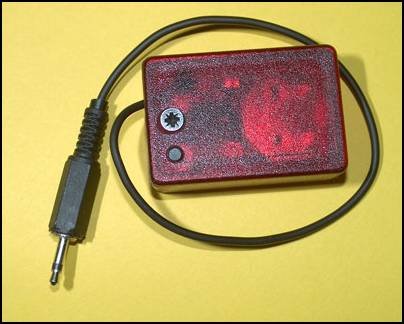 Thanks to an optical coupling, it enables safely to use even the oldest flashguns that could otherwise damage DC by high voltage ignition. The Slave Flash Trigger enables to place the external flashgun in the close proximity of DC, but thanks to high sensitivity the flashgun can be even tens of metres away from the camera, if needed. Having such sensitivity, the device is remarkable with high resistance against the effects of ambient lighting and the interference by varying light sources. Also, the operation outside under sunshine does not make problems for it thanks to an adaptation algorithm. Not a negligible advantage is the possibility of its simple and safe application with cameras to which otherwise the external flashguns cannot be connected at all.
THIS SOFTWARE CAN FREELY BE USED ONLY FOR NON-COMMERCIAL PURPOSES. THE AUTHOR PROVIDES THIS SOFTWARE “AS IS”, ABSOLUTELY WITHOUT ANY GUARANTEES, AND DOES NOT ASSUME ANY RESPONSIBILITY FOR ITS QUALITY, FUNCTIONALITY OR ANY DAMAGES INCURRED BY USING THIS SOFTWARE. TO CLAIM ANY COMPENSATION FOR DAMAGES FROM THE AUTHOR IS THEREFORE FULLY EXCLUDED.
The program is in the HEX INTEL format and includes a configuration word.
Slave Flash Trigger Software version FL6318 for processor PIC 12F675
Copyright by Pavel Janko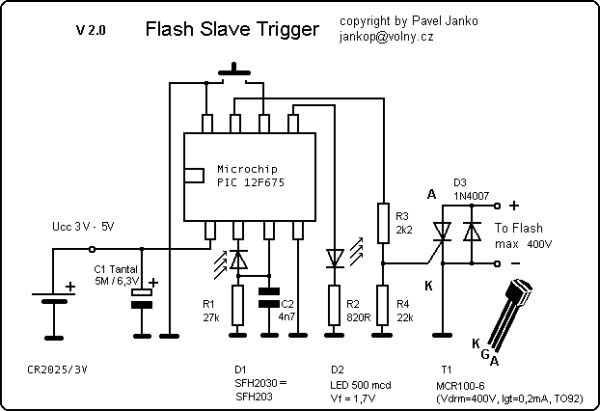
The Slave Flash Trigger in connection with the external flashgun helps solve the following problems:
- It ensures a reliable synchronization even when measuring pre-flashes exist
- It reliably eliminates the creation of light spots – “UFO” when photographing in the environment with dust particles
- It reduces the creation of the effect of red eyes
- It allows using a more powerful flash during demanding light conditions
- It can be effectively used as a synchronization unit of the external flash for underwater photography or speleology
- It excellently helps in the close-up of very near objects when the embedded flash of a camera cannot in many cases be used
For more detail: A Programmable Optical Slave Flash Trigger for Digital Cameras with Processor PIC 12F675
- What is the Slave Flash Trigger used for?
It optically synchronizes external flashguns to a camera's embedded flash, eliminating pre-flash issues and enabling contact-free triggering. - Can it be used with digital cameras?
Yes, it is optimized for digital cameras and handles measuring pre-flashes effectively. - Does it protect cameras from old high-voltage flashes?
Yes, optical coupling allows safe use of old flashguns that could otherwise damage digital cameras. - How far can the external flash be placed from the camera?
The device is highly sensitive and can trigger flashguns tens of metres away if needed. - Is it affected by ambient lighting or sunshine?
No, it has high resistance to ambient lighting and an adaptation algorithm that allows operation outdoors in sunshine. - Can it eliminate pre-flash triggering problems?
Yes, it is capable of eliminating the effect of measuring pre-flashes. - Is the software for the device freely usable?
The software can be freely used only for non-commercial purposes and is provided as is without any guarantees. - What processor does the software target?
The software version FL6318 is for the PIC 12F675 processor and is provided in HEX Intel format. - Can it be used for specialized photography like underwater or macro?
Yes, it can be effectively used for underwater photography, speleology, and close-up of very near objects.