
Summary of Polyswitch fuses miniSMD series will protect not only
This article explains Polyswitches as resettable fuses ideal for compact, non-user-accessible devices where traditional bulky fuses or PCB holders are unsuitable. It details their PTC resistor mechanism, where conductive particles in a polymer expand upon heating to increase resistance and cut off current. The text defines key parameters like holding current (I hold) and tripping current (I trip), explaining how ambient temperature affects performance and describing the operational regions of the component's behavior graph.
Parts used in the Polyswitch Project:
- Polyswitch
- PTC resistor
- Polymeric structure
- Conductive particles
- Amorphous polymer
- MiniSMD series Polyswitch fuses
Polyswitch-es provide a big service at protection of devices, where they behave like „resettable“ fuses. How many times it is suitable or necessary to use a fuse in a device, but a relatively bulky fuse socket simply doesn´t have a space in our device (or it would spoil a device design) and we also don´t want to use a PCB fuse holder, because a device would have to be constructed as user accessible… Then and not only then, is the ideal solution to use a Polyswitch. Such „fuses“ are available from various producers (for example also under names Polyfuse, Multifuse), Polyswitch is a trade name of company TE Connectivity/ Raychem, representing a top level in this segment.
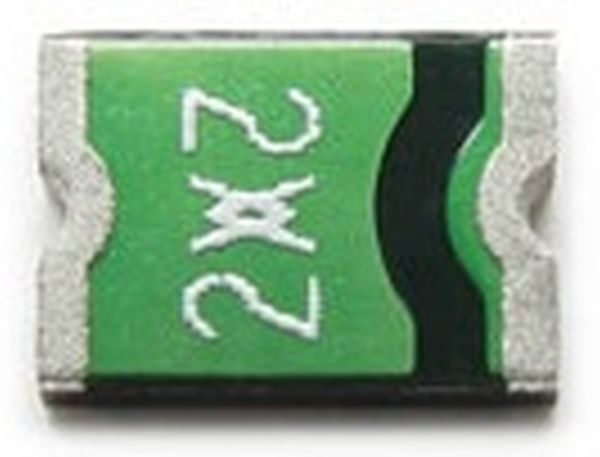
in a principle, a Polyswitch is a PTC resistor with a Polymeric structure designed for a big change of resistance in a narrow temperature range. Conductive particles are dissipated in an amorphous polumer, which changes its structure at a higher temperature (melts), increases its volume resulting in a rapid increasing of a component resistance. In this point (tripping point) a very rapid increasing of resistance appears, which is high enough, so that a leakage current is practically negligible and won´t cause a damage to a protected circuit. Each Polyswitch has a defined holding current (I hold), nominal resistance at a given temperature and tripping (switch off) current (I trip). By a current flowing through a Polyswitch, it gets calorified (I2R), until a certain current it will reach a level, where a rapid increasing of its resistance appears. An exact current at which this change arises naturally depends also on an ambient temperature (at higher temperature a lower current is sufficient). This behavior is digestedly illustrated on an enclosed graph (Fig.4). In the A region, a Polyswitch is switched off (tripped) and a device is disconnected. In the region B the Polyswitch allows for normal operation (on) at any combination of a current and ambient temperature. In the region C can the component go tripped (off) so to say “anytime” depending on a concrete resistance value of a given piece.
For more detail: Polyswitch fuses miniSMD series will protect not only
- What is the primary advantage of using a Polyswitch over a traditional fuse?
It acts as a resettable fuse that fits in small spaces without needing bulky sockets or user-accessible PCB holders. - How does a Polyswitch function as a protection device?
It is a PTC resistor with a polymeric structure that changes resistance rapidly when heated by excess current. - What happens inside a Polyswitch during a fault condition?
Conductive particles dispersed in an amorphous polymer cause the material to melt and increase volume, raising resistance to negligible leakage levels. - Which company owns the trade name Polyswitch?
The trade name belongs to TE Connectivity/Raychem, representing a top level in this segment. - Does ambient temperature affect the operation of a Polyswitch?
Yes, at higher temperatures a lower current is sufficient to trigger the rapid resistance increase. - What are the two main current values defined for each Polyswitch?
Each unit has a defined holding current and a tripping current. - What occurs in region B of the Polyswitch characteristic graph?
In region B the Polyswitch allows for normal operation at any combination of current and ambient temperature. - What happens in region A of the Polyswitch characteristic graph?
In region A the Polyswitch is switched off or tripped, disconnecting the device.