
Summary of LOW VOLTAGE MICROPHONE PREAMPLIFIER WITH VARIABLE COMPRESSION AND NOISE CANCELING
This project is a low-voltage microphone preamplifier for voice-band use that provides amplification, variable compression, limiting, and a noise gate. It uses a low-noise VCA controlled by a detector loop to maintain selectable compression ratios (1:1 to >10:1) with two rotation points, user-adjustable compression ratio and gate threshold, and fixed gains. It optimizes condenser microphone signals for personal electronics, computer audio, communications, and PA systems, reducing background noise and preventing overload before digitization.
Parts used in the Microphone Signal Conditioning Project:
- Condenser microphone
- Low-noise voltage-controlled amplifier (VCA), specifically SSM2167
- Control loop components for VCA (detector circuitry)
- Compression ratio selection jumper
- Noise gate (downward expander) threshold control
- Fixed gain stages (two rotation point values)
- Limiters for overload and pop prevention
- Power supply (low-voltage)
- Passive components (resistors, capacitors) for time constants and filtering
- Connectors and PCB or prototyping hardware
This is a complete microphone signal conditioning project. Designed primarily for voice-band applications, this project provides amplification, limiting, variable compression, and noise gate. User-adjustable compression ratio, noise gate threshold, and two different fixed gains optimize circuit operation for a variety of applications.
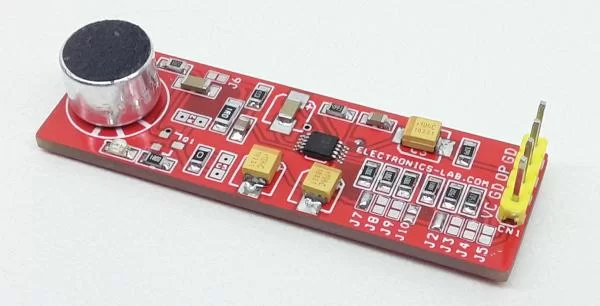
This is a complete and flexible solution for conditioning condenser microphones for personal electronics and computer audio systems. It is also excellent for improving vocal clarity in communications and the public address systems. A low noise voltage-controlled amplifier (VCA) provides a gain that is dynamically adjusted by a control loop to maintain a set compressions characteristic. The compression ratio is set by a jumper and can be varied from 1:1 to over 10:1 relative to the fixed rotation point. Signals above the rotation point are limited to prevent overload and eliminate popping.
A downward expander (noise gate) prevents the amplification of background noise or hum. This results in an optimized signal level prior to digitization, thereby eliminating the need for additional gain or attenuation in the digital domain. The flexibility of setting the compression ratio and the time constant of the level detector, coupled with two values of rotation point, make the SSM2167 easy to integrate into a wide variety of microphone conditioning applications.
Read more: LOW VOLTAGE MICROPHONE PREAMPLIFIER WITH VARIABLE COMPRESSION AND NOISE CANCELING
- What is the primary function of this microphone preamplifier?
To provide amplification, variable compression, limiting, and a noise gate for condenser microphones in voice-band applications. - Which VCA is used in the project?
The project uses the SSM2167 low-noise voltage-controlled amplifier. - Can the compression ratio be adjusted by the user?
Yes, the compression ratio is user-adjustable via a jumper and can vary from 1:1 to over 10:1. - Does the circuit include noise reduction?
Yes, it includes a downward expander (noise gate) to prevent amplification of background noise or hum. - Are there different rotation point options?
Yes, the design provides two values of rotation point for flexibility. - What problem does the limiter solve?
The limiter prevents overload and eliminates popping for signals above the rotation point. - Is this suitable for digital audio systems?
Yes, it optimizes signal level prior to digitization, reducing the need for digital-domain gain or attenuation. - Can the time constant of the level detector be changed?
Yes, the time constant of the level detector can be set for different responses.