
Summary of 36V, 2-ch, 1.6A synchronous buck LED driver has I²C dimming
Analog Devices introduced the LT3964, a dual-channel 36V synchronous step-down LED driver under its "Power by Linear" brand. This device features internal 40V, 1.6A power switches and an I2C interface for simplified digital PWM dimming with ratios up to 8192:1. Operating between 4V and 36V with switching frequencies up to 2 MHz, it achieves over 94% efficiency. The chip includes comprehensive protection features like fault detection and thermal shutdown, housed in a compact QFN package suitable for automotive and industrial applications.
Parts used in the LT3964 Project:
- Dual channel 36V high efficiency synchronous step-down LED driver
- Internal 40V 1.6A power switches
- I2C interface for digital control
- Microcontroller (for PWM signal generation)
- External clock signal source (optional for synchronization)
- Thermally enhanced 36-lead 5 x 6 mm QFN package
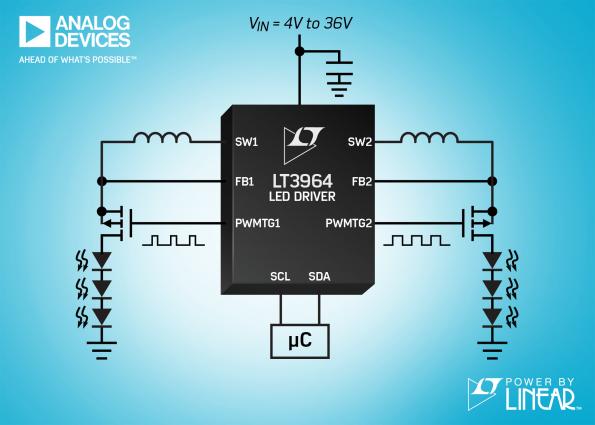
The LT3964 operates with a 4V to 36V input range, and features two independently controlled LED drivers that switch at up to 2 MHz, resulting in a highly integrated, compact solution with small external components.
The LT3964 employs fixed frequency, current mode control and operates as a constant-current and constant-voltage source with accurate current regulation to provide optimal LED lighting in automotive, industrial and architectural lighting applications. Synchronous operation results in efficiencies above 94% with both channels at full current load.
Its 400 kHz I2C interface simplifies digital PWM dimming. A PWM signal from a microcontroller to the LED driver is not necessary; instead, internal registers are programmed with the desired dimming duty cycle, which is synchronized to the internal clock. This provides dimming ratios up to 8192:1 and eliminates beat frequencies caused when the PWM signal and the internal oscillator are not synchronized. Alternatively, with analogue dimming, an I2C settable 8-bit scale factor sets the control voltage-to-LED current ratio allowing more control of analogue dimming adjustments. 1000:1 external PWM dimming and 10:1 analog dimming are also provided.
The LT3964’s switching frequency is programmable from 200 kHz to 2 MHz or it can be synchronized to an external clock signal. LED driver protection features include open LED and short-circuit LED fault detection, and LED overcurrent and overvoltage detection, all of which can be reported via the I2C interface. Thermal shutdown provides an added layer of protection.
The LT3964EUHE is available in a thermally enhanced 36-lead 5 x 6 mm QFN package. Three temperature grades are available, with operation from –40°C to 125°C (junction) for the extended and industrial grades, and a high temperature grade of –40°C to 150°C. Pricing is from $4.50 (1000).
Read More: 36V, 2-ch, 1.6A synchronous buck LED driver has I²C dimming
- What is the input voltage range of the LT3964?
The device operates with a 4V to 36V input range. - Can the switching frequency be synchronized to an external clock?
Yes, the switching frequency can be synchronized to an external clock signal or programmed from 200 kHz to 2 MHz. - How does the I2C interface simplify LED dimming control?
It allows internal registers to be programmed with the desired dimming duty cycle, eliminating the need for a PWM signal from a microcontroller. - What is the maximum dimming ratio provided by the digital PWM feature?
The digital PWM dimming provides dimming ratios up to 8192:1. - Does the LT3964 support analogue dimming adjustments?
Yes, analogue dimming is supported via an I2C settable 8-bit scale factor that sets the control voltage-to-LED current ratio. - What protection features are included in the LT3964?
Protection features include open LED and short-circuit LED fault detection, LED overcurrent and overvoltage detection, and thermal shutdown. - In what package is the LT3964EUHE available?
The LT3964EUHE is available in a thermally enhanced 36-lead 5 x 6 mm QFN package. - What is the highest operating temperature grade for this device?
A high temperature grade is available with operation from –40°C to 150°C junction temperature.