
Summary of Sensored brushless DC (BLDC) motor control with PIC16F877A microcontroller
This article explains driving a CD-ROM sensored three-phase BLDC motor with a PIC16F877A using CCS C. It details hall sensor inputs, six-phase bridge outputs on PORTD, RB4–RB6 sensor inputs, LM339 comparators, 74LS08 for PWM gating, ADC speed control via a potentiometer, RB interrupt-on-change commutation with a lookup table, and includes full source code and schematic references.
Parts used in the Sensored BLDC motor control project:
- PIC16F877A microcontroller
- CD-ROM sensored BLDC motor (three-phase)
- LM339 quad comparator
- 74LS08 quad 2-input AND gate
- Three hall effect sensors (Sensor A, Sensor B, Sensor C)
- Three-phase bridge (motor driver) with high-side and low-side switches
- Potentiometer (connected to analog channel AN0)
- +5V power supply
- +12V power supply (motor supply)
- Wiring to use PORTD for six driver outputs
- Wiring to use RB4, RB5, RB6 for hall sensor inputs
This topic shows an easy way to drive a Cd-Rom sensored brushless DC motor (BLDC motor) using PIC16F877A microcontroller with CCS PIC C code.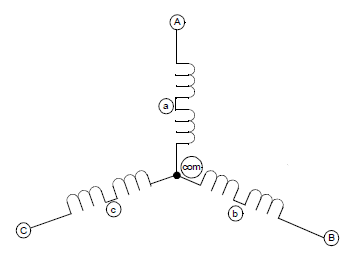
This motor is three phase motor, it has three stator phases that are excited two at a time to create arotating electric field. This method is fairly easy to implement, but to prevent the permanent magnet rotor from getting locked with the stator, the excitation on the stator must be sequenced in a specific manner while knowing the exact position of the rotor magnets.
The sensored BLDC motor has 3 hall effect sensors (Sensor A, Sensor B and Sensor C), this sensors sense the rotor position. Each sensor outputs a digital high for 180 electrical degrees and outputs a digital low for the other 180 electrical degrees. The following figure shows the relationship between the sensors outputs and the required motor drive voltages for phases A, B and C.
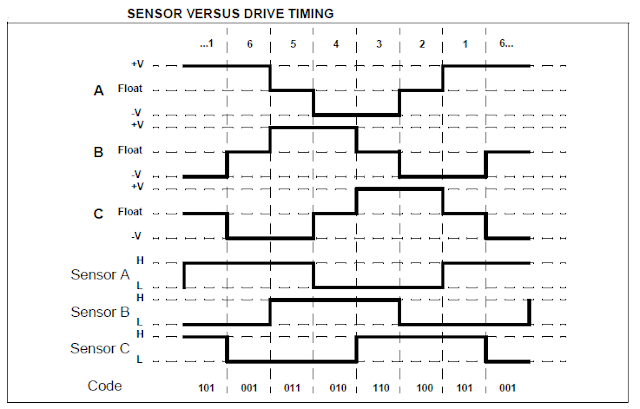
A three phase bridge is used to energize the BLDC motor windings.A three phase bridge is used to energize the BLDC motor windings.
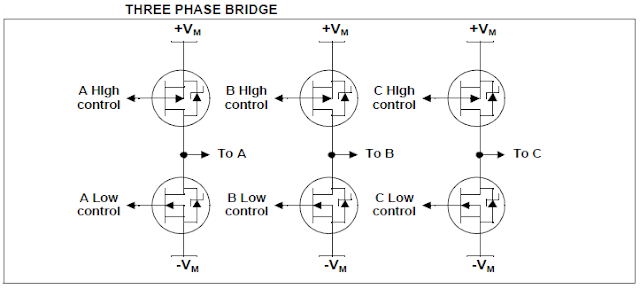
Each phase driver requires 2 pins one for the high side and the other one for the low side which means a total of 6 pins are required to drive the three phase bridge. In this project 6 pins of PORTD will be used.
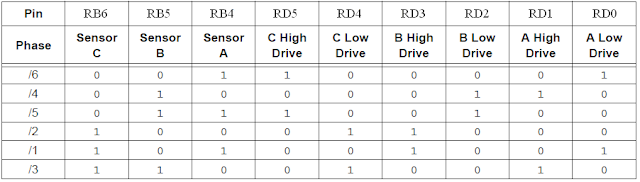
The 3 hall effect sensors needs 3 pins and for that RB4, RB5 and RB6 are used.
A lookup table is used to commutate the motor driver according to the following table:
CD-ROM sensored brushless DC (BLDC) motor speed control with PIC16F877A microcontroller:
The following image shows project circuit schematic diagram.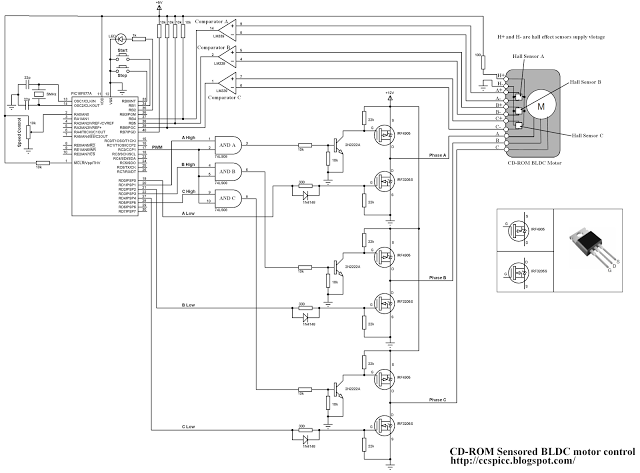
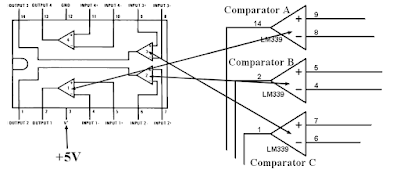
LM339 consists of four independent precision voltage comparators. 3 camparators are needed for the 3 hall effect sensors as shown in the circuit schematic above. A +5V is needed for the LM339 chip as shown below:
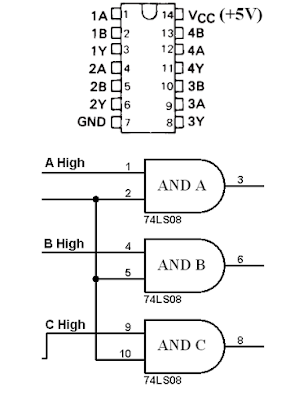
74LS08 contains four independent 2-input AND gates. 3 AND gates are needed to make 3 PWM signals. The 74LS08 must be supplied with +5V as shown below:
The CD-ROM BLDC motor pin configurations is shown in the following image where the rotor has been removed :
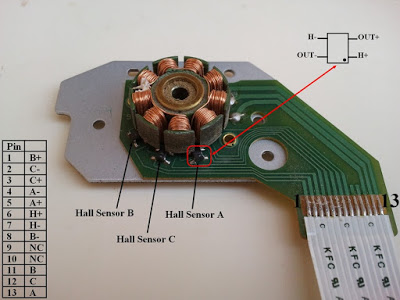
In this BLDC motor each hall effect sensor has 4 pins:
H+ and H- : sensor power supply pins
OUT+ and OUT- : sensor output pins.
For the system power supply there is +5V and +12V. The +12V supplies the 3 phase bridge circuit which is the same as the motor supply voltage.
CD-ROM sensored brushless DC (BLDC) motor control with PIC16F877A microcontroller CCS PIC C compiler code:
This is the full code of this project. The code is small and not complicated.
RB interrupt on change (IOC) is used to interrupt when the rotor changes its position.
A potentiometer connected to analog channel 0 is used to control the BLDC motor speed.
The PWM frequency is 500Hz and the duty cycle is related to analog channel 0 reading.
// CD-ROM Sensored BLDC motor control with PIC16F877A CCS C code
// http://ccspicc.blogspot.com/
// [email protected]

#include <16F877A.h>
#fuses HS,NOWDT,NOPROTECT,NOLVP
#device ADC = 10
#use delay(clock = 8000000)
#use fast_io(B)
#use fast_io(D)

int8 hall;
int8 MoveTable[8] = {0, 33, 6, 36, 24, 9, 18, 0};
int16 value;
#INT_RB                                       // RB port interrupt on change
void rb_isr(void){
  hall = (input_b() >> 4) & 7;
  output_d(MoveTable[hall]);
  clear_interrupt(INT_RB);
}
void main(){
  output_b(0);                                // PORTB initial state
  set_tris_b(0xF3);
  port_b_pullups(TRUE);                       // Enable PORTB internal pull-ups
  output_d(0);
  set_tris_d(0);
  setup_adc(ADC_CLOCK_DIV_16);                // Set ADC conversion time to 16Tosc
  setup_adc_ports(AN0);                       // Configure AN0 as analog
  set_adc_channel(0);                         // Select channel 0 input
  setup_timer_2(T2_DIV_BY_16, 250, 1);        // Set PWM frequency to 500Hz
  setup_ccp1(CCP_OFF);                        // CCP1 OFF
  enable_interrupts(GLOBAL);
  delay_ms(100);                              // Wait 100ms
  while(TRUE){
    if(!input(PIN_B0)){                       // If RB0 button pressed
      if(input(PIN_B2)){                      // Check if motor is already running
        disable_interrupts(INT_RB);
        output_d(0);
        setup_ccp1(CCP_OFF);                  // CCP1 OFF
        output_low(PIN_B2);                   // RB2 LED OFF
      }
    }
    if(!input(PIN_B1)){                       // If RB1 button pressed
      if(!input(PIN_B2)){                     // Check if motor is already running
        output_high(PIN_B2);                  // RB2 LED ON
        clear_interrupt(INT_RB);              // Clear RB IOC flag bit
        enable_interrupts(INT_RB);            // Enable PORTB IOC
        setup_ccp1(CCP_PWM);                  // Configure CCP1 as a PWM
        hall = (input_b() >> 4) & 7;
        output_d(MoveTable[hall]);
      }
    }
    if(input(PIN_B2)){
      read_adc(ADC_START_ONLY);
      while(!adc_done());                     // Wait until conversion complete
      value = read_adc(ADC_READ_ONLY);        // Read ADC value
      set_pwm1_duty(value);                   // Set PWM duty cycle
    }
  }
}
CD-ROM BLDC motor control with PIC16F877A microcontroller:
The following video shows a hardware circuit for this project..
References:
Microchip: Sensored BLDC Motor Control Using dsPIC30F2010 (AN957).
Microchip: Brushless DC Motor Control Made Easy (AN857).
Source : Sensored brushless DC (BLDC) motor control with PIC16F877A microcontroller
- How many pins are used to drive the three phase bridge?
Six pins of PORTD are used, two per phase for high and low side. - Which pins read the hall effect sensors?
RB4, RB5 and RB6 are used to read the three hall effect sensors. - What component is used to condition the hall sensor signals?
LM339 quad comparators are used to interface the hall effect sensors. - How is PWM generated for speed control?
CCP1 PWM on the PIC16F877A is used with Timer2 set for 500Hz. - How is motor speed adjusted?
A potentiometer connected to analog channel AN0 feeds the ADC and the ADC value sets the PWM duty cycle. - How does the microcontroller detect rotor position changes?
RB interrupt on change (IOC) is used to trigger commutation when rotor position changes. - What logic chip creates the PWM signals for the drivers?
Three AND gates from a 74LS08 are used to make three PWM signals. - Where is the commutation sequence defined?
A lookup table MoveTable in the code maps hall sensor states to PORTD output patterns for commutation.
