Summary of 2.8” COMPACT LOW-POWER GRAPHIC LCDS
EA Display Visions’ DOGL128 2.8" chip-on-glass graphic LCDs offer compact, low-power 128×64 pixel displays in multiple STN/FSTN optical variants, with a 2.54 mm pin pitch for direct soldering or socketing. Their efficient size-to-active-area ratio and single-supply operation (2.5–3.3 V, typically 250 µA) suit handheld devices. Evaluation requires only the EA 9780-4USB development board and free Windows simulator; no proprietary hardware or software is needed. Optional LED backlights in various colors and high-contrast STN/FSTN with 15 µm dot-gap are supported.
Parts used in the DOGL128 2.8" Graphic LCD Project:
- EA Display Visions DOGL128 2.8" chip-on-glass graphic LCD (128 x 64 pixels)
- EA 9780-4USB development board
- 2.54 mm socket strips or mating connectors
- Optional LED backlight (various colors)
- Power supply (single supply 2.5 V to 3.3 V)
- Windows PC running the free simulator software
- Soldering tools or socket mounting hardware
EA Display Visions’ chip-on-glass 128 x 64 graphic LCD is compact, low-power, and pin-connected
EA Display Visions’ DOGL128 series 2.8″ graphic LCDs are available in FSTN positive transflective, STN positive transmissive, STN negative transmissive, FSTN negative transmissive, and STN positive reflective versions.
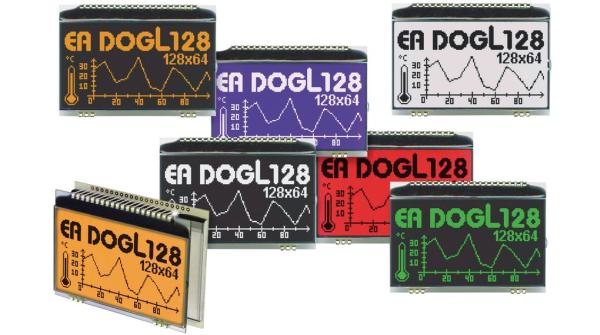
These displays have a 2.54 mm pitch and can be soldered directly or plugged into socket strips. Therefore, cumbersome gluing procedures, the need for designing a special mounting device, and error-prone cable connections that may lose contact are no longer a concern.
The extremely efficient ratio of external dimensions to the active display area helps in designing very compact devices. Furthermore, its low power use (single supply 2.5 V to 3.3 V (typically 250 µA)) makes it ideal for handheld applications.
The EA 9780-4USB development board and free windows simulator are all that users require to evaluate pin-connected chip-on-glass LCDs with and without backlight. Simply plug the 2.54 mm connector pins of the display into the socket strips of the development board. Proprietary hardware or software development is not required, and decisions can be made quickly at a minimum expense.
Features
- High-contrast LCD supertwist display (STN and FSTN) with 15 µm dot-gap
- Optional LED backlights in various colors
- 128 x 64 pixels (corresponds to 8 x 21 characters or 4 x 16 large characters)
Read more: 2.8” COMPACT LOW-POWER GRAPHIC LCDS
- What pixel resolution does the DOGL128 display have?
The display has a resolution of 128 x 64 pixels. - Can the DOGL128 be plugged into a socket or soldered directly?
Yes, it has a 2.54 mm pitch and can be soldered directly or plugged into socket strips. - What supply voltage does the DOGL128 require?
It requires a single supply between 2.5 V and 3.3 V. - How much current does the DOGL128 typically draw?
Typical current consumption is 250 µA. - Are there backlight options for the DOGL128?
Yes, optional LED backlights are available in various colors. - What optical variants are available for the DOGL128?
Available variants include FSTN positive transflective, STN positive transmissive, STN negative transmissive, FSTN negative transmissive, and STN positive reflective. - What is the dot-gap specification of the DOGL128?
The displays use a 15 µm dot-gap. - Do I need proprietary hardware or software to evaluate the DOGL128?
No, evaluation requires only the EA 9780-4USB development board and the free Windows simulator; proprietary hardware or software is not required. - How many characters correspond to the 128 x 64 pixel grid?
It corresponds to 8 x 21 characters or 4 x 16 large characters.