


Summary of The Super-Simple pocket size mp3 player using PIC16LF877A
This project is a pocket MP3 player based on the PIC16LF877(A) microcontroller using a VS1001K MP3 decoder and CompactFlash storage; it has assembly and C firmware, is open source, and requires intermediate electronics and PIC programming skills. Format CF as FAT32, place MP3s in root in desired playback order, and clear the brownout fuse when programming the PIC.Parts used in the Super-Simple pocket size mp3 player:
- PIC16LF877 or PIC16LF877A microcontroller
- VS1001K MP3 decoder chip
- CompactFlash card (supports microdrives and CF cards up to large capacities)
- CF card socket
- USB CF card reader/writer (for loading files)
- Power supply (appropriate for PIC and VS1001K)
- Passive components (resistors, capacitors as needed)
- PCB or prototyping board and connectors
- Optional oscilloscope for debugging
- PIC programmer (PIC burning device)
It is based on the PIC 16LF877, with plenty of processor time to spare. There is a bare bones assembly version, and a new C version with more features and stability. It uses compact flash cards up to over 100 gigabytes (once they exist) including microdrives. (right now they are about 8 gig) It uses the vs1001k decoder chip. Super simple, low pin count, built in DAC.
And most importantly, it does indeed play music! Have fun! Please Email me if you have any specific questions, or just to let me know you are doing this project!
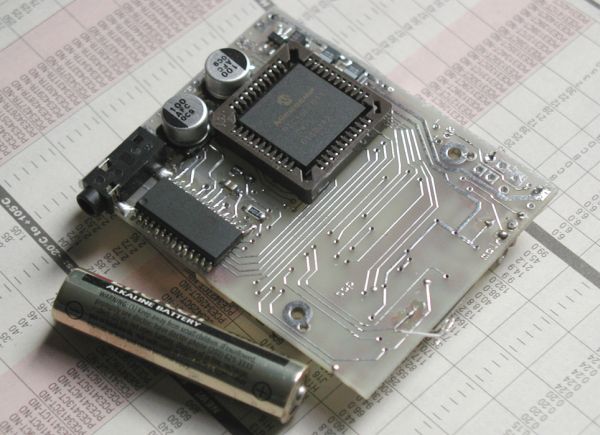
And it’s completely open source!
BEGINNERS BEWARE! This is an upper-intermediate project. You will need things like a PIC programming device and some working knowlege of C and/or assembly language programming, as well as a decent but not huge amount of electronics experience. An oscilloscope doesn’t hurt either. Be warned! It’s an involved project to say the least!
If you are a beginner, give these books and websites a try:
www.parallaxinc.com www.tech-tools.com www.microchip.com www.microchipc.com www.dontronics.com www.jameco.com ccsinfo.com (the midrange compiler is the one I used for this project)
all the Forrest Mims III books, available at radio shack
Practical Electronics for Inventors, by Paul Scherz
and Nuts and Volts Magazine (tower books has it most of the time)
Use at your own risk!
This edition, dec 20, 2001 to Feb. 20, 2003.
By Raphael Abrams, not for commercial use under any circumstances!
-------------------------------------------------------------
A Friendly Note on PIC Burning
Please remember to clear the BROWNOUT fuse when burning the pic. Otherwise, nothing will work. This is the most common mistake, by far!
-------------------------------------------------------------
HOW IT WORKS:
The first thing to do is to format the CF card FAT32 and load the root directory with songs. Use a standard reader/writer like the Zio. It plugs into a USB port. Drag and drop the files onto the card in windows. The order that you put them onto the card is the order that they play. All files must be on the root directory, I haven’t added directory support.
For more detail: The Super-Simple pocket size mp3 player using PIC16LF877A
- What microcontroller is used in this project?
The PIC16LF877 (or PIC16LF877A) is used as the processor. - Which MP3 decoder chip does the player use?
The project uses the VS1001K decoder chip. - What storage media does the player support?
It uses CompactFlash cards, including microdrives, with support up to very large capacities. - How should MP3 files be arranged for playback?
Format the CF card as FAT32 and place all files in the root directory; files play in the order they were copied onto the card. - Does the project include firmware in different languages?
Yes, there is a bare-bones assembly version and a newer C version with more features and stability. - Is there any configuration advice for programming the PIC?
Clear the BROWNOUT fuse when burning the PIC, otherwise the device will not work. - Is this project suitable for beginners?
No; it is upper-intermediate and requires a PIC programmer, C or assembly knowledge, and electronics experience. - Is the project open source?
Yes, the project is completely open source.
Related projects
Audio Spectrum Analyzer
We developed an audio spectrum analyzer as our final project for ECE 4760. This analyzer presented a histogram-style representation of audio signals....
Audio, Sound & Radio · PIC12F675Audio CRO using PIC12F675 Microcontroller
This project is a miniature Audio CRO. For those not familiar with the abbreviation "CRO," it means "Cathode Ray Oscilloscope" and this...
Audio, Sound & RadioBuild a musical EKG with the Freescale FRDM-KL05
Short Introduction: I have been following the Battle of the DreamBoards Championship with interest and I enjoyed the variation of functionality features...
Audio, Sound & RadioPIC MicroController Volume Adjuster Program(Proteus 8 Stimulation)
Hello everyone, The important aspect of every learning is to induce curiosity and doing something meaningful to satisfy that.With the help of...
Audio, Sound & RadioWireless Radio Frequency Module Using PIC Microcontroller
It's a Microcontroller Based DIY Electronics Project. Named Wireless RF Module Using PIC Microcontroller. The RF module is a small electronic circuit...
Audio, Sound & Radio · PIC16F676Shrieker using PIC16F676 Microcontroller
Recently a cell phone ring tone was in the news - it's 17,000 Hertz and meant to be heard by teenagers, but...

Ibrar Ayyub
I am an experienced technical writer holding a Master's degree in computer science from BZU Multan, Pakistan University. With a background spanning various industries, particularly in home automation and engineering, I have honed my skills in crafting clear and concise content. Proficient in leveraging infographics and diagrams, I strive to simplify complex concepts for readers. My strength lies in thorough...