
Summary of EV26Q64A PIC18F16Q41 CURIOSITY NANO EVALUATION KIT
Microchip’s PIC18F16Q41 Curiosity Nano evaluation kit is a pocket-sized development board with an onboard debugger for programming and debugging the PIC18F16Q41 MCU using MPLAB X IDE and MPLAB Code Configurator. It includes pre-programmed firmware, offers access to intelligent analog and core-independent peripherals, USB power, adjustable target voltage, virtual serial port, and a logic analyzer channel to accelerate prototype development.
Parts used in the PIC18F16Q41 Curiosity Nano evaluation kit:
- PIC18F16Q41 MCU
- On-board debugger
- One mechanical user switch
- One green power and status LED
- One yellow user LED
- USB connector (for power and connectivity)
- MIC5353 LDO regulator
- Adjustable target voltage circuitry (1.8 V to 5.5 V output)
- Virtual serial port (CDC) interface
- One logic analyzer channel (GPIO)
Microchip’s low-cost evaluation kit for the PIC18F16Q41 8-bit microcontroller (MCU)
The PIC18F16Q41 Curiosity Nano evaluation kit from Microchip Technology is a hardware platform to evaluate MCUs in the PIC18FQ41 family.
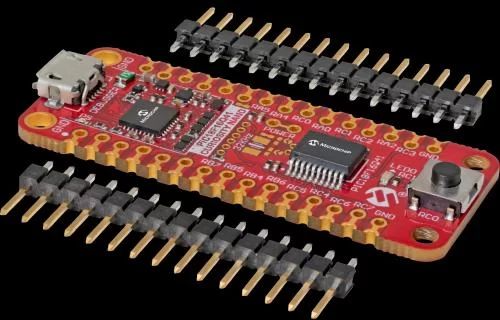
This board has the PIC18F16Q41 MCU mounted. Supported by MPLAB® X IDE, the board provides easy access to the features of the PIC18F16Q41 to explore how to integrate the device into a custom design. The Curiosity Nano series of evaluation boards include an on-board debugger. No external tools are necessary to program and debug the PIC18F16Q41.
With the award-winning MPLAB X integrated development platform and MPLAB Code Configurator (MCC), the kit provides access to the intelligent analog and core independent peripherals on the PIC18F16Q41. MCC is a free graphical programming tool for configuring a rich set of peripherals and functions specific for user applications. Users can take their next idea to market with a development board that they can keep in their pocket. With full programming and debugging capabilities, the PIC18F16Q41 Curiosity Nano evaluation kit has pre-programmed firmware to start development immediately.
Features:
- PIC18F16Q41 MCU
- One mechanical user switch
- On-board debugger
- Board identification in Microchip MPLAB X
- One green power and status LED
- Programming and debugging
- Virtual serial port (CDC)
- One logic analyzer channel (GPIO)
- One yellow user LED
- USB powered
- Adjustable target voltage
- MIC5353 LDO regulator controlled by the on-board debugger
- 1.8 V to 5.5 V output voltage (limited by USB input voltage)
- 500 mA maximum output current
Read more: EV26Q64A PIC18F16Q41 CURIOSITY NANO EVALUATION KIT
- What MCU is mounted on the Curiosity Nano evaluation kit?
The board has the PIC18F16Q41 MCU mounted. - Can I program and debug the MCU without external tools?
Yes, the Curiosity Nano series includes an on-board debugger so no external tools are necessary. - Which IDE supports the evaluation kit?
The board is supported by MPLAB X IDE. - Is there a graphical tool for configuring peripherals?
Yes, MPLAB Code Configurator (MCC) is available for configuring peripherals and functions. - Does the kit include any pre-programmed software to start development?
Yes, the PIC18F16Q41 Curiosity Nano evaluation kit has pre-programmed firmware to start development immediately. - What power options does the board provide?
The board is USB powered and has adjustable target voltage from 1.8 V to 5.5 V, limited by USB input voltage. - What regulator is used for the board power?
The board uses a MIC5353 LDO regulator controlled by the on-board debugger. - Does the kit provide serial communication capability?
Yes, it provides a virtual serial port (CDC). - Is there a logic analyzer feature on the board?
Yes, the board provides one logic analyzer channel via a GPIO. - What LEDs and switches are present on the board?
The board includes one mechanical user switch, one green power and status LED, and one yellow user LED.