Summary of SOLAR INTEGRATED ULP FEATHER NEEDS NO BATTERIES
This article details Jake Wachlin's ultra-low power Feather MCU board, designed for solar energy harvesting in IoT applications. The board utilizes an ATSAML21 microcontroller and two KXOB25 solar cells to operate without batteries. It employs an MCP1810 LDO regulator for voltage conversion and includes a supercapacitor for energy storage on the rev2 version. The system achieves extremely low power consumption, making it ideal for "deploy and forget" scenarios where constant charging is impractical.
Parts used in the Solar Integrated ULP Feather:
- ATSAML21 Microcontroller
- KXOB25 Monocrystalline Solar Cells
- MCP1810 LDO Regulator
- Supercapacitor (0.33F)
- Cortex M0+ Processor
Long battery-life and Low power consumption are usually top on the list of requirements for most hardware devices these days, as the weariness of having to constantly charge a device continues to have significant effect on customers’ choice. Asides from consumer applications, another reason fueling this demand is the growth in the deployment of IoT devices, most of which are designed for “deploy and forget” applications where changing batteries is impractical.
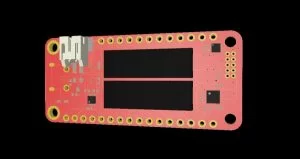
Several approaches to this currently include wireless charging, longer-lasting but more expensive batteries, and energy harvesting. Energy harvesting is expected to play a big role in our future but most of the solutions at the moment still require battery backup and are not able to provide power in a reliable manner. Leading the way into that future, at least for makers, Jake Wachlin recently shared a project he has been working on; the light-powered, Ultra-Low Power, Feather MCU board.
The board which runs the ATSAML21 MCU, a low power variant of the SAM D21 used in the Adafruit feather Mo board, comes with two KXOB25 monocrystalline solar cells that provide 4.46V/5.5mA and serve as the primary source of power to the board. The ATSAML21 is based on the Cortex mo+ running at 48MHz with 256kB Flash, and 32kB RAM.
Given that the energy generated by solar panels vary, a typical DC-DC switching converter is usually applied, but this takes up space and increases cost, so for this board, Wachlin decided to stick with the basics and passed the output the solar panels to an LDO regulator, the MCP1810, which then provides the system with the 3.3V voltage level required by the board.
Thanks to the SAM L21 microcontroller, the board has an incredibly low power consuming of only; 9uA in a standby state, 194uA in idle state, and 285uA inactive state. This and the “sleep when idle” nature of IoT devices means the panel will be generating excess energy when not really powering the device. To provide some energy storage features, on the rev2 version of the board, Wachlin added a supercapacitor (0.33F).
Read more: SOLAR INTEGRATED ULP FEATHER NEEDS NO BATTERIES
- What is the primary purpose of this project?
The project provides a light-powered, ultra-low power MCU board for deploy-and-forget IoT applications. - How does the board generate power without batteries?
It uses two KXOB25 monocrystalline solar cells as the primary source of power. - Does the board use a DC-DC switching converter?
No, the designer chose to use an LDO regulator instead to save space and cost. - What voltage level does the MCP1810 provide?
The MCP1810 LDO regulator provides the 3.3V voltage level required by the board. - How much power does the board consume in standby mode?
The board consumes only 9uA in a standby state. - Can I add energy storage to this board?
Yes, the rev2 version includes a 0.33F supercapacitor for energy storage features. - Why are solar solutions not yet fully reliable for all devices?
Most current energy harvesting solutions still require battery backup and cannot provide power reliably.