
Summary of Contactless Digital Tachometer using PIC Microcontroller
This article introduces a Contactless Digital Tachometer project using a PIC microcontroller. It explains the logic where an infrared reflective sensor detects tire surface changes to generate pulses for RPM calculation via a PIC16F690's CCP module. The system uses a Darlington pair of transistors to process signals into logical high or low states, enabling accurate speed measurement without physical contact.
Parts used in the Contactless Digital Tachometer:
- Infrared reflective object sensor
- Phototransistor
- 2N3904 transistor
- Darlington pair configuration
- 470 Ohm resistor
- PIC16f690 microcontroller
- Capture Compare Pulse width modulation (CCP) module input port
Hey friends, I should have posted this project last month itself but there was some problem with the circuit. [link], author of this project did an exellent job. I have been watching him learning on this website. He came as a total noob but now he is well versed with 8051 and PIC microcontroller. earlier he has submitted Microcontroller Based Home Security System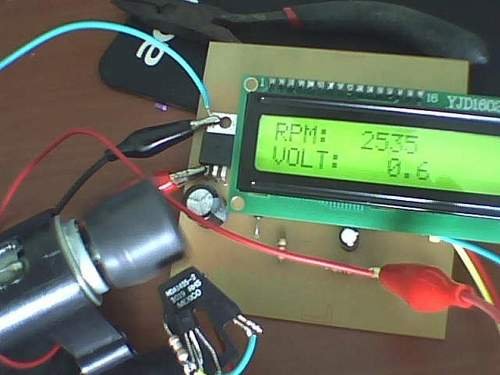
This project is about A Contactless Digital Tachometer. As per defination from wikipedia
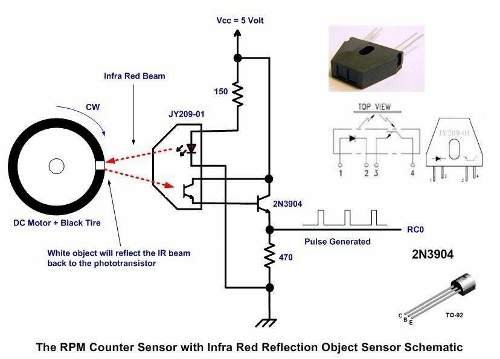
Following diagram explains the logic of this project.
The infra red reflective object sensor work by simply emitting the infra red beam and when it encounter the white object surface than the infra red beam will be reflected back to the phototransistor; next the phototransistor and the 2N3904 transistor which formed the Darlington pair will start to conduct and will generate enough voltage across the 470 Ohm resistor to be considered by the PIC16f690 microcontroller build in Capture Compare Pulse width modulation(CCP )module input port as the logical “1”. When the infra red beam encounters the black tire surface than both of the phototransistor and 2N3904 transistor will turn off; and the voltage across 470 Ohm resistor will drop to 3.5 volt (logical “0”).
Therefore by timing the generated pulse period by the infra red reflective object sensor we could easily calculate the RPM using this following formula:
Frequency = 1/T Hz; T is the generated pulse period in second.
RPM (Rotation per Minute) = Frequency x 60
Here is a sample video of working project:
You can download project related files here:
Download Contactless Digital Tachometer project
Thank you Romel for this contribution. If anyone has doubts regarding this project, please use forum.
For more detail: Contactless Digital Tachometer using PIC Microcontroller
- How does the infrared reflective object sensor work?
The sensor emits an infrared beam that reflects back to a phototransistor when it hits a white surface, triggering conduction. - What happens when the beam encounters a black tire surface?
Both the phototransistor and 2N3904 transistor turn off, causing the voltage across the 470 Ohm resistor to drop to 3.5 volts. - Which microcontroller is used in this project?
The project utilizes the PIC16f690 microcontroller with its built-in Capture Compare Pulse width modulation module. - How is the RPM calculated from the generated pulses?
RPM is calculated by determining the frequency from the pulse period and multiplying that frequency by 60. - What components form the Darlington pair in this circuit?
The phototransistor and the 2N3904 transistor are connected to form the Darlington pair. - Does this tachometer require physical contact with the rotating object?
No, the project is designed as a contactless digital tachometer that works without touching the object. - Can I download the project files?
Yes, the article provides a link to download the Contactless Digital Tachometer project files. - Where can I ask questions about this project?
Users are directed to use the forum if they have any doubts regarding the project.
