
Summary of RESEARCHERS FROM THE UNIVERSITY OF CHICAGO DEVELOPED A FOLDABLE HAPTIC ACTUATOR FOR MIXED REALITY APPLICATIONS
The University of Chicago team developed Touch&Fold, a foldable fingernail-mounted haptic actuator for mixed reality that presses the fingerpad to render touch and low-frequency vibrations for textures. Wireless and self-contained, it uses a linear resonant actuator, folds away when not in use, measures 24×24×41 mm, weighs 9.5 g, and actuates in 92 ms to provide real-time tactile feedback in MR environments.
Parts used in the Touch&Fold:
- Foldable housing sized for a fingernail
- Linear resonant actuator
- Wireless power and/or battery module (self-contained power source)
- Control electronics for receiving control signals
- Actuation mechanism enabling folding and pressing motion
- Mounting interface to attach to the fingernail
- Vibration transmission interface to the fingerpad
- Sensors or input interface to detect virtual object contact (implied)
Actuators are the moving part of a device that controls the mechanism of a system. A simple example of an actuator is the opening of a valve. With this simple example of a solenoidal valve, we can understand that an actuator (or, in other words, a part that performs a movement in a specific direction) needs a control signal along with the source of energy. The control signals are relatively low energy in the form of voltage or current. The control system can be software-based, a human, or any other input. Combining actuators with mixed reality applications can open up a whole new world of interaction. Mixed reality refers to combining real and virtual worlds for producing new environments and visualizations.
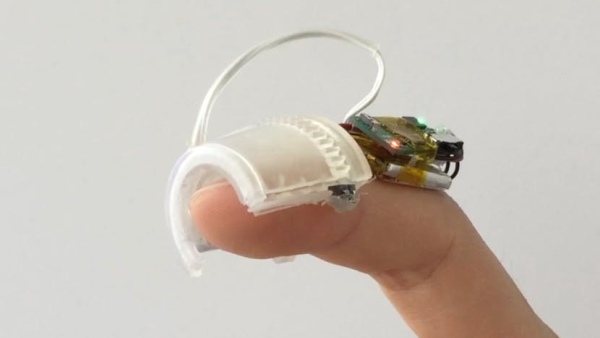
With mixed reality, physical and digital objects can co-exist and interact in real-time. A team of researchers from the University of Chicago recently published an article on a foldable haptic actuator for rendering touch in Mixed Reality. This device is developed to provide an interactive environment where the user can touch a virtual object. The device provides feedback to mixed reality (MR) environments by pressing against the user’s fingerpad when a user touches a virtual object. It provides low-frequency vibrations on the finger contact points. The device is called Touch&Fold, and it is designed to fit on a user’s fingernail. When the device is not in use (when the user is touching real-world objects), the device folds back on top of the user’s nail.
Touch&Fold features a linear resonant actuator that allows rendering not only touch contacts (i.e., pressure) but also textures (i.e., vibrations). The device is wireless and self-contained. It measures only 24×24×41 mm and weighs 9.5 g. The actuation takes only 92 milliseconds.
- What is Touch&Fold?
Touch&Fold is a foldable fingernail-mounted haptic actuator that presses the fingerpad to render touch and vibrations for mixed reality. - How does Touch&Fold render touch in mixed reality?
It presses against the user’s fingerpad to provide pressure feedback and low-frequency vibrations to render textures. - Does Touch&Fold require external wiring?
No, the device is wireless and self-contained according to the article. - What actuator type does Touch&Fold use?
It features a linear resonant actuator. - How big and heavy is Touch&Fold?
The device measures 24×24×41 mm and weighs 9.5 g. - How fast does Touch&Fold actuate?
The actuation takes 92 milliseconds. - Can Touch&Fold fold away when not in use?
Yes, it folds back on top of the user’s nail when the user is touching real-world objects. - What kinds of sensations can Touch&Fold render?
It can render touch contacts (pressure) and textures via low-frequency vibrations.
