
Summary of POWER INTEGRATIONS LINKSWITCH-TNZ OFF-LINE SWITCHER ICS
Power Integrations LinkSwitch-TNZ off-line switcher ICs provide lossless AC zero-cross detection and support buck, buck-boost, and flyback topologies. They integrate a 725V MOSFET, oscillator, high-voltage switched current source, and protection features (soft-start, auto-restart, OVP, OVL, hysteretic OTP). With <100µA standby current, ±3% regulation, 66 kHz operation with frequency jittering, and on/off control for wide-load efficiency, they reduce component count and suit applications like home automation, dimmers, sensors, appliances, and IoT/industrial controls.
Parts used in the LinkSwitch-TNZ Off-line Switcher IC Project:
- LinkSwitch-TNZ off-line switcher IC
- 725V power MOSFET (integrated in IC)
- Oscillator (integrated in IC)
- High-voltage switched current source (integrated in IC)
- Frequency jittering circuitry (integrated in IC)
- Soft-start circuitry (integrated in IC)
- Auto-restart fault circuitry (integrated in IC)
- Output Over Voltage Protection (OVP) circuitry (integrated in IC)
- Line input Over Voltage Protection (OVL) circuitry (integrated in IC)
- Hysteretic Over-Temperature Protection (OTP) circuitry (integrated in IC)
Energy Efficient Off-line Switcher IC with Best-in-Class Light Load Efficiency and Lossless AC Zero-Cross Detection
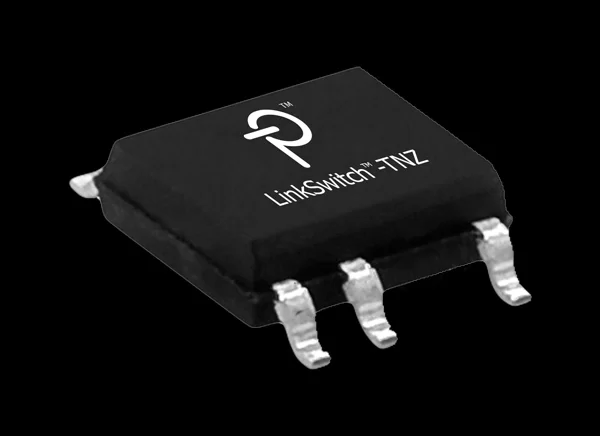
Power Integrations LinkSwitch-TNZ Off-line Switcher ICs are designed to provide lossless zero-cross signal generation and support buck, buck-boost, and flyback topologies. These ICs offer more design flexibility than discrete implementations which reduces component count by 40% or higher. The LinkSwitch-TNZ ICs feature soft-start, auto restart, output Over Voltage Protection (OVP), line input Over Voltage Protection (OVL), and hysteretic Over-Temperature Protection (OTP). These ICs incorporate a 725V power MOSFET, an oscillator, a high-voltage switched current source, frequency jittering, hysteretic thermal shutdown, and input/output overvoltage protection circuitry. The LinkSwitch-TNZ ICs consume <100µA current in standby that results in power supply designs to meet no-load and standby regulations worldwide. These ICs are used in applications such as home and building automation, dimmers, switches and sensors with/without neutral wire, appliances, and IoT/industrial controls.
Features
- Lossless zero-cross signal generation
- Supports buck, buck-boost, and flyback topologies
- Enables ±3% regulation across line and load
- 66kHz operation with accurate current limit
- Frequency jittering reduces EMI filter complexity
- Soft-start limits system component stress at start-up
- Auto-restart for short-circuit and open-loop faults
- Output Over Voltage Protection (OVP)
- Line input Over Voltage Protection (OVL)
- Hysteretic Over Temperature Protection (OTP)
- On/off control provides constant efficiency over a wide load range
Read more: POWER INTEGRATIONS LINKSWITCH-TNZ OFF-LINE SWITCHER ICS
- What topologies do LinkSwitch-TNZ ICs support?
They support buck, buck-boost, and flyback topologies. - How do LinkSwitch-TNZ ICs generate zero-cross signals?
They provide lossless zero-cross signal generation as an integrated feature. - What protection features are included in LinkSwitch-TNZ ICs?
They include soft-start, auto-restart, output OVP, line input OVL, and hysteretic OTP. - What is the standby current consumption of LinkSwitch-TNZ ICs?
They consume less than 100 µA in standby. - What switching frequency do LinkSwitch-TNZ ICs operate at?
They operate at 66 kHz with frequency jittering. - Do LinkSwitch-TNZ ICs include an integrated MOSFET?
Yes, they incorporate a 725V power MOSFET. - Can LinkSwitch-TNZ ICs help reduce component count?
Yes, they offer more design flexibility and can reduce component count by 40% or higher. - What applications are LinkSwitch-TNZ ICs suitable for?
They are used in home and building automation, dimmers, switches and sensors with or without neutral wire, appliances, and IoT/industrial controls.