
Summary of Interface a HD44780 Character LCD with a PIC Microcontroller
An HD44780 character LCD is a text-only display used in many embedded devices. Common sizes include 8x1, 16x2, 20x4 and 40x4 (which uses two controllers). Character LCDs use a 14-pin interface (16 pins with backlight) and may include various backlight types. The article shows interfacing an HD44780 LCD to a PIC16F628A microcontroller in 4-bit mode using mikroC, connecting LCD data lines D4–D7 to RB4–RB7 and RS/EN to RA0/RA1, and reminds to disable PORTA comparator functions when using RA0–RA3 as digital I/O.
Parts used in the Test LCD in 4-bit mode:
- HD44780 character LCD (example sizes: 8x1, 16x2, 20x4, 40x4)
- PIC16F628A microcontroller
- Connection wires
- Power supply for MCU and LCD
- Backlight (optional: LED, fluorescent, or electroluminescent)
- mikroC compiler (software)
- Resistors/potentiometer for contrast (typical for LCD)
Introduction
An HD44780 Character LCD is a liquid crystal display (LCD) display device designed for interfacing with embedded systems. These screens come in a variety of configurations including 8×1, which is one row of eight characters, 16×2, and 20×4. The most commonly manufactured configuration is 40×4 characters, which requires two individually addressable HD44780 controllers with expansion chips as the HD44780 can only address up to 80 characters.
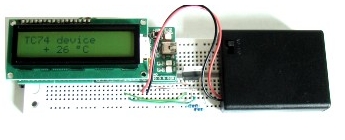 These LCD screens are limited to text only and are often used in copiers, fax machines, laser printers, industrial test equipment, networking equipment such as routers and storage devices. Character LCDs can come with or without backlights, which may be LED, fluorescent, or electroluminescent. Character LCDs use a standard 14-pin interface and those with backlights have 16 pins.
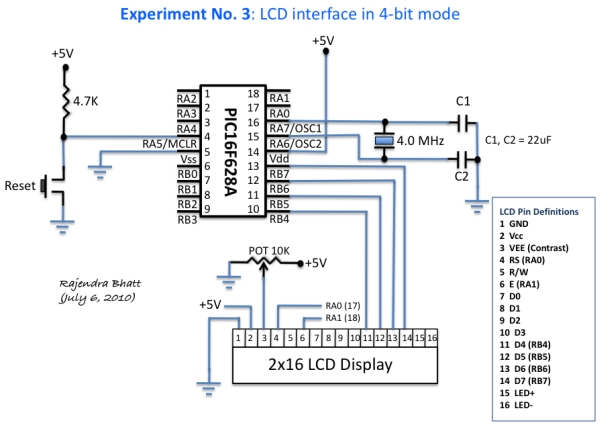
I am going to show you how to interface such a LCD to a PIC microcontroller (PIC16F628A). The programming for PIC will be done in mikroC (a C compiler for PIC from mikroelektronika).
Note: Never forget to disable the comparator functions on PORTA.0, 1, 2, 3 pins if you are going to use those pins as digital I/O.
 /*
/*
Test LCD in 4-bit mode
* Description:
This code demonstrates how to display test message on a LCD which
is connected to PIC16F628A through PORTB. D4-D7 pins of LCD are
connected to RB4-RB7, whereas RS and EN pins connected to RA0 and RA1
- How are the LCD data pins connected to the PIC16F628A in this project?
LCD data pins D4-D7 are connected to PIC PORTB pins RB4-RB7. - Where are RS and EN pins of the LCD connected?
RS and EN are connected to PIC PORTA pins RA0 and RA1 respectively. - Which MCU pins require disabling comparator functions when used as digital I/O?
Disable the comparator functions on PORTA pins RA0, RA1, RA2, and RA3 when using them as digital I/O. - What microcontroller is used in the example interfacing?
The example uses the PIC16F628A microcontroller. - What compiler is used for programming the PIC in this project?
Programming is done using the mikroC compiler from mikroelektronika. - What interface mode is demonstrated for the LCD?
The code demonstrates interfacing the LCD in 4-bit mode. - How many pins does a character LCD use and how many if it has a backlight?
Character LCDs use a standard 14-pin interface and use 16 pins if they include a backlight. - Can HD44780 character LCDs display graphics?
No, these LCDs are limited to text only.
